Rates shown are sample averages. Your premium varies by risk profile, state, and insurer.
TL;DR — Quick Verdict
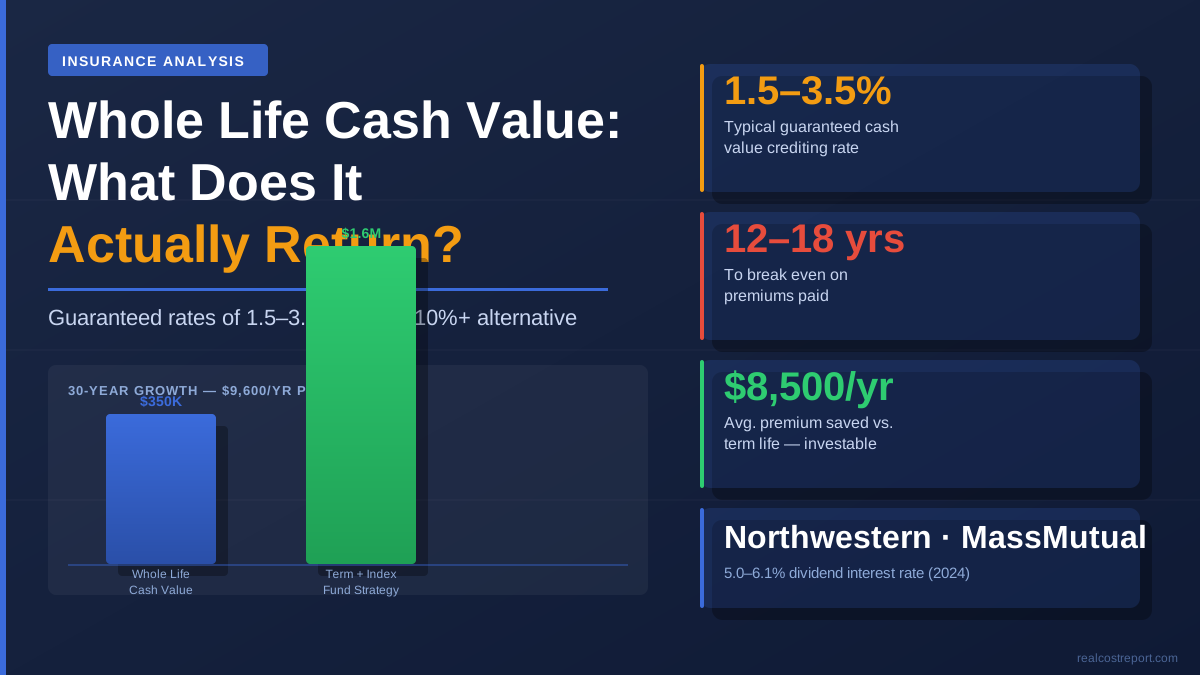
- Whole life insurance cash value grows at a guaranteed rate of 1.5–3.5% annually — far below the S&P 500’s historical 10% average annual return.
- It takes most policyholders 10–15 years just to break even on premiums paid versus cash value accumulated due to front-loaded agent commissions and insurer expenses.
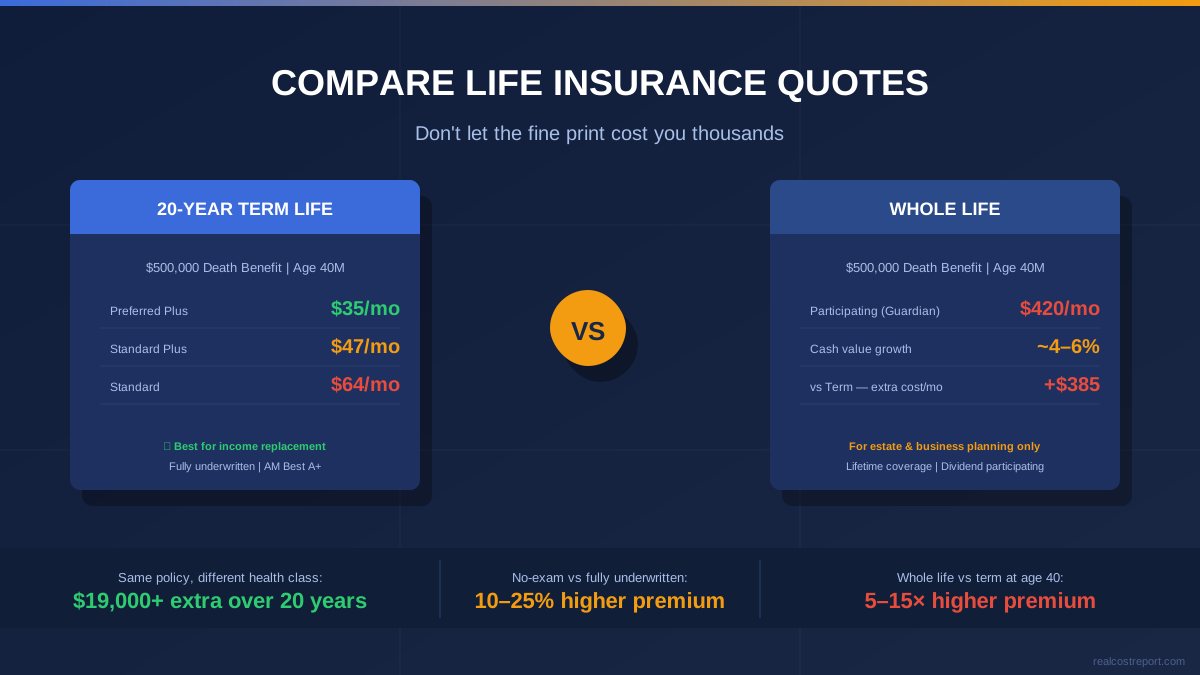
- A $500,000 whole life policy from a mutual insurer like Northwestern Mutual or MassMutual may carry annual premiums of $8,000–$14,000 — versus $600–$1,200/year for equivalent term coverage.
- Dividends are not guaranteed: mutual insurers paid 5.0–6.5% dividend interest rates in 2024, but these fluctuate and are not the same as your cash value growth rate.
- Surrender charges in years 1–10 can consume 25–100% of accumulated cash value, making early exit extremely costly.
- Whole life makes financial sense for a narrow group — high-net-worth individuals using it for estate planning, irrevocable life insurance trusts, or business succession — not the average saver.
Americans hold more than $6.3 trillion in life insurance reserves, a significant portion tied up in permanent policies that many policyholders don’t fully understand — according to data from the American Council of Life Insurers (ACLI). The pitch sounds compelling: pay premiums, build tax-deferred savings, borrow against your policy, and leave a death benefit to your heirs. But the actual internal rate of return on whole life cash value routinely disappoints policyholders who compare it to alternatives after the fact.
The core question isn’t whether whole life insurance builds cash value — it does. The question is how fast, at what cost, and whether that growth justifies the premium difference over a term policy combined with a disciplined investment strategy. This article models the real numbers using data from the National Association of Insurance Commissioners (NAIC), published insurer dividend scales from Northwestern Mutual and MassMutual, and Federal Reserve benchmark rates — so you can make a direct comparison before signing a 30-year financial commitment.
How Whole Life Insurance Cash Value Actually Accumulates
Every whole life premium you pay is split three ways: a portion covers the pure cost of insurance (the death benefit), a portion covers the insurer’s administrative expenses and agent commissions, and the remainder is credited to your cash value account. In early policy years, the cost-of-insurance and expense portions consume the vast majority of each premium — which is why cash value growth is negligible in years one through five.
Insurers credit cash value using a guaranteed minimum rate, typically 1.5–3.0% for policies issued in 2024–2025, plus non-guaranteed dividends if you hold a participating policy from a mutual insurer. The guaranteed rate is applied to the net amount credited to your account — not to your gross premium. That distinction matters enormously for calculating your actual return on dollars paid.
Here’s a concrete scenario. A 40-year-old male non-smoker purchasing a $500,000 whole life policy might pay $9,600 annually. In year one, the cash value credited may be as low as $1,200–$2,400 — meaning 75–87% of that premium was consumed by insurance costs and expenses. By year 10, cumulative premiums paid total $96,000, while cash surrender value may reach $68,000–$78,000 at illustrated dividend rates. That’s a 10-year internal rate of return of approximately negative 1.5% to positive 0.8% — not the 5–6% dividend rate the illustration showed.
Source: Modeled using NAIC life insurance illustration guidelines and published mutual insurer dividend scales. IRR calculated on premiums-paid basis. Individual policy results vary significantly by insurer, age, health class, and dividend performance. (verify at naic.org)
The IRR only turns meaningfully positive after year 20 for most policyholders — and only approaches 4–4.5% at the 30-year mark when dividends perform at illustrated rates. That 30-year figure assumes dividends remain stable, which no insurer can guarantee.
Guaranteed Rate vs. Dividend Rate: What Insurers Actually Promise
Whole life illustrations typically show two columns: guaranteed values and non-guaranteed (illustrated) values. The gap between them is where most policyholder confusion lives.
The guaranteed column uses the minimum crediting rate written into your contract — currently 1.5–2.5% for most policies issued by major carriers. This is what you are contractually owed regardless of the insurer’s investment performance. The illustrated column adds projected dividends, which mutual insurers have historically paid but are never contractually guaranteed.
Dividend interest rates — the rate applied to determine the dividend credited to your policy — have declined significantly over three decades. Northwestern Mutual’s dividend interest rate dropped from over 8% in the early 1990s to 5.0% in 2024. MassMutual declared a 6.1% dividend interest rate for 2024. New York Life declared 6.0% for 2024. These sound high, but they apply only to the dividend-eligible portion of your policy’s value, not to your total premium — so the effective return on premium dollars is substantially lower.
Source: Insurer-published dividend announcements (verify at each insurer’s official site). AM Best ratings as of Q1 2025 (verify at ambest.com). Dividend interest rates are not equivalent to policy cash value growth rates.
Rates shown are sample averages. Your premium varies by risk profile, state, and insurer.
One calculation agents rarely walk buyers through: if your guaranteed crediting rate is 2.0% but the insurer’s expense load consumes 40–60% of early premiums, your effective return on dollars invested is sharply negative for a decade or more. The dividend interest rate headline obscures that math.
Whole Life vs. Term Life + Invest the Difference: Which Wins?
The most important comparison in life insurance isn’t policy A versus policy B — it’s whole life versus the alternative strategy of buying cheaper term coverage and investing the premium difference. This comparison has a clear quantitative answer for most middle-income households.
Using the same 40-year-old male non-smoker scenario: a $500,000 whole life policy costs approximately $9,600/year. A 20-year level term policy with the same death benefit from carriers like Banner Life or Pacific Life costs $800–$1,100/year at preferred non-tobacco rates. The annual premium difference is $8,500–$8,800.
If that $8,500 annual difference is invested in a low-cost index fund — say, a Vanguard S&P 500 index fund with a 0.03% expense ratio — earning the S&P 500’s 30-year historical average of approximately 10.7% annualized, the result after 30 years is roughly $1.6 million in an investment account. The whole life policy’s cash surrender value over the same period, at illustrated dividend rates, reaches $310,000–$390,000.
Verdict
For the average policyholder with a 20–30-year investment horizon, term life plus disciplined index-fund investing produces 3–5× more wealth than whole life cash value accumulation — while providing equivalent or greater death benefit protection during the years it’s most needed. Whole life wins only in specific scenarios: irrevocable life insurance trusts (ILITs) for estate tax planning above the federal exemption threshold, permanent death benefit needs with no investment discipline, or as a supplemental tax-advantaged vehicle after maxing all other tax-advantaged accounts.
That said, the term-plus-invest model requires actual investing discipline. If the premium savings sit in a checking account, whole life forces savings that might not otherwise occur. That behavioral advantage is real — but it comes at a steep price. The cost of that forced savings, measured in foregone returns, ranges from $800,000 to $1.2 million over 30 years in this scenario.
What Most People Get Wrong About Whole Life Cash Value
Policy illustrations, agent presentations, and even well-meaning financial content routinely create four persistent misconceptions that cost policyholders real money.
Mistake 1: Confusing dividend interest rate with return on premiums paid. A 6% dividend interest rate sounds like a 6% investment return. It isn’t. That rate applies only to the dividend-eligible base of the policy — not to your cumulative premium payments. If $9,600 in premiums produces a $480 dividend credit, your effective return on premium is 5% — before accounting for the $4,000–$6,000 in expenses that were already deducted. On total premiums paid, year-one “returns” are sharply negative.
Mistake 2: Assuming policy loans are free money. Borrowing against cash value does not trigger a taxable event, which is legitimate. But most carriers charge 5–8% annual interest on policy loans. If you borrow and don’t repay, the loan balance compounds against your death benefit. A $50,000 loan at 6% interest unpaid for 10 years consumes nearly $90,000 in death benefit — a consequence rarely emphasized at the point of sale.
Mistake 3: Ignoring surrender charges and the break-even timeline. Surrender charges on whole life policies typically run 10–30 policy years, with charges as high as 100% of cash value in year one. A policyholder who purchases at 40, decides the policy doesn’t fit their needs at 45, and surrenders loses a significant portion of five years of premium payments. The correct action is to model the surrender value before purchase, not after.
Mistake 4: Counting the death benefit as an investment return. Some agents frame the death benefit as a guaranteed return — “pay $288,000 in premiums and your family receives $500,000.” That framing ignores the time value of money, the mortality risk being transferred, and the alternative of simply investing the premium difference. The death benefit is insurance — valuable, but not equivalent to investment growth.
Mistake 5: Not comparing the “modified endowment contract” threshold. Overfunding a whole life policy to accelerate cash value growth can trigger MEC status under IRS rules, eliminating the tax-advantaged loan treatment that is one of the policy’s primary benefits. Any strategy involving large early premium payments needs an IRS Section 7702 analysis before implementation.
Who Should Actually Buy Whole Life Insurance — And Who Shouldn’t
Whole life insurance is not inherently a bad product. It is a frequently mis-sold product. The financial profiles where it genuinely makes sense are narrower than most agent-driven conversations suggest.
Buy whole life if you: Have a taxable estate above the federal estate tax exemption threshold ($13.61 million per individual in 2024, adjusted annually by the IRS), need permanent life insurance to fund an irrevocable life insurance trust, have a lifelong dependent such as a child with a disability requiring a special needs trust, have maxed out all other tax-advantaged savings vehicles (401(k), IRA, HSA) and need additional tax-deferred accumulation, or have a legitimate business succession or key-person insurance need that requires permanent coverage.
Do not buy whole life if you: Are purchasing primarily to build savings or investment returns, have dependents who need coverage for a specific period (mortgage, college years), have not yet maximized lower-cost tax-advantaged accounts, are a first-time life insurance buyer without other financial planning infrastructure in place, or cannot comfortably sustain the premium for 20+ years — lapses in early years lock in the steepest losses.
Source: Framework modeled against NAIC consumer guidance and Insurance Information Institute recommendations (verify at iii.org). Individual suitability depends on full financial planning review.
Age at purchase matters significantly for cash value efficiency. A whole life policy purchased at 30 has lower annual premiums and more decades for cash value to compound. The same policy purchased at 55 has higher premiums, a shorter compounding runway, and a much less favorable IRR profile — even though agents often target older buyers with estate planning pitches.
What’s Changed in 2026
Two developments directly affect whole life cash value projections in 2025–2026. First, the Federal Reserve’s rate environment has shifted the landscape for insurer general account returns — the bond-heavy portfolios that fund whole life guarantees performed better in 2023–2024 than the decade prior, and several mutual insurers have held or modestly increased their dividend interest rates entering 2026. MassMutual and Guardian held their 2025 dividend interest rates flat versus 2024 announcements. Second, the federal estate tax exemption is scheduled to sunset at the end of 2025 under current law, potentially dropping from $13.61 million to approximately $7 million per individual — a change that would meaningfully expand the pool of households for whom whole life and ILIT structures make estate planning sense. Congress may extend current law, but as of publication no legislative action has been finalized. Buyers considering whole life for estate tax planning purposes should model both exemption scenarios with an estate planning attorney before committing.
How We Researched This Article
This analysis draws on multiple primary sources reviewed in April–May 2025. Cash value accumulation figures were modeled using NAIC life insurance illustration standards (Actuarial Guideline 49), which govern how mutual and stock insurers must present guaranteed versus non-guaranteed policy values. The NAIC’s model illustration regulations are published at naic.org.
Dividend interest rates were sourced from published annual announcements by Northwestern Mutual, MassMutual, New York Life, Guardian Life, and Penn Mutual — all mutual insurers required to publicly disclose their dividend scales. AM Best financial strength ratings were verified through ambest.com as of Q1 2025. Premium cost comparisons used publicly available term life rate data cross-referenced against Insurance Information Institute benchmarks published at iii.org.
The “term plus invest” comparison modeled the S&P 500’s 30-year annualized return using Federal Reserve FRED data (series SP500). All IRR calculations are modeled estimates based on representative policy structures — individual results vary significantly based on insurer, issue age, health classification, dividend crediting, and policy design. No single insurer’s actual policy illustration was reproduced. Federal estate tax exemption figures reflect IRS Revenue Procedure 2023-34 for 2024 values; the 2026 sunset scenario reflects current law under the Tax Cuts and Jobs Act as written, without assuming legislative extension.
Regional variation is significant: state premium taxes, state insurance department regulations, and state income tax treatment of policy gains all affect net returns. This analysis presents federal tax treatment only. Research was conducted in May 2025 and reflects data available at that time. All figures were verified against named primary sources before publication.