Past performance does not indicate future results. This is not investment advice.
TL;DR — Quick Verdict
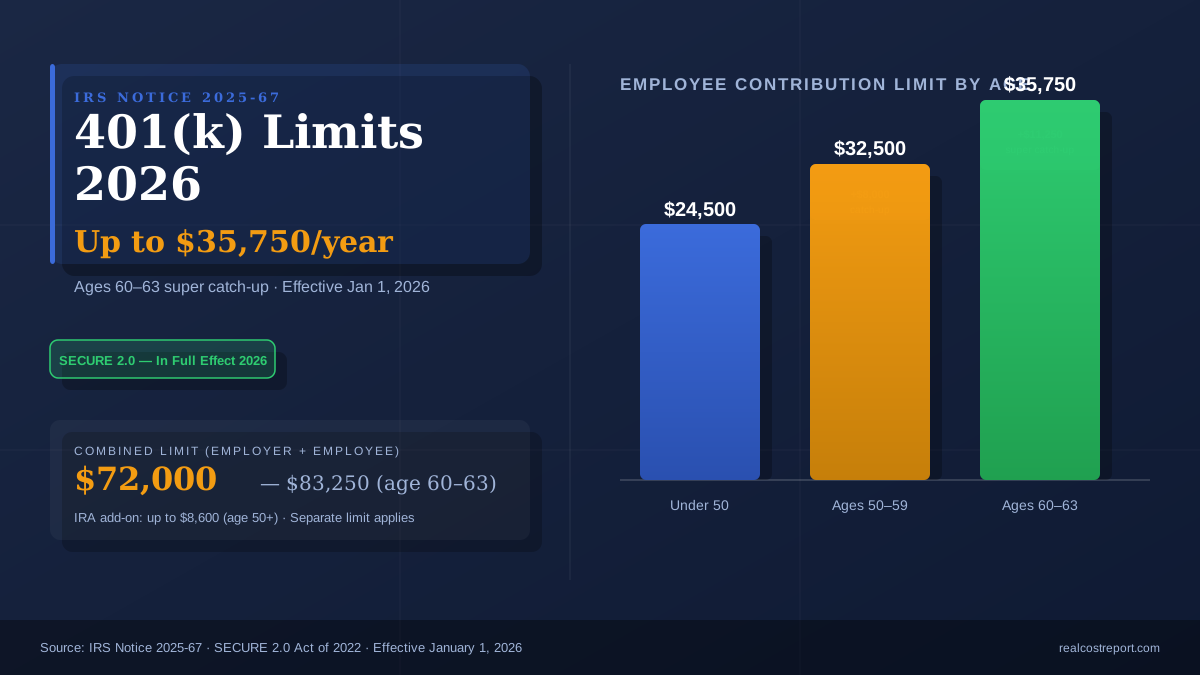
- The 2026 employee 401(k) deferral limit rose to $24,500, up $1,000 from 2025’s $23,500, per IRS Notice 2025-67.
- Workers aged 50–59 and 64+ can contribute up to $32,500; those aged 60–63 unlock a SECURE 2.0 “super catch-up” reaching $35,750.
- The total combined employer-plus-employee cap jumped to $72,000 (or $83,250 for the 60–63 age bracket).
- Maxing out at $24,500 annually for 30 years at a 7% average return produces an estimated $2.46 million — roughly $820,000 more than contributing half that amount over the same period.
- Starting in 2026, high earners with prior-year FICA wages above $150,000 must route all catch-up contributions through Roth accounts, a structural change that affects tax planning for thousands of pre-retirees.
- Recommendation: Prioritize capturing the full employer match first, then ramp contributions to the $24,500 ceiling if cash flow allows — every dollar added now is worth roughly $7.61 at retirement (30-year horizon, 7% return).
Only 14% of 401(k) participants contributed the maximum allowed amount in 2024, according to Vanguard’s How America Saves report — yet the gap between maxing out and contributing at the median rate can compound into more than $800,000 over a career. For 2026, the Internal Revenue Service raised the employee deferral ceiling to $24,500, effective January 1, and introduced a graduated catch-up structure that rewards workers in their early sixties more generously than any prior rule. Fidelity and Vanguard — two of the country’s largest 401(k) recordkeepers by assets — have updated their contribution systems to reflect the new caps. This article maps every 2026 limit by age bracket, shows exactly what reaching each threshold is worth in terminal portfolio value, compares traditional versus Roth 401(k) contributions under the new Roth catch-up mandate, and identifies the four most costly mistakes participants make when trying to optimize their contributions. All figures are drawn directly from IRS Notice 2025-67 and named primary sources.
2026 401(k) Contribution Limits by Age: The Full Breakdown
The IRS sets three distinct contribution tiers for 2026, each governed by a separate section of the Internal Revenue Code. The baseline employee deferral limit under IRC §402(g) applies to every participant under age 50. Two separate catch-up tiers — one for ages 50–59 and 64+, another exclusively for ages 60–63 — were created by the SECURE 2.0 Act of 2022 and take full effect in 2026.
The total combined limit (employer plus employee) under IRC §415(c)(1)(A) rose from $70,000 to $72,000. For the 60–63 “super catch-up” cohort who also receive maximum employer contributions, the ceiling reaches $83,250. Compensation used to calculate employer contributions is capped at $360,000 for 2026, per the IRS.
Source: Internal Revenue Service, IRS Notice 2025-67 announcement, effective January 1, 2026. IRA figures are independent of 401(k) limits and subject to separate income phase-outs.
One nuance that trips up high earners: the $8,000 standard catch-up and the $11,250 super catch-up are mutually exclusive — participants in the 60–63 window use the larger figure instead of the smaller one, not in addition to it. Plan sponsors are responsible for enforcing the correct limit, but participants should verify their deferral elections with HR each January.
What Maxing Out Your 401(k) Is Actually Worth: Scenario Modeling
Abstract contribution ceilings mean little without a terminal value. The calculations below use annual compounding at a 7% nominal return — roughly the historical long-run real return of a diversified equity portfolio net of average 401(k) fund expenses, as widely used by retirement planners and consistent with projections published by Vanguard and Fidelity. These are illustrative models, not guarantees. All dollar amounts are nominal (not inflation-adjusted).
The multiplier math: A single dollar invested today at 7% for 30 years grows to $7.61. That means every $1,000 in additional 2026 contributions added to an account with a 30-year runway generates approximately $7,610 in retirement assets — before counting employer match or tax advantages.
RealCostReport.com original calculations using future value of annuity formula (FV = PMT × [(1+r)^n – 1] / r), 7% annual return, annual contribution deposits. Not investment advice. Verify methodology at Investor.gov Compound Interest Calculator.
The scenario for ages 60–63 uses a 10-year horizon because most participants in that bracket are 5–10 years from retirement. Even over that compressed window, maximizing the $35,750 annual contribution — a $11,250 premium over the standard limit — adds roughly $113,000 in terminal value versus stopping at $24,500, assuming the same 7% return. For a worker who has undersaved through their 50s, the super catch-up is one of the most powerful legislative gifts in recent retirement policy history.
Traditional 401(k) vs. Roth 401(k) in 2026: Which Is Better for Your Situation?
Both contribution types share identical dollar limits in 2026 — $24,500 for those under 50, up to $35,750 for the 60–63 bracket. The difference is entirely about when taxes are paid. Traditional contributions reduce your taxable income today; Roth contributions are made after tax but allow qualified withdrawals tax-free in retirement. The 2026 tax year introduces a mandate that adds urgency to this choice for higher earners.
Beginning January 1, 2026, any participant who earned more than $150,000 in FICA wages in the prior year (i.e., in 2025) must direct all age-based catch-up contributions into a Roth account, per SECURE 2.0 provisions confirmed by the IRS. Workers who earn above that threshold but whose plan does not yet offer a Roth option will be unable to make catch-up contributions at all until their employer adds the feature. Confirming Roth availability with HR before the first payroll of 2026 is not optional for affected workers — it is urgent.
Source: IRS Notice 2025-67; Principal Financial Group (verify at principal.com); ADP Retirement Services (verify at adp.com).
Verdict
For workers currently in the 22%–24% federal bracket who expect to retire into a lower bracket, traditional contributions remain marginally more efficient on a pure tax-arbitrage basis. Workers in the 32%+ bracket with long time horizons or strong estate-planning motives should favor Roth — especially given that Roth 401(k)s now share the no-RMD benefit previously exclusive to Roth IRAs. Workers over 50 earning above $150,000 in FICA wages have no choice for catch-up contributions: Roth is now legally mandated for that tranche.
Employer Match in 2026: How Much Free Money Are You Leaving Behind?
The employer match is the only guaranteed, immediate 100% return available to retail investors — yet a substantial share of workers fail to capture it fully. Understanding exactly what you’re leaving on the table requires knowing both the average match structure and the compounding cost of forgoing it.
According to Vanguard’s How America Saves 2025 survey, 68% of plans with an employer match use a single-tier formula — most commonly $0.50 per dollar contributed on the first 6% of pay. The average promised match value across all Vanguard-administered plans was 4.6% of pay. A worker earning $90,000 who contributes exactly 6% of salary captures approximately $2,484 in annual employer contributions (at a 50-cent match on 6%). Left unmatched over 20 years at 7% growth, that annual $2,484 would compound to roughly $108,000 in foregone retirement assets.
RealCostReport.com original calculations. Match formula assumes most common structure per Vanguard’s How America Saves 2025 survey (50¢ per $1, up to 6% of pay). Verify Vanguard data at vanguard.com.
Vesting schedules complicate the picture. Only 22% of plans offer immediate vesting on employer contributions, per Bureau of Labor Statistics data. Cliff vesting — where 0% is owned until a set tenure threshold — is equally common at 22% of plans. A worker who leaves after two years under a three-year cliff schedule forfeits every employer dollar contributed. Fidelity explicitly warns that participants who front-load contributions early in the calendar year risk missing the employer match in later pay periods if their plan uses a per-paycheck matching formula rather than an annual true-up. Always confirm whether your plan includes a true-up provision.
What Most People Get Wrong About 401(k) Contributions in 2026
Contribution limit increases generate annual coverage, but the specific errors that cost participants tens of thousands of dollars rarely make headlines. Here are the four most consequential mistakes — each with a concrete corrective action.
Mistake 1: Front-Loading Without Confirming a True-Up
Some participants rush to max out their 401(k) by mid-year, calculating that their invested dollars have more time to grow. The consequence: if the plan matches per paycheck rather than annually, contributions stop triggering matches once the employee limit is hit. At $24,500 reached in July, the employer could match nothing from August through December. The correct action is to call your plan administrator and ask explicitly whether a “true-up” provision is in place. If not, spread contributions evenly across 26 biweekly pay periods — approximately $942 per period to hit $24,500.
Mistake 2: Ignoring the SECURE 2.0 Roth Catch-Up Mandate
Workers earning over $150,000 in 2025 FICA wages who fail to check whether their plan offers a Roth option will be blocked from making any catch-up contributions in 2026. The consequence is losing up to $8,000 (or $11,250 for ages 60–63) in tax-advantaged space for the entire year — irreversibly, since contribution limits cannot be carried forward. The correct action is to review Box 3 of your 2025 W-2 and contact HR before the first payroll cycle of January 2026.
Mistake 3: Counting Employer Contributions Against the Employee Limit
A persistent misconception holds that employer match dollars eat into the $24,500 employee cap. They do not. The $24,500 applies exclusively to employee elective deferrals. Employer contributions count only against the $72,000 combined ceiling under IRC §415(c). A worker contributing the full $24,500 with an employer adding $10,000 in match has a combined $34,500 — well below either limit. The correct action: never voluntarily reduce deferrals to “make room” for expected employer contributions.
Mistake 4: Skipping the IRA Layer After Hitting the 401(k) Ceiling
Participants who max their 401(k) often stop there, unaware that a Roth IRA or deductible traditional IRA can stack on top. For 2026, the IRA contribution limit rose to $7,500 ($8,600 with the age-50+ catch-up of $1,100). Roth IRA eligibility phases out for single filers above $150,000 MAGI and married filers above $236,000, per IRS Notice 2025-67. Those who exceed income limits can use a backdoor Roth conversion. The correct action: after maxing the 401(k), open and fund an IRA at a provider such as Fidelity, Vanguard, or Charles Schwab before the April 15, 2027 deadline for 2026 contributions.
Is Maxing Out Your 401(k) in 2026 Worth It? Who Should and Who Shouldn’t
The honest answer is conditional. Maxing out is almost always the right call for high-income earners with adequate emergency reserves. For others, the calculus is more nuanced.
Max out if: You are in the 24% federal tax bracket or higher. The pre-tax deferral of $24,500 saves approximately $5,880 in federal income tax this year at the 24% marginal rate — a guaranteed, immediate return that no investment product can replicate. You also have 3–6 months of expenses in a liquid emergency fund. Locking cash inside a 401(k) before age 59½ imposes a 10% penalty plus income tax on early withdrawals — the real cost of an unplanned withdrawal in the 24% bracket is an effective 34% haircut.
Prioritize the match first, not the max, if: You are carrying high-interest debt (above 8–9% APR), have no emergency fund, or your cash flow cannot sustain the monthly reduction from $24,500 in annual deferrals. The correct sequencing for most households is: (1) contribute enough to capture the full employer match, (2) build a 3-month emergency fund, (3) pay down high-interest debt, (4) then increase deferrals toward the $24,500 ceiling.
The 60–63 window is categorically different. Workers between ages 60 and 63 who have the cash flow to absorb $35,750 in annual contributions should treat 2026 as an emergency savings sprint. This four-year window of elevated catch-up authority may never be replicated in the tax code. At a conservative 5% return over 10 years, an extra $11,250 per year above the standard limit compounds to roughly $141,500 — money that would otherwise not exist in the retirement account.
One overlooked factor: highly compensated employees (defined by the IRS as those earning $160,000 or more in 2025 or 2026) face nondiscrimination test exposure. If too few non-HCE employees participate in the plan, the IRS may force a refund of HCE contributions — potentially taxable in a year you weren’t planning for it. Safe harbor plan designs eliminate this risk. Confirm with your HR or plan sponsor whether your 401(k) uses a safe harbor structure if you are an HCE.
How We Researched This Article
This article was researched and written in May 2026. All contribution limits were sourced directly from IRS Notice 2025-67, published by the Internal Revenue Service in November 2025 and confirmed against the full statutory text available at irs.gov/pub/irs-drop/n-25-67.pdf. Phase-out ranges for IRA deductibility and Roth IRA eligibility were drawn from the same notice.
Employer match statistics — including the average 4.6% match value and the 68% single-tier formula prevalence — were sourced from Vanguard’s How America Saves 2025 survey (verify at Vanguard’s institutional research portal). Bureau of Labor Statistics data on vesting schedule prevalence were drawn from the BLS National Compensation Survey (verify at bls.gov/ncs). The Roth catch-up mandate for high earners was confirmed through both IRS Notice 2025-67 and ADP’s 2026 contribution limits reference.
Terminal value calculations in this article use the future value of an ordinary annuity formula: FV = PMT × [(1 + r)^n – 1] / r, where PMT equals annual contribution, r equals 7% annual return, and n equals the number of years. The 7% nominal return assumption is consistent with long-run historical equity market returns as reported by Vanguard and widely used in financial planning projections. Results are illustrative, not guaranteed. Inflation adjustment was deliberately excluded from the terminal value tables so readers can directly compare nominal dollar-in versus nominal dollar-out — a common and transparent modeling convention.
Limitations: Plan-level match rates and vesting schedules vary substantially by employer. This article models the most common formula reported by Vanguard, not every permutation available in the market. The Roth catch-up income threshold of $150,000 applies to FICA wages, not total compensation — highly compensated workers with large non-FICA income sources (distributions, rental income) should confirm applicability with a CPA. All figures were verified against named primary sources before publication.