Past performance does not indicate future results. This is not investment advice; consult a qualified tax or financial professional before making withdrawal decisions.
TL;DR — Quick Verdict
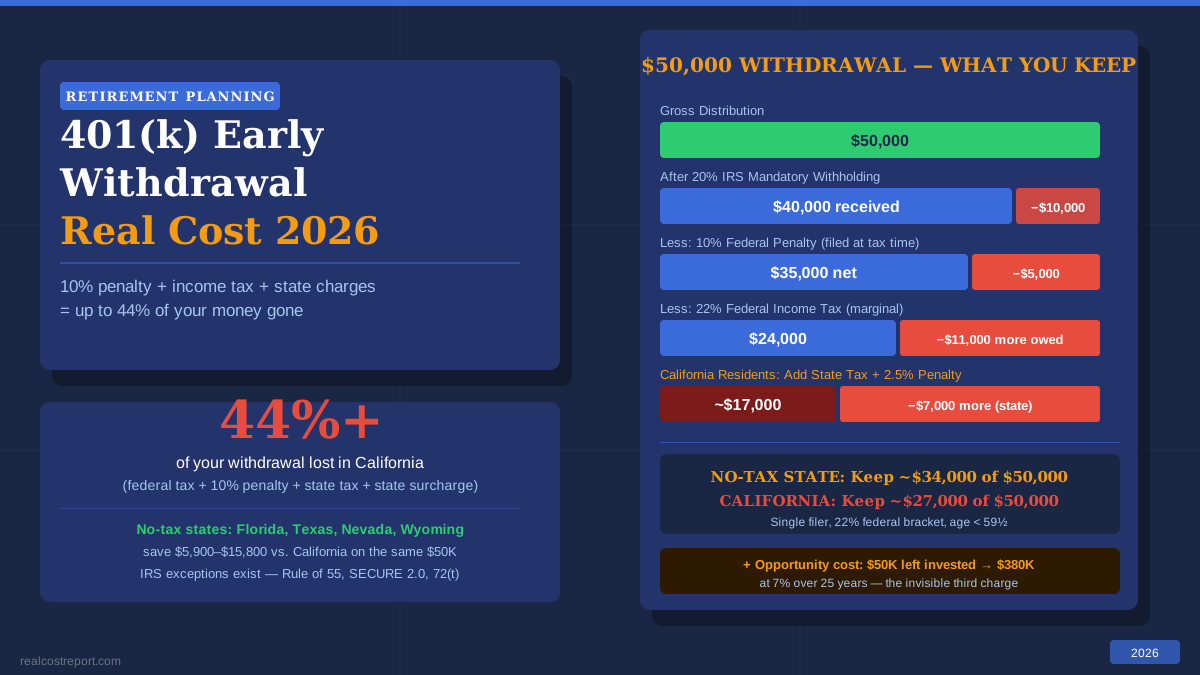
- A $50,000 early 401(k) withdrawal by a single filer in the 22% federal bracket leaves roughly $32,500 in hand after the 10% penalty and income taxes — a 35% loss before state taxes.
- The IRS mandates 20% automatic federal withholding at distribution, but your final tax bill can be higher or lower depending on your bracket that year.
- California residents face four separate levies — federal income tax, 10% federal penalty, state income tax up to 13.3%, and a 2.5% California early-distribution surcharge — potentially surrendering 44%+ of the withdrawal.
- Thirteen states impose zero state tax on 401(k) withdrawals, including Florida, Texas, Nevada, and Wyoming, making geography a significant cost variable.
- A 401(k) loan at the 2026 prime-plus-one rate of 8.5% is almost always cheaper than an outright early withdrawal for solvent borrowers with stable employment.
- Unless you qualify for a SECURE 2.0 exception or the Rule of 55, a $50,000 withdrawal should be treated as a last resort — the compounded opportunity cost over 20 years rivals the tax bill itself.
The advertised cost of tapping your 401(k) before age 59½ is 10%. The real cost is almost always double that. According to the Internal Revenue Service, any taxable distribution paid directly to a plan participant triggers mandatory 20% federal withholding at the moment of distribution — before the 10% early-withdrawal penalty even posts on your tax return. Add a marginal federal income tax rate of 22% or 24%, pile on state taxes that can reach 13.3% in California, and a $50,000 emergency withdrawal can yield less than $28,000 in spendable cash. Fidelity and Vanguard both make this calculator available on their plan portals, but few participants run the full four-layer calculation before calling to request the check. This article builds that math from primary IRS sources, applies 2026 federal tax brackets confirmed by the Tax Foundation, models three withdrawal scenarios across income levels, and names every exception that legitimately reduces or eliminates the penalty.
What an Early 401(k) Withdrawal Actually Costs: The Four-Layer Calculation
Most articles stop at the 10% penalty. That framing is dangerously incomplete. A traditional 401(k) early withdrawal generates four distinct charges, and each one stacks on top of the gross amount withdrawn — not on what’s left after the previous charge.
Layer 1 — Ordinary income tax. Every dollar withdrawn from a pre-tax 401(k) is added to your taxable income for that year, per IRS Publication 575. If you earn $75,000 in wages and pull $25,000 from your 401(k), you file as though you earned $100,000. The marginal rate on the added dollars is whatever bracket that $100,000 lands in — not your effective rate on your wages alone.
Layer 2 — The 10% early-withdrawal penalty. IRS Topic No. 558 imposes an additional 10% tax on the gross distribution for participants under age 59½ who do not qualify for a statutory exception. This is reported on Form 5329 and added to your tax due at filing.
Layer 3 — Mandatory 20% federal withholding. Before you ever see the funds, your plan administrator withholds 20% for federal taxes, per IRS 401(k) Resource Guide — General Distribution Rules. This is a prepayment, not a final tax. If your marginal rate plus penalty exceeds 20%, you owe the difference at filing. If it’s less, you get a refund — but you’ve lost the use of that cash in the interim.
Layer 4 — State income tax. This varies from 0% (Florida, Texas, eight others) to 13.3% (California’s top bracket) and can include an additional state early-distribution tax of 2.5% in California specifically.
Modeled calculations using 2026 federal income tax rates confirmed by the Tax Foundation (verify at taxfoundation.org). Federal income tax applied at marginal rate on the withdrawn amount only. State taxes excluded from this table; see state comparison section below.
These figures assume the withdrawal pushes income fully into the stated bracket, which is the worst-case scenario. In practice, a portion of the withdrawal may be taxed at lower marginal rates if you’re near the bottom of a bracket. Running this calculation requires knowing your full projected AGI for the year — not just your salary. Fidelity’s NetBenefits portal (verify at netbenefits.fidelity.com) includes a distribution tax estimator for account holders.
State-by-State 401(k) Early Withdrawal Tax: Where You Live Changes Everything
The federal calculation is the same nationwide. State taxes are not, and the spread is enormous. A single filer withdrawing $50,000 in Florida pays zero state income tax on that amount. The same person in California could owe an additional $4,650 in state income tax (at the 9.3% bracket) plus a $1,250 state early-distribution penalty — a combined state hit of $5,900 on top of the federal charges.
Per the Tax Foundation’s 2026 State Income Tax Rates and Brackets report, nine states levy no individual income tax at all: Alaska, Florida, Nevada, New Hampshire (which eliminated its interest and dividends tax effective January 1, 2025), South Dakota, Tennessee, Texas, Washington, and Wyoming. Four additional states — Illinois, Mississippi, Pennsylvania, and Iowa (for residents 55 and older) — impose income taxes but fully exempt qualified retirement income including 401(k) distributions.
California stands alone as the highest-cost state for early withdrawals. The California Franchise Tax Board taxes 401(k) distributions as ordinary income at rates up to 13.3% and applies a separate 2.5% state early-distribution penalty on top of the federal 10%. That means a California resident in the top bracket faces a combined federal-plus-state marginal cost of over 55% — leaving less than 45 cents of every early-withdrawal dollar.
State rate data from Tax Foundation 2026 State Income Tax Rates and Brackets (verify at taxfoundation.org/data/all/state/state-income-tax-rates-2026). California early-distribution penalty per the California Franchise Tax Board (verify at ftb.ca.gov). Dollar estimates model a $50,000 withdrawal for a mid-bracket filer; actual liability depends on total AGI and filing status.
New York partially mitigates the sting for older withdrawers: the state’s pension and annuity exclusion of up to $20,000 applies only once you reach age 59½, so early withdrawers forfeit that exemption entirely. Michigan, previously a partial taxer of retirement income, phases out its retirement income tax entirely by 2026 under Michigan’s Public Act 4 of 2023, making it effectively tax-free for 401(k) distributions that year.
401(k) Early Withdrawal vs. 401(k) Loan: Which Is Better for Your Situation?
When a financial emergency forces a choice, most plan participants default to whichever option they understand first. Understanding both is the difference between a recoverable setback and a permanent retirement scar.
The 401(k) loan: IRS rules cap borrowing at the lesser of $50,000 or 50% of your vested balance. The loan must be repaid within five years through substantially level payments (longer for primary-residence purchases). Interest is set by the plan — most use prime rate plus one percentage point. With the prime rate at 7.50% as of March 2026, the standard 401(k) loan rate is 8.5%. Crucially, that interest is paid back into your own account, not to a bank. No taxes or penalties apply as long as repayment is on schedule. No credit check is required.
The early withdrawal: You receive the funds minus the mandatory 20% withholding, owe income tax at your marginal rate, owe a 10% penalty at filing, and pay applicable state taxes. The money is gone from your retirement account permanently, losing all future compounded growth on that balance.
The math over time is damning for the withdrawal side. A $30,000 withdrawal by a 40-year-old in the 22% federal bracket in a no-state-tax state nets approximately $20,400 after taxes and penalties. That $30,000 left invested at a 7% annualized return would grow to roughly $114,300 by age 65 — meaning the true cost of the withdrawal is not $9,600 in taxes but closer to $93,900 in foregone wealth.
Verdict
The 401(k) loan wins for any participant with stable employment who needs less than $50,000 and can service monthly repayments. The early withdrawal is only rational when: (a) you’ve exhausted every alternative, (b) you qualify for a penalty exception, or (c) job separation makes loan repayment impossible. If you’ve just been laid off, the loan option collapses — a defaulted loan converts automatically into a taxable distribution subject to the same penalties you were trying to avoid.
One critical loan risk requires emphasis: if you leave your employer while a 401(k) loan is outstanding, the balance typically becomes due by your tax return deadline (including extensions) under SECURE 2.0. A borrower who separates in early 2026 and files with an extension has until October 2027 — but a newly unemployed person is unlikely to have $30,000 to $50,000 readily available. The defaulted balance then becomes a taxable distribution, triggering the full penalty stack at the worst possible financial moment.
What Most People Get Wrong About 401(k) Early Withdrawals
The 10% penalty is the least of your problems. That framing leads to five expensive errors that audits, tax bills, and retirement calculators repeatedly expose.
Mistake 1: Treating the 20% withholding as the final tax. Plan administrators withhold 20% by law. If your total marginal rate on the withdrawal — including the 10% penalty — is 32%, you owe another 12% at filing. Many people spend the withheld-adjusted check, then face a tax bill they can’t pay in April. The correct action: use an IRS Form W-4P worksheet or tax software to estimate your true liability before you spend a cent.
Mistake 2: Ignoring the bracket bump. A $40,000 withdrawal added to $75,000 in wages pushes $115,000 in taxable income. At 2026 rates for a single filer, that moves a meaningful portion of the withdrawal from the 22% bracket into the 24% bracket. Calculating the penalty at your pre-withdrawal marginal rate will understate the actual bill. Run the calculation on your full projected year income.
Mistake 3: Assuming hardship equals penalty exemption. A hardship withdrawal approved by your plan administrator allows you to take the distribution — but it does not automatically waive the 10% IRS penalty. Hardship is a plan-level determination; penalty exemption is a separate IRS-level determination based on specific statutory exceptions enumerated in IRS Topic No. 558. These two lists overlap but are not identical. Medical hardship expenses exceeding 7.5% of AGI can qualify for an IRS penalty exemption; “I need money for a car” does not, regardless of what your HR department approves.
Mistake 4: Missing the Rule of 55. Participants who separate from service in or after the calendar year they turn 55 can take penalty-free withdrawals from that specific employer’s 401(k). Rolling the balance to an IRA before making those withdrawals permanently eliminates this option — the Rule of 55 applies only to employer plans, not IRAs. Early retirees who roll their balance to Fidelity or Schwab before tapping it pay a penalty they would have legally avoided.
Mistake 5: Overlooking the SECURE 2.0 $1,000 emergency exception. The SECURE 2.0 Act of 2022 added a provision allowing one penalty-free withdrawal of up to $1,000 per year for unforeseeable personal or family emergency expenses. If the distribution is repaid within three years, it is treated as a rollover and is not even taxable. Many plan participants and even HR departments are unaware this option exists for 2024 onward. For a modest cash shortfall, this is a far cheaper route than a full early withdrawal.
11 IRS Exceptions That Waive the 10% Penalty (Income Tax Still Applies)
The penalty is not inevitable. The IRS maintains a list of statutory exceptions under Section 72(t) that eliminate the 10% additional tax while leaving ordinary income tax in place. None of these eliminate the tax — they only remove the surcharge.
Exceptions sourced from IRS Retirement Topics — Exceptions to Tax on Early Distributions (verify at irs.gov/retirement-plans/plan-participant-employee/retirement-topics-exceptions-to-tax-on-early-distributions). SECURE 2.0 provisions effective for distributions beginning 2024.
The SEPP / 72(t) route is technically available to anyone at any age, but the commitment is severe: once you begin substantially equal periodic payments, you cannot alter them for the longer of five years or until you reach 59½. Modifying the schedule even slightly triggers retroactive penalties on every payment already received. Vanguard’s participant services team (verify at vanguard.com) can help model 72(t) payment amounts using the three IRS-approved calculation methods before you commit.
Is an Early 401(k) Withdrawal Worth It? A Decision Framework
The answer is almost never yes in isolation — but context matters, and the correct comparison is not the early withdrawal against nothing. It’s the early withdrawal against every available alternative.
You should strongly consider alternatives if: You have equity in a home (a HELOC currently runs 8.0%–9.5%, which is painful but does not destroy your retirement balance permanently). You qualify for a personal loan under 20% APR. You have Roth IRA contributions — not earnings — that can be withdrawn tax-free and penalty-free at any age. Your employer plan allows a 401(k) loan and your job is stable. Any of these preserve the compounding growth inside the account.
The early withdrawal may be the least-bad option if: You face foreclosure or eviction and have no other liquidity. You have a terminal illness and qualify for the SECURE 2.0 exception. You are separating from service at 55 or older and the Rule of 55 eliminates the penalty. You are over 59½ — in which case no penalty applies, only income tax, and withdrawal is simply a tax-planning decision.
Consider geographic arbitrage if the withdrawal is planned. Residency is determined by domicile at the time of distribution. A California resident who legally establishes domicile in Nevada before taking a $100,000 distribution saves approximately $13,300 in state income tax and $2,500 in California’s early-distribution penalty — $15,800 in additional take-home on that single transaction. The Tax Foundation and California Franchise Tax Board both note that California aggressively audits domicile changes, so documentation of the move must be thorough.
The hidden third cost: opportunity loss. Every dollar withdrawn early stops compounding. A $50,000 withdrawal at age 40, invested at a long-term equity return of 7% annually, would be worth approximately $380,600 by age 70. Even netting the post-tax value of a $50,000 withdrawal at the 22% bracket — approximately $34,000 — that $34,000 reinvested in a taxable account at 7% reaches only $258,900 over the same period, and is subject to capital gains taxes along the way. The gap is $121,700. That is the true price of the withdrawal, and it never appears on the Form 1099-R you receive in January.
How We Researched This Article
This analysis was researched and modeled in May 2026. All tax rates, penalty structures, and exception rules were cross-referenced against primary government and regulatory sources, not secondary aggregators.
Federal tax rates and brackets were drawn from the Tax Foundation’s confirmed 2026 federal and state bracket data, which incorporates the One Big Beautiful Bill Act (OBBBA) signed July 2025 and IRS Revenue Procedure 2025-32. The Tax Foundation’s full 2026 federal bracket analysis is available at Tax Foundation — 2026 Federal Tax Brackets.
IRS penalty and withholding rules were verified against IRS Topic No. 558 (Additional Tax on Early Distributions from Retirement Plans Other Than IRAs), IRS 401(k) Resource Guide — Plan Participants — General Distribution Rules, and IRS Retirement Topics — Exceptions to Tax on Early Distributions. These are primary IRS publications available at IRS — Retirement Topics Exceptions and IRS — 401(k) General Distribution Rules.
State income tax rates were taken from the Tax Foundation’s 2026 State Income Tax Rates and Brackets report, available at Tax Foundation — 2026 State Income Tax Rates. California’s additional 2.5% early-distribution penalty was confirmed through the California Franchise Tax Board (verify at ftb.ca.gov). Michigan’s 2026 full retirement income exemption was confirmed against Michigan’s Public Act 4 of 2023.
SECURE 2.0 exception provisions — including the $1,000 annual emergency expense distribution, the $22,000 disaster distribution cap, the $10,000 domestic abuse exception, and the terminal illness exception — were confirmed against the text of the SECURE 2.0 Act of 2022 (Division T of the Consolidated Appropriations Act, 2023), available through Congress.gov — SECURE 2.0 Act Text.
401(k) loan rate (prime plus one percentage point) was confirmed using the March 2026 prime rate of 7.50%, sourced from Federal Reserve H.15 data (verify at federalreserve.gov). Opportunity cost calculations use a 7% annualized nominal return assumption based on long-term U.S. equity historical averages, modeled rather than measured, and should be understood as illustrative projections, not guarantees.
Limitations: marginal rate calculations in all scenario tables apply a flat stated bracket to the withdrawn amount for simplicity. Actual effective rates on the incremental withdrawal depend on the precise structure of the participant’s total income. State tax estimates in the comparison table represent mid-bracket modeling; individual results will vary. This article does not model AMT exposure, Net Investment Income Tax, or IRMAA surcharges triggered by high-income-year distributions, all of which are potential compounding costs for participants above the relevant thresholds.
All figures were verified against named primary sources before publication.