APR disclosure: All rate ranges shown reflect lender-published figures including autopay discounts where applicable. Annual percentage rates depend on creditworthiness, loan amount, and term. Compare lender-disclosed APR figures before accepting any loan offer.
TL;DR — Quick Verdict
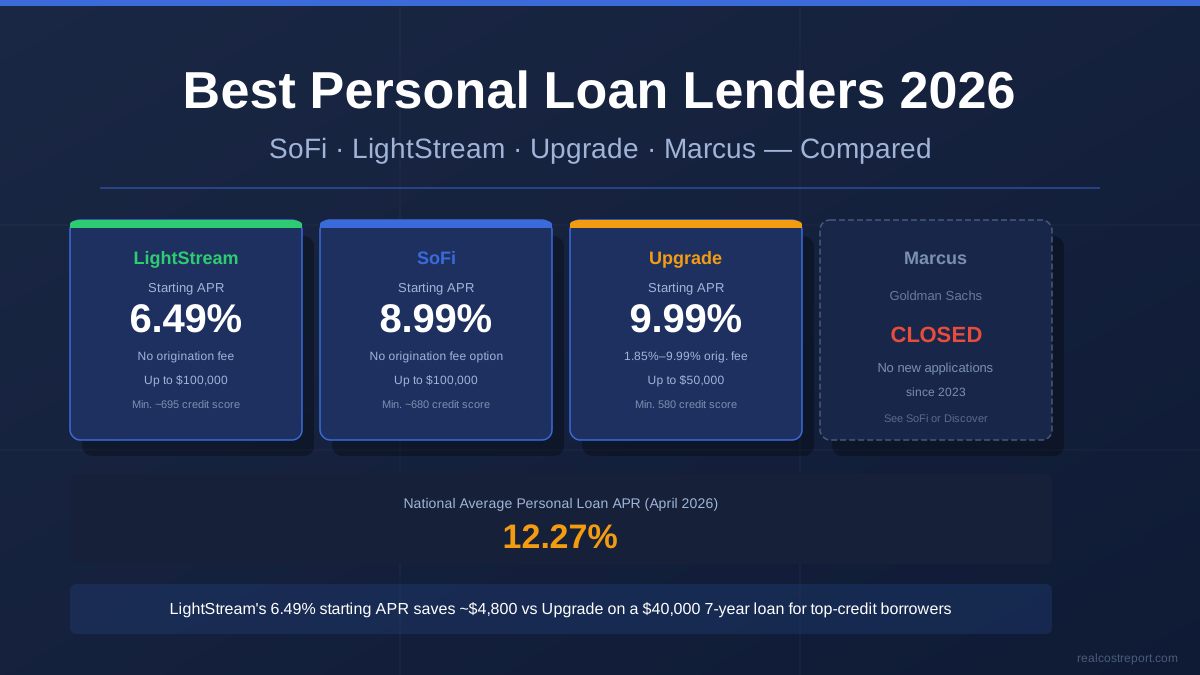
- LightStream offers the lowest starting APR in this comparison at 6.49% (with autopay), making it the cheapest option for borrowers with credit scores above 695 — but it requires a hard credit inquiry to even see your rate.
- SoFi’s APR range of 8.99%–25.81% comes with zero origination fees, same-day funding, and member perks including unemployment protection — best overall value for borrowers with 680+ credit scores.
- Upgrade’s APR range of 9.99%–35.99% carries origination fees of 1.85%–9.99%, which on a $20,000 loan means $370–$1,998 deducted from your proceeds before you see a dollar — but it accepts credit scores as low as 580.
- Marcus by Goldman Sachs stopped accepting new personal loan applications in 2023; borrowers who valued its no-fee structure should consider SoFi or Discover as the closest current equivalents.
- The average personal loan APR across all credit tiers was approximately 12.27% in April 2026, according to Bankrate marketplace data — a useful benchmark when evaluating any offer.
- If your credit score is 700 or above, prequalify with both SoFi and LightStream first; the rate difference between the two can exceed 2 percentage points, translating to $1,200–$2,500 in savings on a $25,000 loan over five years.
The personal loan market in 2026 has a painful divergence baked in: borrowers with excellent credit can lock in rates at or below 7%, while borrowers with fair credit routinely face APRs above 25% — on the exact same loan amount. That gap costs thousands. Four lenders have dominated comparison searches this year: SoFi, LightStream, Upgrade, and Marcus by Goldman Sachs. Each serves a meaningfully different borrower profile, and picking the wrong one can mean paying a $2,000 origination fee you didn’t need to, or leaving a 2-point APR reduction on the table. This article breaks down every major cost variable, credit score requirement, and funding timeline for each lender using data verified directly from lender disclosures and primary financial sources including the Consumer Financial Protection Bureau (consumerfinance.gov) and Federal Reserve G.19 release data. By the end, you will know exactly which lender fits your situation — and which ones to skip.
Current Personal Loan APR Ranges: What Each Lender Actually Charges
Advertised rates are almost always the best possible rate — reserved for borrowers with excellent credit, low debt-to-income ratios, and autopay enrollment. The ranges below reflect full lender-published APRs including autopay discounts where applicable, sourced from lender disclosures as of May 2026.
Sources: SoFi NMLS #696891 lender disclosures; LightStream (verify at lightstream.com); Upgrade lender disclosures (verify at upgrade.com); WalletHub Marcus review citing Goldman Sachs historical data. *SoFi’s origination fee applies only to Cross River Bank-originated loans (up to 9.99%) or SoFi Bank-originated loans choosing the fee option (0%–7%). The no-fee option is available to most borrowers via SoFi Bank, N.A.
Three things stand out immediately. First, LightStream’s APR ceiling of 25.99% is substantially lower than Upgrade’s 35.99% — for a borrower at the high end of each range, that 10-point gap on a $15,000 three-year loan means paying roughly $2,900 more in interest with Upgrade. Second, SoFi’s no-fee option effectively makes its APR comparable to its interest rate, while Upgrade’s origination fee inflates true cost regardless of APR. Third, Marcus is no longer a live option — Goldman Sachs exited consumer personal lending in 2023, and borrowers searching for its no-fee, no-late-fee structure should apply to SoFi or Discover instead.
What Actually Determines Your Rate: Credit Score, DTI, and Loan Purpose
Published APR ranges span 15–25 percentage points at most lenders. Understanding where you land within that range matters more than the headline number.
Credit score is the single largest driver, but it works differently at each lender. LightStream requires a minimum score of approximately 695 and skews heavily toward very good and excellent credit: according to 12 months of Credible marketplace data, borrowers with scores above 800 averaged below 10% APR, those with 740–799 averaged below 11%, and scores of 700–740 saw roughly 12%. Borrowers below 700 are typically declined outright. SoFi’s floor is approximately 680, with its member perks — including a 0.25% autopay discount and an additional 0.25% SoFi Plus discount — available to reduce rate further. Upgrade accepts scores as low as 580, which is why its APR ceiling is 10 points higher than LightStream’s.
Debt-to-income ratio is the second major lever. Upgrade caps DTI at 75% including mortgage. SoFi prefers DTI below 50%. LightStream looks for a demonstrated savings pattern — liquid assets, retirement contributions, and manageable revolving balances matter as much as the score itself.
Loan purpose affects rate only at LightStream, which uniquely prices by use case. A home improvement loan at LightStream may carry a starting APR 1–2 percentage points lower than a general-purpose loan. One practical tip: always select the most specific eligible purpose. Selecting “home improvement” rather than “other” on a bathroom remodel could save a borrower $1,500–$3,000 in interest on a $30,000, five-year loan.
To model the real cost difference, consider a borrower with a 730 FICO score seeking $25,000 over 60 months. At LightStream’s estimated 10.5% APR (no fee), total repayment is approximately $32,375. At SoFi’s estimated 13% APR (no fee), repayment is roughly $34,225. At Upgrade with a 14% APR and a 5% origination fee ($1,250), the borrower receives $23,750 but repays based on the full $25,000 — total outlay approximately $35,650 plus the $1,250 fee. The LightStream-to-Upgrade gap on this scenario: over $4,500.
SoFi vs LightStream: Which Is Better for Well-Qualified Borrowers?
These two lenders compete directly for the same borrower — good-to-excellent credit, stable income, and a need for $10,000 to $100,000. The decision comes down to five variables.
Sources: SoFi (verify at sofi.com/personal-loans); LightStream (verify at lightstream.com); NerdWallet lender reviews, May 2026.
Verdict
LightStream wins on raw APR — its 6.49% floor is 2.5 points below SoFi’s, and on a $40,000 home improvement loan over seven years, that gap produces roughly $4,800 in interest savings. LightStream also offers loan terms up to 20 years for home improvement, making monthly payments meaningfully lower for large projects. SoFi wins on flexibility and safety: soft-pull prequalification lets you check your rate without a credit score hit, unemployment protection is a genuine differentiator for borrowers in volatile industries, and the member ecosystem adds value beyond the loan. For borrowers with 750+ credit and a specific major expense, apply to LightStream first. For borrowers who want to rate-shop without damaging their credit — or who work in fields with layoff risk — start with SoFi.
What Most Borrowers Get Wrong When Comparing Personal Loan Lenders
These are not generic cautions. Each mistake has a specific dollar consequence.
Mistake 1: Comparing APR without accounting for origination fees. Upgrade charges an origination fee of 1.85%–9.99% deducted from loan proceeds at disbursement. If a borrower needs $20,000 net and accepts a loan with a 9.99% origination fee, they must borrow approximately $22,200 to receive $20,000. The higher principal increases both monthly payment and total interest paid — yet the APR figure already factors in the fee, which can make two loans with the same APR misleadingly appear identical when the one with a fee requires you to borrow more. Always confirm your net disbursement amount before signing.
Mistake 2: Applying to LightStream as a first step. LightStream does not offer soft-pull prequalification. Every application triggers a hard inquiry, which typically reduces your credit score by 5–10 points temporarily. If you apply to LightStream, get declined, and then apply elsewhere, you’ve used up credit inquiry capacity and may receive a slightly worse rate. The correct sequencing: prequalify with SoFi, Upgrade, and other soft-pull lenders first. Use those offers to satisfy LightStream’s Rate Beat Program, then apply to LightStream once you have a competing rate in hand.
Mistake 3: Assuming Marcus is still accepting applications. Goldman Sachs ceased new Marcus personal loan originations in 2023. Borrowers who search “Marcus personal loan” and reach the Marcus homepage will find no loan application — but may waste time before realizing the product is gone. The lender closest to Marcus’s original fee-free, fixed-rate model is SoFi (via SoFi Bank, N.A. originations) or Discover Personal Loans, which also charges no origination fee.
Mistake 4: Ignoring the loan purpose field at LightStream. LightStream prices differently by loan category. Selecting “other” or “personal” rather than the specific eligible purpose — home improvement, auto purchase, medical — can cost 1–2 percentage points in APR. On a $30,000 five-year loan, 1.5 percentage points equals approximately $2,100 in additional interest. Read LightStream’s rate table by category before selecting a purpose.
Mistake 5: Choosing the longest available term to minimize monthly payments. A 7-year term on a $20,000 loan at 12% APR produces a monthly payment of roughly $349 — versus $483 on a 4-year term. But the 7-year borrower pays approximately $9,300 in total interest versus $3,200 on the 4-year loan. Personal loans are not mortgages; the rate premium for extending term is not offset by tax deductibility or asset appreciation. Match the term to the shortest period you can realistically afford.
Who Should Use Each Lender — and Is a Personal Loan Worth It?
The answer depends almost entirely on what you’re replacing and your credit profile.
Use LightStream if: your credit score is 700 or above, you’ve built diverse credit history over several years, you’re financing a home improvement project or large purchase above $25,000, and rate is your primary concern. The 6.49% starting APR is the lowest in this comparison. If you have a competing pre-qualified offer from SoFi or another lender, bring it — LightStream’s Rate Beat Program will match and beat it by 0.10 percentage points. This lender is not appropriate for borrowers who want to shop rates without a credit score impact.
Use SoFi if: your credit score falls between 680 and 749, you want to rate-shop risk-free via soft pull, you’re in an industry with meaningful layoff risk and value the unemployment protection, or you want a loan up to $100,000 with zero origination fees and access to member financial services. SoFi’s NerdWallet recognition as Best Personal Loan for Large Loan Amounts in 2026 reflects its positioning for mid-to-high borrowing amounts with good credit.
Use Upgrade if: your credit score falls between 580 and 660 and you cannot qualify for SoFi or LightStream. Upgrade’s accessibility to fair-credit borrowers is its primary value proposition. Borrowers who can add a co-borrower with stronger credit may receive meaningfully lower rates. Be rigorous about calculating the total cost including origination fee before accepting any offer — on a $15,000 loan with a 9.99% origination fee, you pay $1,499 upfront that does not reduce your repayment obligation.
The personal-loan-vs-credit-card math: The Federal Reserve G.19 release (consumerfinance.gov) shows average credit card APRs above 21% for accounts assessed interest as of early 2026. A borrower carrying $15,000 in credit card debt at 22% APR who consolidates at 12% APR on a 48-month personal loan saves approximately $4,800 in interest over the loan term — even after accounting for a 3% origination fee. The break-even math almost always favors a personal loan for borrowers with good credit and balances above $5,000. Below $3,000, the time and inquiry cost of the loan application diminishes the savings materially.
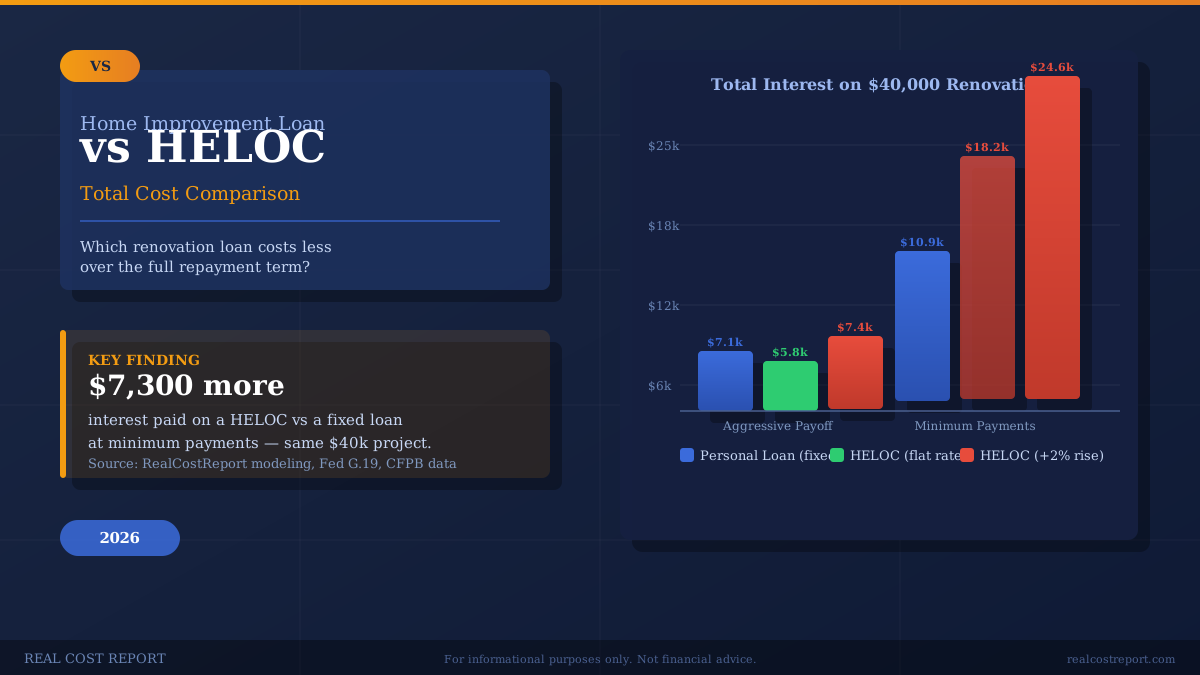
Is it worth it for home improvement? Compared to a home equity line of credit, an unsecured personal loan carries a higher rate but avoids the risk of losing your home and eliminates appraisal costs, which typically run $400–$700. For projects under $40,000 where a homeowner has less than 20% equity or wants to avoid a collateral risk, a personal loan at 8%–12% is often the right tool.
What’s Changed in Personal Lending in 2026
Three developments have shifted the landscape since early 2025. First, the Federal Reserve’s rate environment has kept personal loan APRs elevated relative to pre-2022 levels, though competition among online lenders has compressed the spread at the top end of the credit spectrum. LightStream’s 6.49% floor is aggressively competitive in this environment. Second, SoFi’s NerdWallet “Best for Large Loan Amounts” recognition reflects growing lender differentiation by loan size — borrowers needing $75,000–$100,000 for home improvement or major life expenses have meaningfully fewer options than those in the $10,000–$30,000 range, giving SoFi a structural advantage in that segment. Third, Upgrade’s expansion beyond personal loans into a card-loan hybrid product (the Upgrade Card) blurs the boundary between revolving and installment credit — worth evaluating if you anticipate needing flexible ongoing access to credit rather than a single disbursement.
How We Researched This Article
Rate data for SoFi was sourced directly from SoFi’s lender disclosure page (sofi.com/personal-loans/personal-loan-rates/) and third-party reviews citing NMLS #696891 disclosures current as of March–April 2026. LightStream APR data was verified via LightStream’s official rate calculator, cross-referenced against WalletHub and Credible review data citing 12 months of closed-loan APR averages through early 2026. Upgrade rate and origination fee data was sourced from Upgrade’s official lender disclosures (upgrade.com/personal-loans) and confirmed via NerdWallet and Credible reviews dated January–April 2026. Marcus loan status was verified through finder.com and Goldman Sachs public communications confirming the cessation of new personal loan originations in 2023.
Credit score thresholds represent consensus estimates across multiple third-party review sources; lenders do not uniformly publish official minimums, and approvals depend on full credit profile evaluation. Scenario modeling (the $25,000 60-month comparison and the $20,000 7-year vs. 4-year term analysis) was calculated using standard amortization formulas and lender-published APR midpoints — these are illustrative projections, not guaranteed offers. Origination fee cost calculations used lender-disclosed fee ranges applied to specific loan amounts for directional comparison. Federal Reserve G.19 data on credit card APRs was referenced from the Federal Reserve G.19 Consumer Credit release. CFPB guidance on APR calculation methodology was referenced from the CFPB consumer education portal. Research was conducted in May 2026. Rates are subject to change; verify current offers directly with each lender before applying. All figures were verified against named primary sources before publication.