APR figures cited reflect lender-disclosed ranges and aggregated marketplace data. Your actual rate depends on your credit score, debt-to-income ratio, income, and state of residence. This is not a loan offer.
TL;DR — Quick Verdict
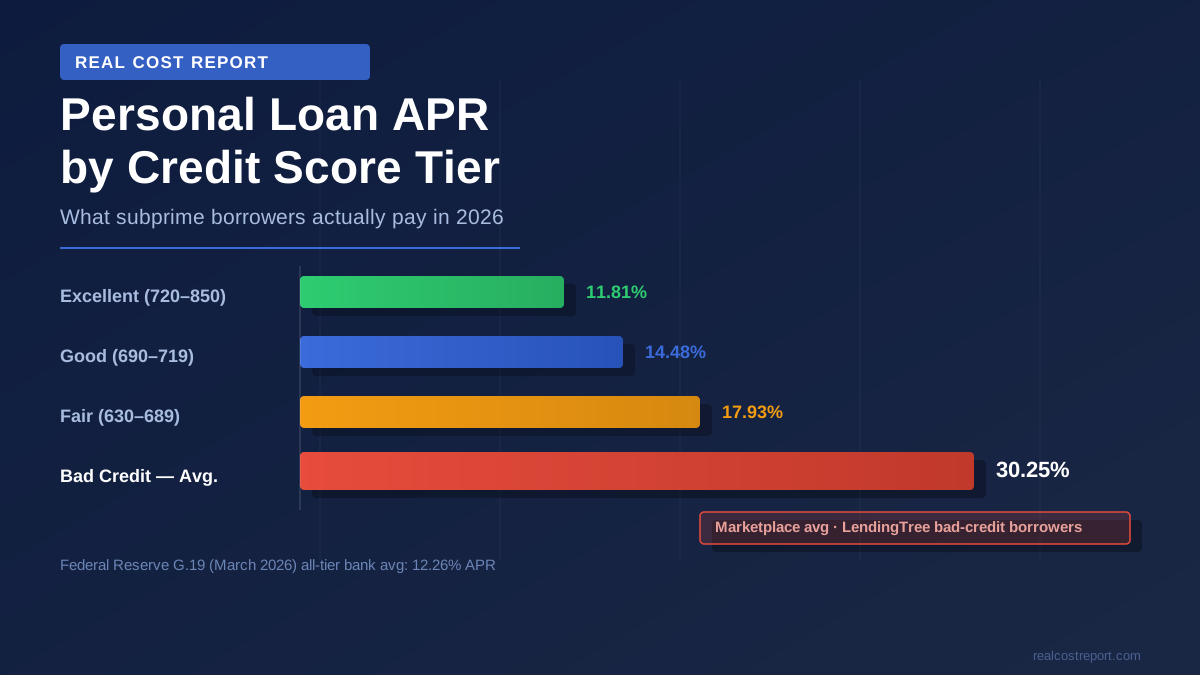
- The average APR for bad-credit personal loan borrowers on the LendingTree marketplace is 30.25% — nearly triple what a prime borrower pays.
- Subprime lenders like OneMain Financial start at 18% APR and top out at 35.99%; Upstart and Avant both cap at 35.99%, with origination fees reaching up to 12%.
- On a $10,000 loan over 60 months at 30.25% APR, total interest paid exceeds $9,100 — more than 90 cents for every dollar borrowed.
- Any APR above 36% crosses into payday-loan territory; avoid lenders advertising “no credit check” loans, which carry annualized rates of 200%–400%.
- A credit score jump from 580 to 640 can cut your quoted rate by 5–8 percentage points at most major online lenders, saving $3,000–$5,000 on a typical $10,000 loan.
- If your score is below 580 and the best rate you’re offered exceeds 32% APR, a credit-builder loan or secured card for 6–12 months will almost always cost less than the loan.
A borrower with a 620 FICO score taking out a $10,000 personal loan today will pay roughly $9,100 in interest over five years — nearly as much again as the original loan. That is not a hypothetical. It is the direct mathematical output of the 30.25% average APR that LendingTree’s marketplace data shows for bad-credit borrowers. Meanwhile, the Federal Reserve’s G.19 release puts the all-tier commercial bank average at 12.26% APR as of March 2026. The gap between those two numbers — 18 percentage points — is what bad credit actually costs you in dollar terms.
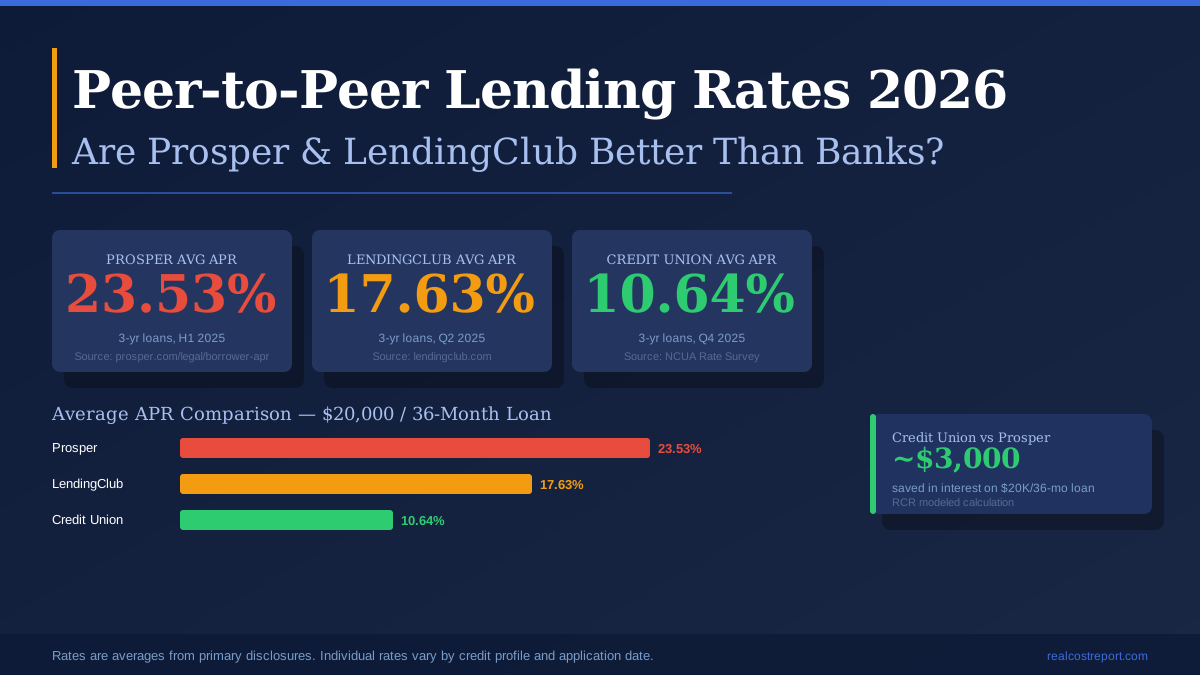
This article cuts through the advertised minimums that lenders splash across their homepages and shows you the APR ranges subprime borrowers actually receive from lenders like Upstart, Avant, OneMain Financial, and LendingClub. It also models the real total cost at different rates, identifies the mistakes that push borrowers into the most expensive tier, and tells you precisely when a personal loan makes sense versus when it will make your financial situation worse.
What Bad Credit Actually Costs: APR Ranges by Credit Score Tier
Advertised APRs are not the rates bad-credit borrowers receive. Almost every lender leads with a minimum rate reserved for applicants with 750+ FICO scores and low debt-to-income ratios. The numbers below reflect what subprime and near-prime borrowers are actually quoted.
According to NerdWallet’s aggregated pre-qualification data from 2024, the average APR offered to borrowers in the “bad credit” tier (scores 300–629) was 21.65% — but that figure only covers lenders with a maximum APR at or below 36%. Lenders with no cap are excluded. In the open market, borrowers in the 580–620 range regularly see quotes of 28%–35.99%, with some online-only lenders clustering right at the 35.99% ceiling.
Source: NerdWallet pre-qualification data (January 1–December 31, 2024); LendingTree marketplace average for bad-credit borrowers (verify at lendingtree.com). Marketplace average reflects $5,000–$54,999 loan amounts, 36–83 month terms.
Rates shown are sample averages. Your actual APR varies by credit score, income, debt-to-income ratio, loan amount, and state. These figures apply only to lenders capping APR at 36% or below.
The 18-point gap between excellent and bad-credit average APRs is not abstract. On a $10,000 loan over 60 months, the excellent-credit borrower at 11.81% pays $2,817 in total interest. The bad-credit borrower at 30.25% pays $9,136. Same loan amount, same term, same lender type — a $6,319 penalty for a lower credit score.
What Subprime Lenders Actually Charge: Upstart vs. Avant vs. OneMain Financial
Not all subprime lenders price the same way. The difference between going to Upstart versus OneMain Financial on a $10,000 loan can easily be $4,000 in total interest paid. Here is how the three most widely used bad-credit lenders actually structure their pricing as of May 2026.
Source: Lender-disclosed APR ranges as of March–May 2026 (verify at upstart.com, avant.com, onemainfinancial.com, lendingclub.com). Origination fees are deducted from loan proceeds before disbursement.
Rates shown are sample averages. Your premium varies by risk profile, state, and insurer.
Upstart’s differentiator is its AI-driven underwriting model, which factors in employment history, education, and income stability alongside credit score. A borrower with a 580 FICO and a stable job in a high-income field may receive a meaningfully lower rate from Upstart than from Avant or OneMain. Upstart’s own representative example (March 2026) shows a $10,000 loan at 21.23% APR with a 7.25% origination fee — so the borrower receives $9,275 in hand but repays against the full $10,000 principal.
OneMain’s floor of 18% APR means even its best-case borrower pays above what federal credit unions are legally permitted to charge as a maximum. That floor exists because OneMain focuses on high-risk, thin-file borrowers and requires a branch visit for large loans. The trade-off: they approve borrowers many online lenders reject outright.
Upstart vs. OneMain Financial: Which Is Better for Borrowers with Bad Credit?
Both lenders serve the subprime market, but they serve different segments of it. The choice between them depends almost entirely on your credit profile, income, and loan purpose.
Source: Lender-disclosed terms (verify at upstart.com, onemainfinancial.com). Secured loan terms vary by state and collateral value. OneMain branch requirement applies to secured loans and certain loan amounts.
Verdict
Choose Upstart if your credit score is below 600 but you have stable employment, a college degree, or a high income — Upstart’s AI model weighs these factors and can produce a better rate than a score-only assessment. Choose OneMain Financial if you need a secured loan option to unlock a lower rate, if you’ve been rejected elsewhere, or if you prefer in-person guidance. For borrowers in the 620–660 range with a verifiable income above $45,000, Avant often splits the difference — lower origination fees than OneMain, more accessible underwriting than traditional banks.
How Subprime Lenders Actually Set Your Rate: What Drives the Range
The single biggest misconception among bad-credit borrowers is that their credit score alone determines their APR. Score matters — but it is one input in a multi-variable model. Understanding what else lenders measure can meaningfully change the rate you’re offered.
Debt-to-income ratio (DTI) is frequently more decisive than score for subprime borrowers. Most lenders prefer a DTI below 36%. Some will lend up to 43%–45%. Above 50%, approval becomes difficult regardless of credit score. A borrower with a 600 FICO and a 28% DTI will often receive a better rate than a 630-score borrower at 45% DTI.
Loan amount and term affect risk pricing directly. Smaller loans (under $5,000) at short terms (24–36 months) typically receive higher APRs on a percentage basis because origination costs are spread over a smaller principal. A $15,000 loan at 36 months will generally produce a lower APR quote than a $3,000 loan at the same term from the same lender.
Collateral changes the equation substantially. OneMain Financial, for example, charges lower APRs on secured loans backed by a vehicle lien versus unsecured loans to the same borrower. If you own a vehicle free and clear, a secured loan from OneMain can reduce your rate by 3–7 percentage points versus an unsecured equivalent.
Employment and income stability carry significant weight at lenders using alternative underwriting (Upstart is the clearest example). A borrower who graduated two years ago and has been employed full-time since graduation may qualify for Upstart’s lower tier despite a thin credit file. Upstart’s representative example from March 2026 — a $10,000 loan at 21.23% APR — reflects a borrower profile that a traditional score-only lender would price at 28%–32%.
State of residence also matters. Origination fees and rate ceilings are governed by state lending laws, and some states impose APR caps that restrict what lenders can charge. California, for instance, caps most personal loans between $2,500 and $10,000 at 36% APR. Other states have no cap at all for licensed non-bank lenders — which is why you’ll see triple-digit APR products operating legally in certain markets.
What Most Bad-Credit Borrowers Get Wrong
The mistakes that push subprime borrowers into the most expensive loan tier are specific and preventable. Each one below has a quantifiable cost.
Mistake 1: Applying without pre-qualifying first. Hard credit inquiries knock 5–10 points off your FICO score each time. A borrower who applies to four lenders sequentially — rather than pre-qualifying through soft pulls — can drop their score enough to move into a higher pricing tier before the process is finished. The correct action: use pre-qualification tools (all major online lenders offer them) to see estimated rates without a hard pull, then submit one formal application to the best offer.
Mistake 2: Ignoring origination fees in the APR comparison. An 8% origination fee on a $10,000 loan means you receive $9,200 but make payments on $10,000. Some borrowers compare interest rates rather than APR — which folds in origination fees — and end up paying more to the lender charging a “lower” rate. Always compare the APR figure disclosed under the Truth in Lending Act (Regulation Z), not the nominal interest rate. The CFPB requires lenders to display this figure prominently on loan disclosures (verify at consumerfinance.gov).
Mistake 3: Borrowing at 30%+ APR to consolidate credit card debt at 24% APR. This is not always wrong — credit cards have variable rates and minimum payment traps — but it is frequently wrong when the borrower does not simultaneously close or freeze the cards. The consequence: within 18 months, many borrowers carry both the personal loan and rebuilt credit card balances, doubling their debt load. The correct action: if consolidating, close or lock the accounts being paid off, and confirm the math shows net interest savings after the origination fee.
Mistake 4: Choosing the longest term to minimize monthly payments. A $10,000 loan at 30.25% APR costs $9,136 in interest over 60 months but only $5,062 in interest over 36 months. The 60-month payment is lower by about $96 per month — but it costs an extra $4,074 in total. For most subprime borrowers, the difference in monthly payment ($340 vs. $436) does not justify nearly doubling the total interest paid. Choose the shortest term your cash flow can absorb.
Mistake 5: Using an installment loan for expenses that will recur. A personal loan has a fixed payoff. Medical costs, home repairs, and car maintenance frequently recur. A borrower who takes a $8,000 personal loan at 29% APR for a medical bill, then faces another $4,000 procedure 18 months later, now carries both a loan balance and a new debt — in a credit position worse than before because of the new hard inquiry and higher utilization. The correct action: for recurring cost categories, build an emergency fund before borrowing, or pursue category-specific financing (medical payment plans, for instance, are frequently interest-free for 12–18 months).
What’s Changed in 2026: Rate Environment and Lender Shifts
The Federal Reserve cut its benchmark rate three times in late 2024 and held steady in January and March 2026, leaving the federal funds target at 3.50%–3.75%. The effect on personal loan rates has been real but modest. According to Federal Reserve G.19 data, the all-tier commercial bank average for personal loans sits at 12.26% APR in March 2026, down from roughly 12.8% in mid-2024. For prime borrowers, rate improvements have been more noticeable — LightStream’s best rate fell from 6.99% to 6.49% over the same period.
For bad-credit borrowers, the rate environment has changed less dramatically. Subprime pricing is driven more by default risk models than by Fed policy, so the 30.25% LendingTree marketplace average for bad-credit borrowers has remained relatively sticky even as prime rates declined. Bankrate’s 2026 forecast projected up to three additional cuts totaling 0.75 percentage points through year-end — but Fed policymakers’ own projections show only one. Subprime borrowers should plan around rates remaining near current levels through at least Q3 2026.
Is a Personal Loan Worth It with Bad Credit? A Conditional Framework
The answer depends entirely on what you are replacing or funding, your realistic repayment capacity, and whether you have alternatives that cost less in total.
A personal loan makes sense for bad-credit borrowers when the APR is below the interest cost of the obligation being replaced. If you carry $8,000 in credit card debt at 24.99% APR and you qualify for a 28% personal loan, the math does not favor the loan on interest alone — but the fixed payoff schedule and no-minimum-payment structure may justify it if the card’s minimum payment cycle would extend repayment by years. Run both scenarios to the final payment date, not the monthly payment amount.
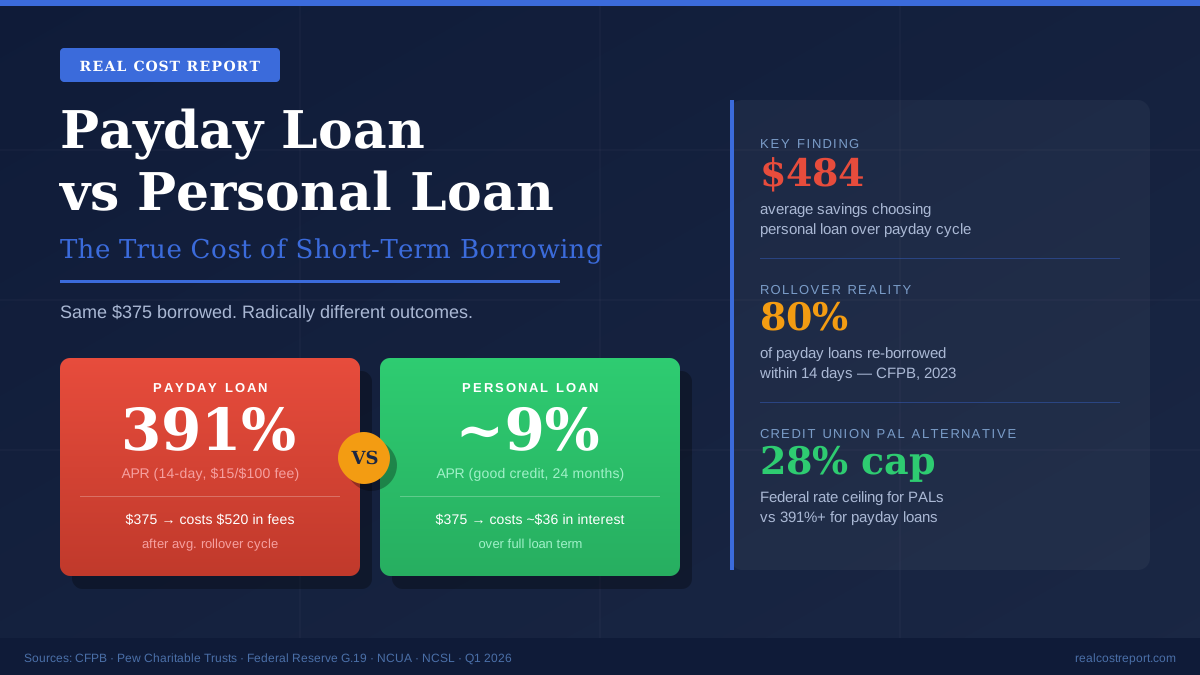
A personal loan does not make sense when your quoted APR exceeds 36%. At that threshold — which represents the practical boundary between subprime installment lending and payday-adjacent products — the total cost of borrowing typically outweighs the benefit for any expense that is not an immediate emergency. The CFPB identifies 36% as the threshold many consumer advocates use to define high-cost loans (verify at consumerfinance.gov).
Consider a personal loan if you meet all of these conditions: your quoted APR is below 35%; your monthly payment fits within your budget without cutting essential expenses; you will use the loan to pay off higher-rate debt or a one-time fixed cost; and you will not re-accumulate the debt you’re paying off. Decline or defer if: your DTI after the new loan exceeds 43%; your credit score is below 550 and you have no employment income growth trajectory; or you cannot pre-qualify at multiple lenders because even soft-pull results show rates above 33%.
What if you can’t qualify at 36% or below?
Two alternatives consistently outperform high-APR personal loans for most borrowers in this position. First, credit-builder loans — offered by credit unions and fintechs like Self — report on-time payments to all three bureaus, improve your score over 12–24 months, and return a portion of your payments as savings at the end. Second, secured credit cards with a $200–$500 deposit give you revolving access to emergency funds at a fraction of the total interest cost of a 30%+ installment loan used for the same purpose. Six to twelve months of on-time payments on either product typically move a 580 FICO score into the 630–660 range — enough to qualify for Avant or LendingClub at rates 8–12 percentage points lower.
How We Researched This Article
This article draws on four categories of primary sources, all accessed in April and May 2026.
Rate benchmarks come from the Federal Reserve G.19 Consumer Credit release (March 2026 print), which provides the average APR on personal loans at commercial banks across all credit tiers. The G.19 rate methodology is described in the release footnotes: rates are simple unweighted averages of each bank’s most common rate charged during the first calendar week of the middle month of each quarter, as defined under Regulation Z.
Credit-tier APR averages are sourced from NerdWallet’s pre-qualification dataset (January 1–December 31, 2024), which aggregates anonymized offer data from borrowers who pre-qualified through NerdWallet’s platform. These figures apply only to lenders with maximum APRs at or below 36% and represent estimated ranges, not guaranteed rates.
The 30.25% bad-credit marketplace average is drawn from LendingTree’s published marketplace data, which reflects anonymized loan inquiries on its platform. LendingTree specifies this figure applies to loan amounts of $5,000–$54,999 with terms of 36–83 months.
Lender-specific APR ranges, origination fees, and credit score requirements were verified against lender-disclosed terms on Upstart, Avant, OneMain Financial, and LendingClub as of March–May 2026. Representative payment examples from Upstart’s website (March 2026) are used in the modeling section and reflect the lender’s own published disclosures, not editorial estimates.
Federal rate environment context draws on Bankrate’s Federal Reserve impact analysis (March 2026), FOMC meeting records, and the Federal Reserve G.19 historical series.
Total interest cost calculations in this article are modeled figures based on standard amortization formulas applied to the APR and term inputs cited. They assume fixed-rate loans with equal monthly payments and no prepayment. State-level variation in origination fees, rate caps, and minimum loan amounts is acknowledged but not modeled in detail; borrowers in California, New York, and other states with active rate cap legislation may see different maximum APRs than those shown. Research was conducted in April–May 2026. All figures were verified against named primary sources before publication.