Include APR disclosure: Rates shown are representative averages from named primary sources. Your actual APR depends on your credit score, debt-to-income ratio, loan amount, lender, and state. Always compare offers from multiple lenders before borrowing.
TL;DR — Quick Verdict
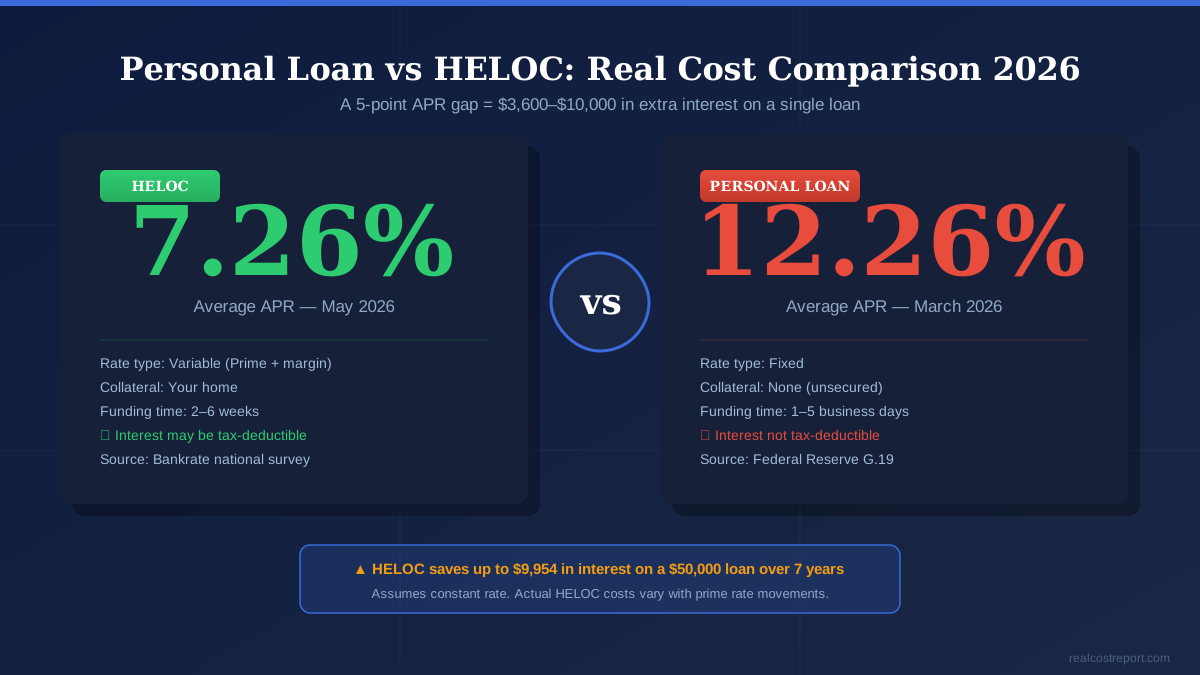
- The average HELOC rate is 7.26% APR (Bankrate, May 2026) versus 12.26% APR for the average personal loan (Federal Reserve G.19, March 2026) — a spread of nearly 5 percentage points.
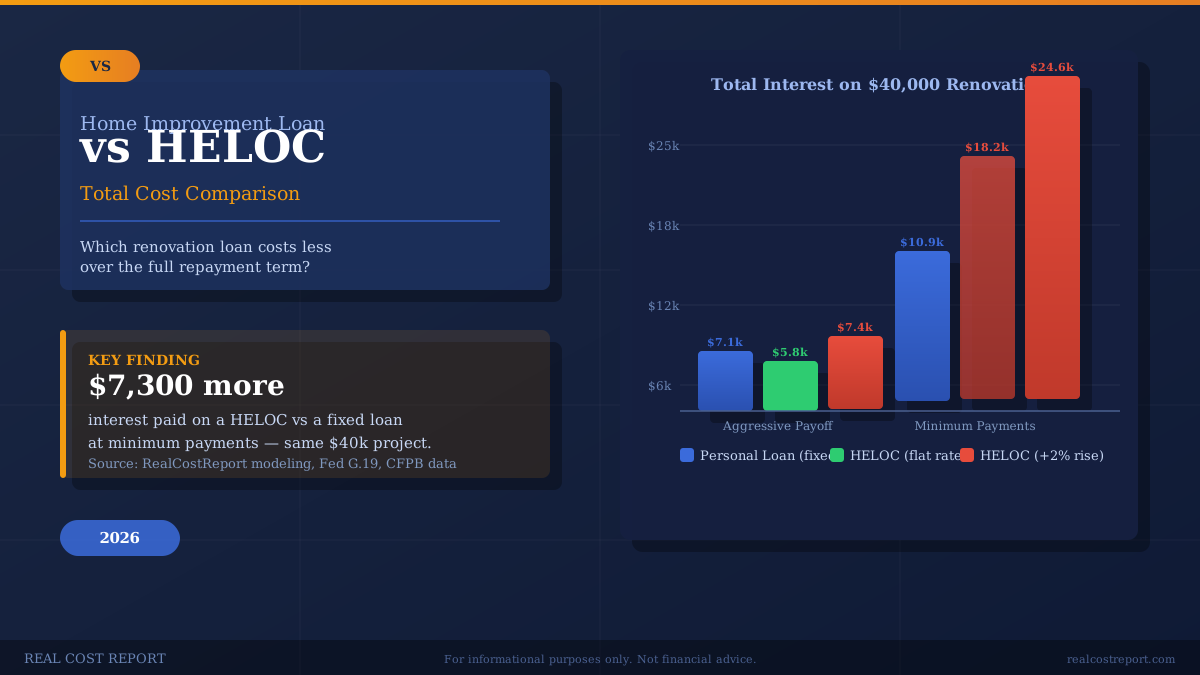
- On a $30,000 loan over 5 years, that rate gap costs you roughly $4,700 more in interest with a personal loan than a HELOC.
- HELOCs win on rate; personal loans win on speed (1–5 days to fund vs. 2–6 weeks), certainty (fixed payments), and safety (no foreclosure risk).
- Borrowers needing more than $25,000 for a planned expense with a 4–8 week runway should strongly consider a HELOC. Borrowers needing funds fast or under $15,000 are usually better served by a personal loan.
- HELOC interest used for qualifying home improvements may be tax-deductible under current IRS rules; personal loan interest never is.
- Bottom line: If you have at least 20% equity in your home and can wait 4–6 weeks, a HELOC will cost materially less. If speed, simplicity, or protecting your home title matters more, a personal loan is the right tool.
The average American homeowner is sitting on more equity than at any point in recorded history — and yet many are still choosing personal loans at 12% APR when a HELOC at 7.26% is available to them. That decision can cost $4,000 to $8,000 in unnecessary interest on a single mid-size borrowing need. According to Bankrate’s national survey of lenders as of May 6, 2026, the average HELOC rate stands at 7.26% APR. The Federal Reserve’s G.19 Consumer Credit release puts the average 24-month personal loan at commercial banks at 12.26% APR as of March 2026. That nearly 5-point gap matters enormously over a 3- to 7-year repayment period.
This article cuts through the generalities. You’ll see the exact dollar-cost difference across three loan-size scenarios, the mechanics of how each product is priced, a direct comparison with a named verdict, the five mistakes borrowers consistently make when choosing between these two products, and a conditional framework for deciding which is right for your specific situation. Lenders like LightStream, SoFi, and Figure operate in both markets — knowing which product to target with each will determine how much you ultimately pay.
Current Personal Loan vs. HELOC Rates: What the Data Actually Shows
The rate picture as of May 2026 is clear. HELOCs are materially cheaper than personal loans for borrowers with decent credit and usable home equity. The full range, however, matters as much as the average.
Sources: Bankrate national HELOC survey (May 6, 2026); Federal Reserve G.19 Consumer Credit release (March 2026); Curinos national average data (May 6, 2026); Credible prequalification data (week ending May 3, 2026); National Credit Union Administration Q4 2025.
Rates shown are representative averages. Your actual APR varies by credit score, loan-to-value ratio, debt-to-income ratio, state, and lender.
Two numbers cut through the noise. The prime rate is currently 6.75%, per the Federal Reserve H.15 release. Most HELOC lenders price at prime plus a margin — if a lender adds 0.75%, you’d land at 7.50%. Personal loan pricing is disconnected from prime; it reflects credit risk, unsecured status, and competitive factors at each lender. That structural difference explains most of the 5-point gap between the two products. Borrowers with FICO scores above 780 and a combined loan-to-value (CLTV) below 70% can access HELOC rates as low as 6.05%, closing the gap with the best personal loan offers. But average borrowers will rarely close it entirely.
What Actually Determines Your Rate on Each Product
The mechanics behind HELOC and personal loan pricing are fundamentally different — and understanding those mechanics tells you exactly which lever to pull to get a better deal.
HELOCs are second-mortgage products priced off the prime rate. When you apply, the lender evaluates three things that matter most: your CLTV ratio (your first mortgage balance plus the HELOC line, divided by appraised value), your credit score, and your debt-to-income ratio. A CLTV below 80% gives you access to the sharpest pricing; most lenders will go up to 85% CLTV, though rates step up beyond 80%. Most lenders require at least 15% to 20% remaining equity after the HELOC is drawn. Because your home serves as collateral, lenders take on less credit risk — and pass some of that benefit to you as a lower rate.
Personal loans are priced entirely on your creditworthiness. There is no collateral to backstop the lender’s risk. Your FICO score, income stability, existing debt load, and the loan’s term length all drive the APR you’ll see. The Federal Reserve G.19 blends all credit tiers together in its 12.26% average; borrowers with excellent credit can beat it substantially, while subprime borrowers may not qualify below 20–36%.
Consider a concrete scenario. Maria is a homeowner in Ohio with a $380,000 home, a $210,000 first mortgage balance, and a 740 FICO score. She wants to borrow $30,000 for a kitchen remodel.
Her CLTV on a $30,000 HELOC would be ($210,000 + $30,000) / $380,000 = 63.2%. That’s well below the 80% threshold, which earns her a rate near the national average — call it 7.50% with one lender’s margin. On a personal loan at her credit tier, she’s looking at 11–14% depending on the lender and term. That’s a minimum 3.5-point spread. Over five years on $30,000, the total interest cost at 7.50% is approximately $6,200 versus approximately $9,000 at 12.00%. Her HELOC saves her roughly $2,800 — before any tax deduction on qualifying home improvement use.
Source: Bankrate HELOC methodology (bankrate.com); Federal Reserve G.19 release; Credible prequalification data Q1 2026.
Personal Loan vs. HELOC: Which Is Cheaper for Your Loan Size?
The rate comparison above tells one story. The total-cost comparison across realistic borrowing scenarios tells a more complete one. The following models use a HELOC rate of 7.26% (Bankrate national average, May 2026) and a personal loan rate of 12.26% (Federal Reserve G.19, March 2026). All personal loan calculations assume a fixed rate over the stated term. HELOC calculations assume the variable rate holds constant throughout — a conservative modeling assumption that may understate HELOC risk if the prime rate rises.
Source: Interest calculations modeled using standard amortization formula. Rates from Federal Reserve G.19 (March 2026) and Bankrate national HELOC survey (May 6, 2026). HELOC assumes full draw at origination and constant rate throughout term — actual HELOC costs will vary with prime rate movements.
At $10,000 over three years, the HELOC saves $861. That’s real but not transformative — the personal loan’s speed advantage and no-collateral benefit may justify the cost difference for some borrowers. At $50,000 over seven years, the HELOC saves nearly $10,000 in interest. That number is hard to ignore.
Verdict
For loan amounts above $25,000 where the borrower has adequate equity and a 4–6 week approval timeline, the HELOC wins on cost — by thousands of dollars. Below $15,000 or when funds are needed within a week, a personal loan wins on practicality, speed, and the fact that your home title stays clean. Neither product is universally superior — borrowing size and timeline are the deciding variables.
What Most Borrowers Get Wrong When Comparing These Two Products
The rate advertised is not the rate paid. And the cheaper product on paper is not always the cheaper product in practice. These are the five specific mistakes that cost homeowners money when choosing between a personal loan and a HELOC.
Mistake 1: Ignoring HELOC closing costs. HELOCs are not free to open. Closing costs range from 2% to 5% of the credit line. On a $30,000 HELOC, that’s $600 to $1,500 in upfront fees — which can eliminate the interest-rate advantage entirely on small, short-term borrowings. The correct action: calculate the break-even point. Divide total closing costs by the monthly interest savings versus a personal loan. If you’ll pay off the HELOC before the break-even, the personal loan is cheaper despite its higher rate.
Mistake 2: Treating the HELOC draw period payment as the full cost. During the 10-year draw period, HELOC minimum payments are typically interest-only. A $30,000 draw at 7.26% costs just $181.50 per month in interest — easy to afford. What many borrowers miss: once the draw period closes, the remaining balance converts to a 20-year repayment schedule, and principal payments begin. A HELOC is effectively a 30-year instrument. Failing to pay down principal during the draw period inflates the total cost significantly. The correct action: treat your HELOC like an amortizing loan from day one and make principal payments during the draw period.
Mistake 3: Not accounting for HELOC rate variability. The Bankrate 7.26% average is today’s rate. HELOCs are priced at prime plus a margin — and the prime rate can move. The Federal Reserve held rates steady at its May 2026 meeting, but two rate hikes would push a 7.26% HELOC to roughly 7.76% or 8.26%. That narrows the savings gap with a fixed-rate personal loan. Borrowers who locked a personal loan at 11% APR two years ago are now sitting in a better position than HELOC holders who assumed rates would keep falling. The correct action: if your personal loan rate is already below 9%, run the total-cost model before refinancing into a variable HELOC.
Mistake 4: Forgetting that the HELOC is a second lien on your home. A personal loan default damages your credit score and can result in a lawsuit or wage garnishment. A HELOC default can result in foreclosure. These are not equivalent risks. Borrowers using a HELOC to fund discretionary spending — vacations, weddings, non-home-improvement purchases — are placing their property at risk for an unsecured purpose. The correct action: use HELOCs for productive, asset-building purposes (home improvements, education, debt consolidation) where the expected benefit justifies the collateral risk.
Mistake 5: Applying for a HELOC with a high combined loan-to-value ratio. Borrowers who took out their first mortgage recently or have limited equity may find HELOC rates are not as competitive as the headlines suggest. At a CLTV of 85%, lenders price risk into the rate — and some won’t lend at all above 85%. The correct action: calculate your CLTV before applying. If it’s above 80%, compare HELOC offers from at least three lenders or consider whether a personal loan at a competitive rate closes the gap.
Who Should Use a HELOC — and Who Should Stick with a Personal Loan?
The decision is not about which product is generically better. It’s about which product fits your specific situation. Here is the conditional logic that drives the right choice.
Choose a HELOC if: You need more than $25,000; you have at least 20% equity in your home after the HELOC draw; your CLTV will stay below 80%; you can wait 4–6 weeks for funding; the funds will be used for qualifying home improvements where IRS interest deductibility may apply (verify current rules at irs.gov under Publication 936); and your income is stable enough to handle variable-rate payment increases without financial stress.
Choose a personal loan if: You need funds within one week; the loan amount is under $15,000 where closing-cost payback periods make HELOC economics marginal; you are uncomfortable placing a second lien on your home; you want rate certainty — a fixed APR from LightStream, SoFi, or a credit union with no variable-rate risk; or you do not own a home or have insufficient equity to qualify for a HELOC at a competitive CLTV.
The gray zone — $15,000 to $25,000: This range deserves a formal total-cost comparison, not a quick rule of thumb. Run two calculations: (1) HELOC total interest at today’s rate plus closing costs, assuming a constant rate, versus (2) personal loan total interest at your quoted APR. The comparison will often favor the HELOC on a 5-year timeline, but if closing costs are high or your rate quote is exceptional, the gap narrows.
Retirees and pre-retirees: If you are over 60, on a fixed income, and hold substantial equity, the variable-rate risk of a HELOC deserves extra scrutiny. A 1-percentage-point rate increase raises your payment — and on a fixed income, payment unpredictability carries real risk. A fixed-rate home equity loan (currently averaging 7.37% nationally per Curinos, May 2026) offers the rate advantage of home equity financing with the payment certainty of a personal loan, and may be the better fit for this segment.
Recent homeowners with limited equity: If you purchased in the last two to three years with a small down payment, your CLTV may be too high for a competitive HELOC rate. Check your current equity position before applying. A personal loan from a credit union — where average rates run 10.72% APR versus the commercial bank average of 12.26% — often represents the most cost-effective unsecured option for this group.
What’s Changed in 2026 That Affects This Decision
Two developments in early 2026 have shifted the calculus between these products. First, the Federal Reserve held rates steady at its May 2026 meeting — the third consecutive hold — citing modest job growth and persistent inflation. That means HELOC rates, which move directly with the prime rate, are not falling further in the near term. The 7.26% average is likely close to the floor absent a material economic slowdown. Borrowers waiting for HELOC rates to drop another 50–75 basis points before opening a line may be waiting longer than expected.
Second, personal loan rates have remained stubbornly high despite the Fed’s three rate cuts in late 2025. The Federal Reserve G.19 shows the average 24-month bank personal loan at 12.26% in March 2026 — down only marginally from 12.65% a year earlier. Bankrate’s 2026 forecast puts the full-year average near 12%, suggesting no dramatic relief. The rate gap between the two products is unlikely to compress significantly in 2026, which means the HELOC savings advantage documented here is likely to persist through the year for qualified homeowners.
How We Researched This Article
Rate data for home equity lines of credit was sourced from Bankrate’s national survey of the ten largest banks and thrifts in ten major U.S. markets, reflecting their published HELOC rate as of May 6, 2026, based on a $30,000 credit line, a 700 FICO score, and an 80% combined loan-to-value ratio. Curinos national average data for HELOC and home equity loan rates was cross-referenced from Yahoo Finance coverage dated May 10, 2026, based on applicants with a minimum FICO score of 780 and a maximum CLTV of 70%.
Personal loan rate data was drawn from the Federal Reserve’s G.19 Consumer Credit release, which publishes average APR for 24-month personal loans at commercial banks as simple unweighted averages of each bank’s most common rate during the first calendar week of the middle month of each quarter. The most recent data point used is March 2026, reported at 12.26%. National Credit Union Administration Q4 2025 data placed credit union personal loan APRs at 10.72% for 24-month terms. Credible prequalification marketplace data for the week ending May 3, 2026, provided a rate range for borrowers with FICO scores of 720 or higher: 13.45% for three-year loans and 17.79% for five-year loans.
The prime rate figure of 6.75% was verified against the Federal Reserve’s H.15 Selected Interest Rates release dated May 8, 2026. Total-interest calculations in the loan-size comparison table were produced using standard amortization arithmetic applied to the stated principal, rate, and term; these are modeled figures, not directly measured. The HELOC scenario assumes a full draw at origination and a constant rate throughout the repayment term, which will not reflect actual experience if the prime rate changes. HELOC closing-cost estimates of 2%–5% were sourced from NerdWallet’s HELOC rate and fee guidance. IRS deductibility references point to Publication 936 under current Tax Cuts and Jobs Act rules; borrowers should confirm current guidance directly with the IRS or a qualified tax professional. Research was conducted in May 2026. Rate data for this category changes frequently; readers should verify current figures before making borrowing decisions.
All figures were verified against named primary sources before publication.