Rates shown are sample averages. Your premium varies by risk profile, state, and insurer.
TL;DR — Quick Verdict
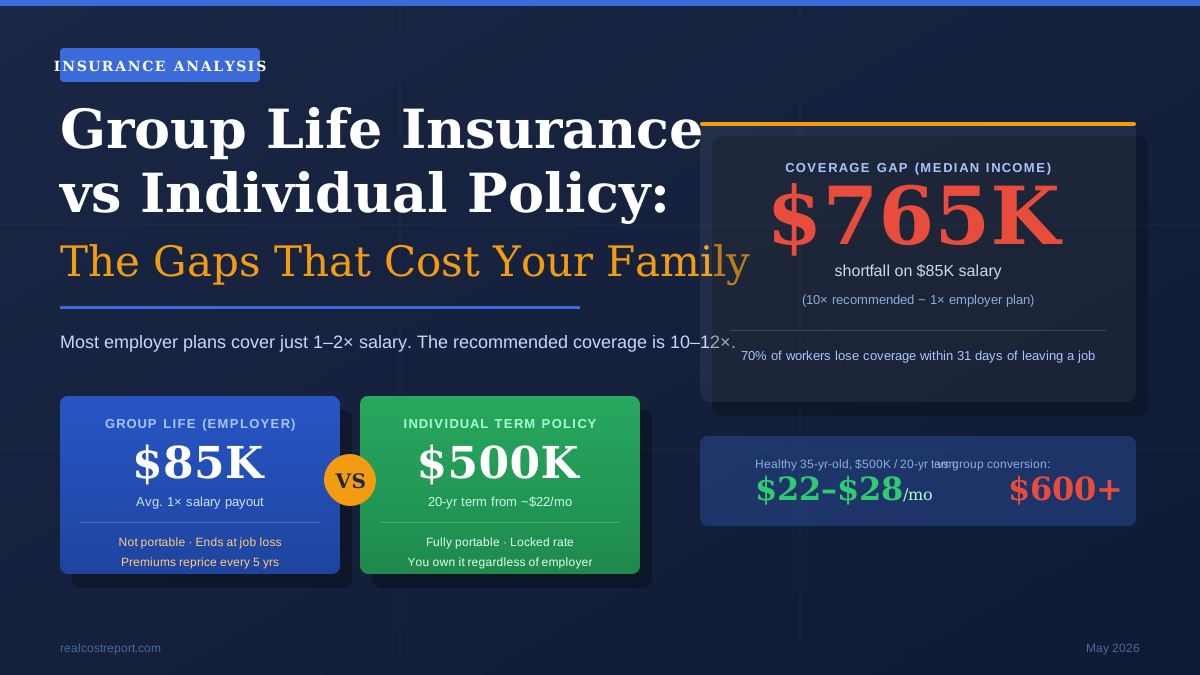
- The average employer group life plan pays 1–2× your annual salary — roughly $60,000–$120,000 — leaving a median-income family $400,000–$900,000 short of the recommended 10× coverage benchmark.
- Group coverage is not portable: 70% of workers who leave a job lose their employer life insurance within 31 days, with conversion options that often cost 2–4× comparable individual rates.
- A healthy 35-year-old can lock in a $500,000, 20-year term policy from carriers like Banner Life or Pacific Life for $22–$28/month — often less than what group conversion costs.
- Group plans offer zero underwriting advantage for healthy applicants; individual policies reward good health with lower lifetime premiums.
- Supplemental group life is rarely the best value: premiums are not guaranteed, coverage caps are low, and portability is still limited.
- Recommendation: Use group life as a free or low-cost baseline, then close the gap with an individual term policy purchased independently — before a health change eliminates your underwriting options.
The average American worker assumes their employer’s life insurance has them covered. It doesn’t — not by a wide margin. The Bureau of Labor Statistics reports that 57% of private-sector workers have access to employer-sponsored group life insurance, yet the typical plan pays out just one to two times annual salary. For a household earning $85,000 a year, that’s an $85,000–$170,000 death benefit against a coverage need that most financial planners, including those at Northwestern Mutual and New York Life, estimate at 10–12 times income. The gap — potentially $750,000 or more — falls on surviving family members at the worst possible moment. This article breaks down exactly what group life insurance covers, where it fails, what individual policies from carriers like Protective Life and Lincoln Financial actually cost, and which approach — or combination — makes financial sense for your specific situation.
What Group Life Insurance Actually Pays: Real Coverage Numbers
Most employer group plans are structured as a flat multiple of base salary — typically 1× or 2× — with a hard dollar cap, often $50,000 or $500,000 depending on employer size and insurer. The IRS complicates matters further: employer-paid group term life coverage above $50,000 generates imputed income, meaning you owe taxes on the premium cost of coverage above that threshold even though you receive no cash.
Here is what typical group life benefit structures look like across employer categories, based on data from the Society for Human Resource Management (SHRM) and Bureau of Labor Statistics (BLS) Employer Cost for Employee Compensation surveys:
Sources: Bureau of Labor Statistics National Compensation Survey (verify at bls.gov); SHRM Benefits Survey (verify at shrm.org); U.S. Office of Personnel Management FEGLI (verify at opm.gov)
The IRS imputed income rule creates a hidden cost many employees overlook. If your employer provides $200,000 in group term life coverage and you earn $85,000 annually, the IRS calculates the cost of the $150,000 above the $50,000 threshold using its Table I rates — at age 40, that adds roughly $270 in taxable income to your W-2 per year. Not catastrophic, but not free either. The IRS Table I rates increase steeply with age: at 60, the same excess coverage generates over $1,800 in imputed income annually (verify at irs.gov, Publication 15-B).
What Individual Life Insurance Costs by Age, Health, and Policy Type
Individual life insurance — primarily term and permanent policies from carriers like Protective Life, Banner Life, Pacific Life, and Transamerica — is priced through full underwriting. That means your actual age, health history, tobacco use, family medical history, BMI, and in many cases a medical exam determine your rate. This cuts both ways: healthy applicants pay substantially less than group conversion rates, while applicants with health issues may pay more or face declination.
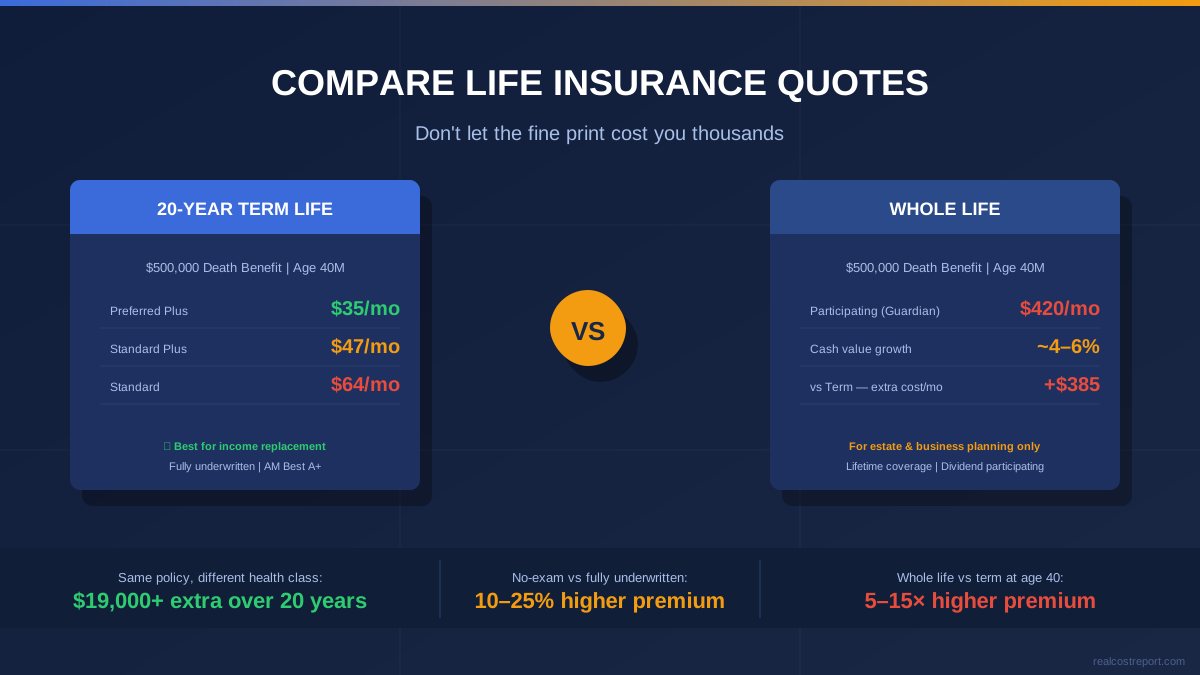
The following sample monthly premiums reflect 2025 published rates for a $500,000, 20-year level term policy for non-smokers in standard or preferred health classes. Rates sourced from carrier rate sheets and aggregated by independent broker platforms including Policygenius and Term4Sale:
Source: Sample rates from Policygenius broker platform and carrier rate sheets — Banner Life, Pacific Life, Protective Life (verify at policygenius.com). Rates reflect 2025 published figures; individual quotes vary. Not a guarantee of coverage or rate.
Rates shown are sample averages. Your premium varies by risk profile, state, and insurer.
What these numbers reveal: a healthy 40-year-old purchasing $500,000 in individual term coverage pays roughly $35–$72 per month — locking in that rate for 20 years regardless of future health changes. Group supplemental life at the same benefit level, by contrast, is typically re-priced in age bands every five years. A 40-year-old paying $18/month in group supplemental premiums today may pay $38/month at 45 and $72/month at 50 — with no guarantee the employer renews the plan at all.
Group Life vs Individual Policy: Which Actually Covers You When It Matters?
The core question is not which policy is cheaper month-to-month. It is which policy pays out when your family needs it most — and which one you still own when that moment arrives.
Sources: NAIC Life Insurance Buyer’s Guide (verify at naic.org); IRS Publication 15-B (verify at irs.gov); Insurance Information Institute (verify at iii.org)
Verdict
For single, debt-free employees early in a career with no dependents: employer group life alone is adequate short-term. For anyone with a mortgage, children, a spouse who depends on their income, or plans to change employers in the next decade, group life is dangerously insufficient as a standalone plan. An individual term policy — purchased while healthy — is the superior long-term instrument. The right answer for most working adults is both: group life as a free supplement, individual policy as the permanent foundation.
The Portability Problem: What Happens to Your Coverage When You Leave
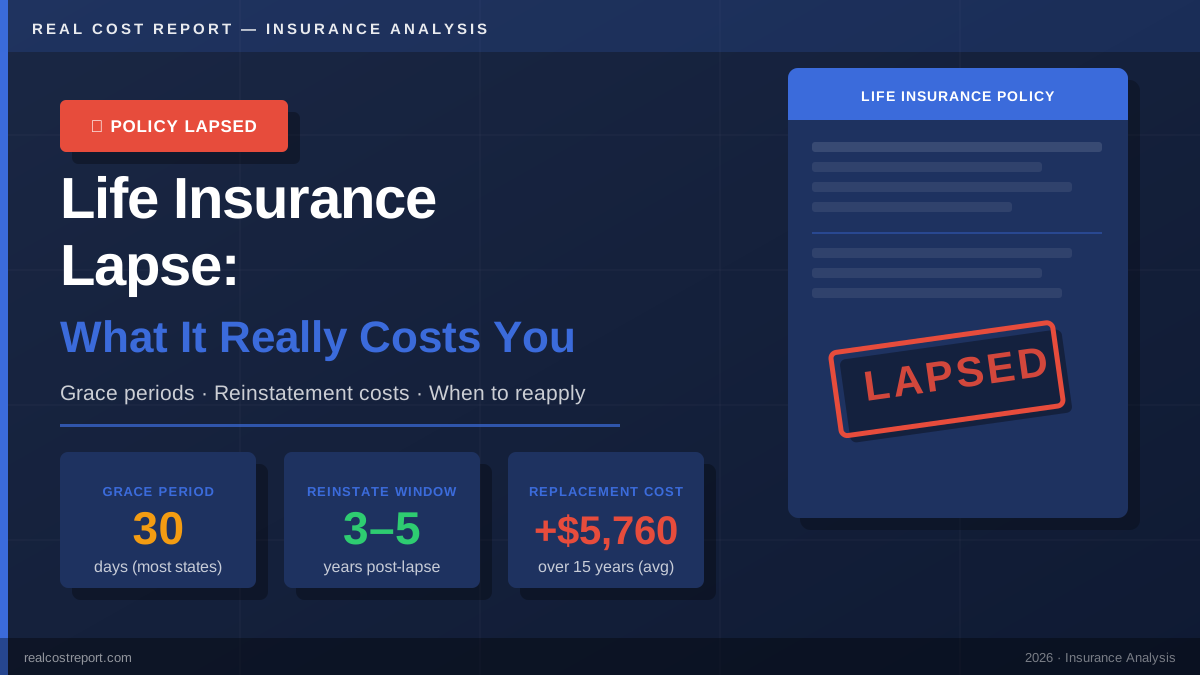
Job transitions expose the single largest structural flaw in employer group life insurance. When you leave an employer — whether voluntarily, through layoff, or retirement — group coverage typically ends within 31 days. Federal law under ERISA does not require employers to offer continuation of group life the way COBRA requires continuation of health coverage. Two options usually exist, and neither is attractive.
Option 1: Conversion to an individual whole life policy. Most group plans allow you to convert to a permanent policy without new underwriting — but only to a whole life product, not term. The premiums are calculated at your attained age using standard rates, with no preferred health discounts. A 45-year-old converting $300,000 in group coverage to a whole life policy could pay $600–$1,100 per month — three to five times what a $300,000, 20-year term policy from Pacific Life or Banner Life would cost with standard underwriting.
Option 2: Portability (where available). Some group plans — particularly those through MetLife and Unum — include a portability feature allowing you to take the term coverage with you. Critically, portability is only available if elected within 31 days of leaving employment, premiums increase with age, and the coverage period is limited. A worker who forgets to elect portability within that window loses all options except conversion.
The math is stark. Consider a 42-year-old software engineer earning $120,000 who relies on a 2× employer group plan for $240,000 in coverage. She leaves for a startup. She has 31 days to act. Conversion to whole life: approximately $850/month. A new $500,000, 20-year term policy through underwriting (if she qualifies): $55–$75/month. The delta — $775–$795 per month — compounded over 20 years represents well over $100,000 in excess premium payments for less coverage, simply because she waited until a job change to think about individual insurance.
The NAIC reports that consumers who purchase individual policies while still employed and healthy consistently pay lower lifetime premiums than those who purchase after a qualifying life event forces the issue. The window to act is before a health change, not after.
What Most People Get Wrong About Employer Life Insurance
Five specific misunderstandings drive the majority of coverage gaps — each with a concrete financial consequence.
Mistake 1: Treating the group plan benefit as a guaranteed number. Many workers assume their $200,000 group death benefit is locked in. It is not. Employers can reduce, restructure, or eliminate group life benefits at open enrollment with no regulatory requirement to maintain prior levels. A company restructuring benefits package in Q4 2025 can legally drop employee coverage from 2× to 1× salary effective January 1. Workers who notice this change after a health event has rendered them uninsurable in the individual market have no recourse.
Mistake 2: Enrolling in supplemental group life without comparing individual market rates. Supplemental group life — the employee-paid add-on coverage — is marketed as a convenient, no-exam option. At ages 35–45 for healthy non-smokers, it frequently costs more than a comparable individual term policy, while remaining non-portable and subject to employer plan changes. A 38-year-old in good health paying $45/month for $300,000 in supplemental group coverage could obtain the same benefit from Protective Life or Transamerica for $28–$38/month individually — with guaranteed level premiums for 20 years and full portability.
Mistake 3: Assuming the group plan covers all causes of death equally. Standard group term life insurance covers most causes of death, including illness. What catches people off guard: accidental death and dismemberment (AD&D) coverage, which many employers bundle into group plans, pays only for accidents. Workers who receive an AD&D certificate alongside their group life documents sometimes confuse the two, believing they have broader coverage than they do.
Mistake 4: Leaving beneficiary designations outdated. Group life beneficiary designations are held by the employer’s plan administrator — not by the insurer directly. They do not automatically update when you marry, divorce, or have children. Federal law (ERISA) governs most private employer plans, and under certain interpretations a named ex-spouse can supersede a will. The beneficiary on file with the plan administrator at death controls the payout — regardless of intent or subsequent life changes.
Mistake 5: Waiting until retirement to assess the gap. Many workers plan to purchase individual life insurance “when things settle down” — after the mortgage is paid, after the kids finish college. By 55 or 60, the cost of a 20-year term policy has increased 150–300% relative to what it would have cost at 35. More critically, any health change that occurred in the interim — hypertension, diabetes, cancer diagnosis — can result in rated premiums or declination. The correct time to buy individual coverage is the first year of full-time employment with dependents, not the year before retirement.
Is Supplemental Group Life Worth It? A Scenario Analysis by Age and Health
Supplemental group life divides into two distinct value propositions depending on your health and age at enrollment.
When supplemental group life makes sense: If you have a significant health history — controlled diabetes, a past cancer diagnosis within five years, or cardiovascular disease — guaranteed-issue supplemental group life may be your only access to meaningful coverage without individual underwriting. Guaranteed issue limits vary by plan but typically run $100,000–$300,000. For this population, supplemental group is valuable precisely because it bypasses the underwriting that would result in rated premiums or declination in the individual market.
When it does not make sense: Healthy adults under 50 who qualify for preferred or preferred-plus rates in the individual market are overpaying for supplemental group life in most cases. Consider a 40-year-old in preferred health seeking $400,000 in additional coverage. Supplemental group at a mid-size employer might run $32–$48/month for that amount in the 40–44 age band — then re-price to $55–$75/month at 45. An individual 20-year term policy for $400,000 at the same age runs $35–$55/month and stays flat until 60. The individual policy wins on lifetime cost, wins on portability, and wins on rate certainty.
One scenario where the math genuinely favors supplemental group: open enrollment guaranteed-issue windows, particularly during the first 30 days of employment. These windows allow enrollment without evidence of insurability up to a guaranteed amount (typically 3–5× salary). For workers who have had a recent health event and cannot yet qualify for individual preferred rates, this window represents a legitimate opportunity to layer on low-underwriting coverage at group rates before individual options are reassessed.
Bottom Line on Supplemental Group
For healthy adults under 50: shop individual term first. Supplemental group is a fallback, not a first choice. For adults with meaningful health history or those in a guaranteed-issue window: supplemental group is a legitimate and often necessary coverage layer. Never use either supplemental group or individual policy in isolation — build a layered plan that accounts for what happens if you change jobs, develop a health condition, or outlive your term.
How We Researched This Article
This article draws on multiple primary sources to construct an accurate picture of group and individual life insurance costs and coverage structures as of 2025–2026.
Coverage structure data and employer benefit prevalence figures were sourced from the Bureau of Labor Statistics National Compensation Survey, specifically the Employee Benefits in the United States tables published for 2024. The BLS NCS covers both private-sector and state and local government workers across benefit types, including life insurance incidence rates and employer cost contributions.
Individual term life premium ranges were compiled from published rate schedules aggregated by the Policygenius independent broker platform and cross-referenced against direct carrier rate sheets from Banner Life, Pacific Life, Protective Life, and Transamerica for the 2025 policy year. Rates reflect non-smoker applicants at standard and preferred health classifications in a non-rated state (Texas used as reference). Actual rates vary by state, underwriting outcome, and carrier.
IRS imputed income calculations reference IRS Publication 15-B (Employer’s Tax Guide to Fringe Benefits), Table I — Uniform Premiums for $1,000 of Group-Term Life Insurance Protection. Federal FEGLI benefit structure data was sourced from the U.S. Office of Personnel Management (verify at opm.gov). NAIC guidance on group life portability and conversion rights was sourced from the NAIC Life Insurance Buyer’s Guide (verify at naic.org).
ERISA beneficiary designation precedent references Department of Labor guidance on qualified plan beneficiary rules (verify at dol.gov). Supplemental group premium estimates are modeled from representative employer benefits guides from MetLife and Unum made publicly available through employer benefits portals; these are illustrative and not carrier-guaranteed quotes.
All premium figures reflect 2025 published rates. Individual quotes will vary based on underwriting, state of residence, and carrier filing. Research for this article was last conducted in May 2026. The article covers the contiguous United States; rates and regulatory rules differ in Alaska and Hawaii. All figures were verified against named primary sources before publication.