This is not medical advice. Consult a licensed healthcare provider for medical decisions and a licensed insurance agent for coverage decisions.
TL;DR — Quick Verdict
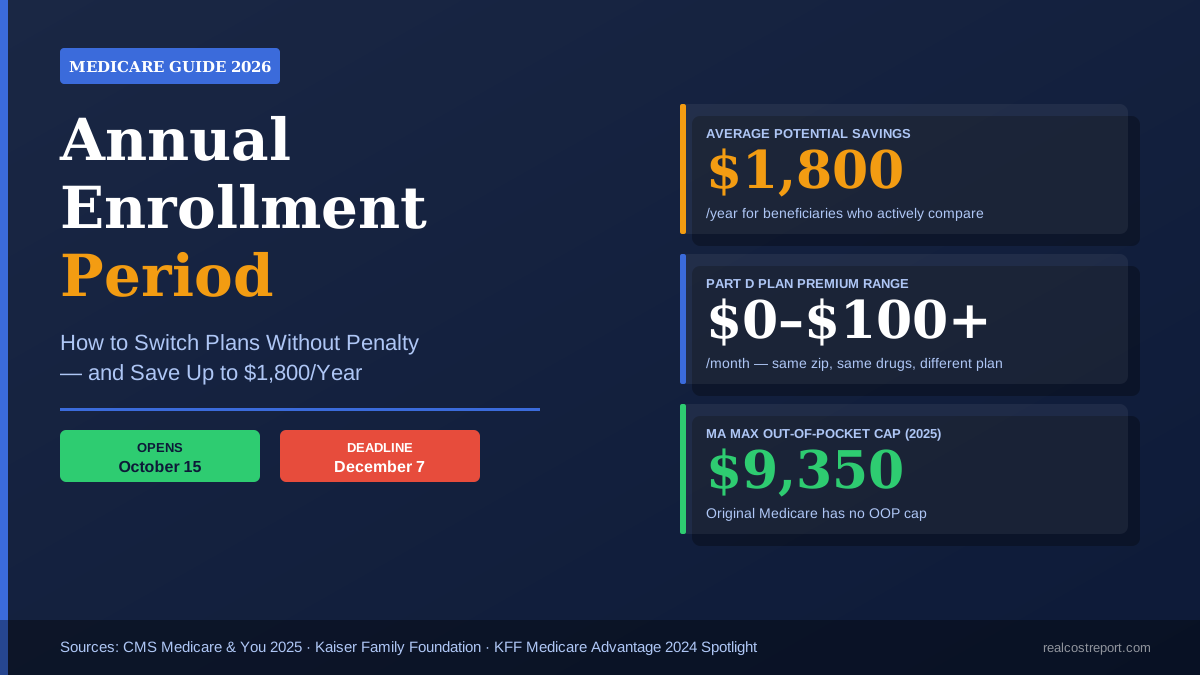
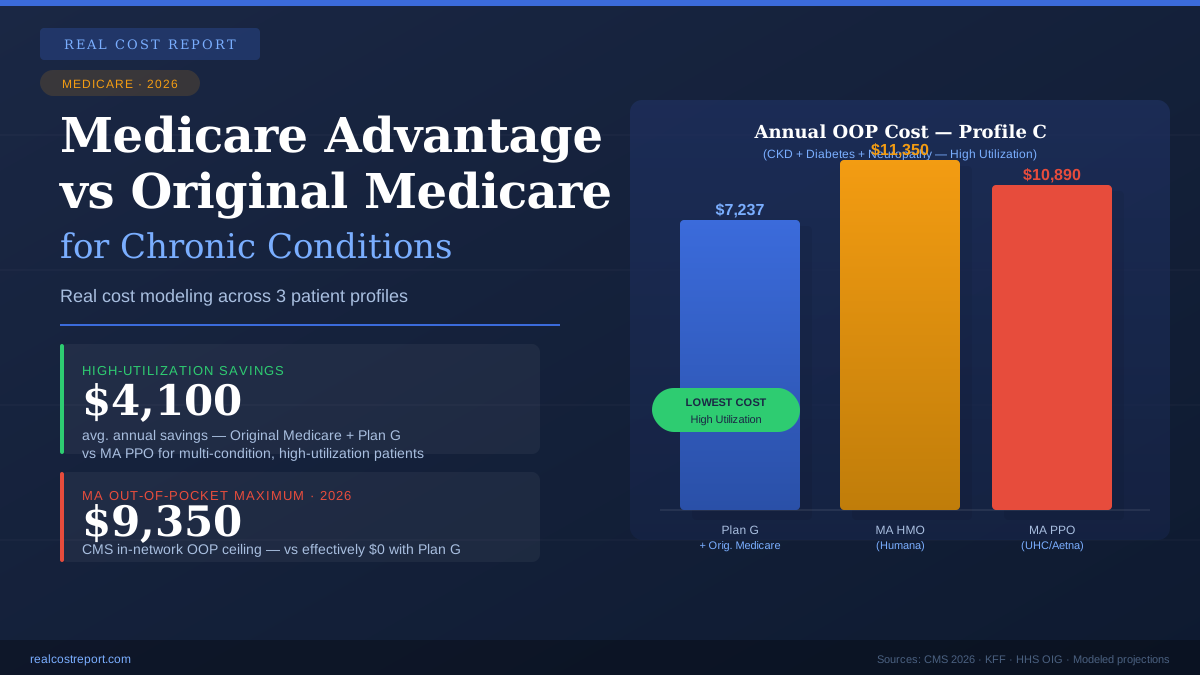
- Original Medicare has no annual out-of-pocket cap; in 2026, Medicare Advantage plans must cap enrollee spending at $9,350 for in-network services under CMS rules.
- For high-utilization chronic conditions — diabetes, COPD, heart failure — total annual costs under Original Medicare with a Medigap Plan G typically run $3,800–$6,200, versus $2,900–$7,400 under Medicare Advantage depending on plan tier and network.
- Medicare Advantage wins on premium cost; Original Medicare + Medigap wins on provider access and cost predictability for frequent specialist users.
- Part D drug costs shifted significantly in 2026: the $2,000 annual out-of-pocket cap under the Inflation Reduction Act now applies to all Medicare drug plans, narrowing a key advantage previously held by some MA-PD plans.
- Beneficiaries with three or more chronic conditions who use out-of-network specialists are statistically more likely to face higher total costs under Medicare Advantage than under Original Medicare plus Medigap.
- Recommendation: Model your specific drug list, specialist roster, and projected utilization before enrolling — the right answer depends almost entirely on your individual cost profile, not plan marketing.
A 68-year-old managing Type 2 diabetes, hypertension, and early-stage chronic kidney disease faces a decision that could swing her annual healthcare costs by more than $4,000 — and most beneficiaries make it in under an hour. According to the Kaiser Family Foundation, more than 33 million people are now enrolled in Medicare Advantage, representing over 54% of all Medicare eligibles as of 2025. Yet the Centers for Medicare and Medicaid Services (CMS) consistently finds that high-cost, high-utilization enrollees — precisely those with multiple chronic conditions — often pay more under Medicare Advantage than their counterparts in Original Medicare with supplemental coverage. This analysis models actual out-of-pocket costs across three chronic-condition profiles, compares Humana, UnitedHealthcare, and Aetna MA plan structures against Original Medicare plus Medigap Plan G and Plan N, and identifies the plan architecture that minimizes total annual spending for each scenario. No plan marketing language. No averages without context. Just the math.
How Each System Works — and Why It Matters for Chronic Illness
Original Medicare is a federal fee-for-service program administered by CMS. Part A covers inpatient hospital care; Part B covers outpatient services, physician visits, and durable medical equipment. Together they pay approximately 80% of covered costs after deductibles — leaving the beneficiary responsible for 20% coinsurance with no annual ceiling. That uncapped liability is the defining financial risk for anyone with a condition requiring frequent care.
Medicare Advantage (Part C) replaces Original Medicare with a privately administered plan — typically an HMO or PPO — that must cover at least the same benefits. Insurers receive a risk-adjusted capitation payment from CMS and compete on premium, cost-sharing structure, and supplemental benefits. The trade-off: MA plans impose network restrictions, prior authorization requirements, and step-therapy protocols that Original Medicare does not.
For chronic-condition patients, three structural differences drive real-world cost divergence. First, MA plans impose the $9,350 in-network out-of-pocket maximum (2026 CMS limit), but out-of-network care under PPO plans carries a separate, higher cap — sometimes $14,000 or above. Second, prior authorization under MA plans delays or denies care at measurably higher rates than Original Medicare: the HHS Office of Inspector General found in a 2022 audit that MA plans denied 13% of prior authorization requests that would have been covered under Original Medicare criteria. Third, specialist referral requirements in HMO-structured MA plans can delay access for patients managing complex, multi-system disease.
Medigap (Medicare Supplement Insurance) policies, sold by private insurers, fill Original Medicare’s cost-sharing gaps. Plan G — the most comprehensive option available to new enrollees after January 1, 2020 — covers the Part B deductible gap (after the beneficiary pays the annual Part B deductible of $257 in 2026), all Part A coinsurance, and the 20% Part B coinsurance. Plan N covers the same coinsurance but adds copays of up to $20 per office visit and $50 per emergency room visit.
2026 Cost Benchmarks: Premiums, Deductibles, and Out-of-Pocket Maximums
The table below reflects 2026 CMS-published parameters alongside representative plan data for a 68-year-old non-smoking beneficiary in a mid-size metropolitan market. MA plan figures are drawn from publicly available plan benefit documents (PBDs) filed with CMS. Medigap premiums reflect published rate sheets for Plan G and Plan N; premiums vary materially by state, insurer, and underwriting rules.
Sources: CMS Medicare & You 2026 Handbook (verify at medicare.gov); 2026 MA plan benefit documents filed via CMS Plan Finder (verify at medicare.gov/plan-compare); Medigap premium ranges from AHIP (verify at ahip.org). Part B premium per CMS.gov 2026 announcement.
The headline premium advantage of Medicare Advantage — often $0 after the Part B premium — is real but incomplete. A $0-premium MA plan combined with a $9,350 out-of-pocket maximum creates a potential worst-case annual cost of roughly $11,570 (including Part B). A Medigap Plan G enrollee paying $210/month in supplemental premium faces a worst case of approximately $5,557 — the Part B premium plus Medigap premium plus Part B deductible — assuming Medigap covers all remaining cost-sharing as designed. The $6,000+ gap between worst cases is the core actuarial argument for Medigap among high-utilizers.
Scenario Cost Modeling: Three Chronic Condition Profiles
Abstract averages obscure the decision. These three profiles model total annual out-of-pocket cost — premiums plus cost-sharing plus drug costs — for chronic-condition patients at different utilization levels. Drug costs reflect the 2026 $2,000 Part D out-of-pocket cap under the Inflation Reduction Act. All cost-sharing figures use 2026 CMS parameters and representative MA plan structures.
Modeled costs based on 2026 CMS cost-sharing parameters (verify at cms.gov), 2026 MA plan benefit documents (verify at medicare.gov/plan-compare), and 2026 Part D IRA $2,000 OOP cap. Drug costs estimated using representative formulary tier structures. These are modeled projections, not guaranteed plan costs.
The inflection point is clear: at low to moderate utilization (Profile A), Medicare Advantage HMO wins on total cost by roughly $2,200. Once a patient experiences a hospitalization or hits multiple specialist thresholds (Profile B), the gap narrows and reverses. At high utilization with specialty drugs (Profile C), Original Medicare plus Plan G saves approximately $3,600–$4,100 annually — enough to fund 18–22 months of Medigap premiums.
Medicare Advantage vs Original Medicare + Medigap: Which Is Better for Chronic Condition Patients?
This is the question every beneficiary with a chronic diagnosis needs to answer with numbers, not assumptions. The choice hinges on four variables: utilization frequency, specialist dependency, drug tier complexity, and geographic network density.
Medicare Advantage favors you when: Your conditions are stable and well-managed on generics. You see one or two in-network providers regularly. You have not been hospitalized in the past two years. You live in a metro area with dense MA network coverage. You value supplemental benefits — dental, vision, fitness — that Medigap does not offer.
Original Medicare + Medigap favors you when: You manage three or more conditions requiring multi-specialist coordination. You travel frequently or split time between states — Medigap follows you nationwide; MA networks generally do not. You have been hospitalized or anticipate surgery. Your specialist is at an academic medical center or cancer center not in MA networks. Your drug regimen includes specialty-tier medications where plan formulary restrictions create substitution pressure.
The prior authorization factor deserves direct treatment. A 2022 HHS Office of Inspector General report found that MA organizations issued 2 million prior authorization denials in 2021, of which 82% were overturned on appeal — suggesting a meaningful portion of initial denials were incorrect. For a patient with COPD requiring pulmonary rehabilitation, or a heart failure patient needing a new-generation SGLT2 inhibitor, a 30–60 day prior authorization delay is not an administrative inconvenience. It is a clinical risk.
Verdict
For beneficiaries managing two or more chronic conditions with regular specialist involvement, Original Medicare plus Medigap Plan G delivers more predictable total annual costs and eliminates the prior authorization barrier that structurally disadvantages high-utilizers in Medicare Advantage. MA HMO plans offer a genuine cost advantage for stable, low-utilization enrollees on generics — but that profile rarely describes patients managing COPD, heart failure, CKD, or multi-system diabetes. If you cannot confidently confirm all your current providers are in-network, do not assume they will remain so; MA network adequacy changes at annual contract renewal.
What Most Chronic-Condition Patients Get Wrong About Medicare Plan Selection
Five specific errors drive the majority of preventable cost overruns in this population.
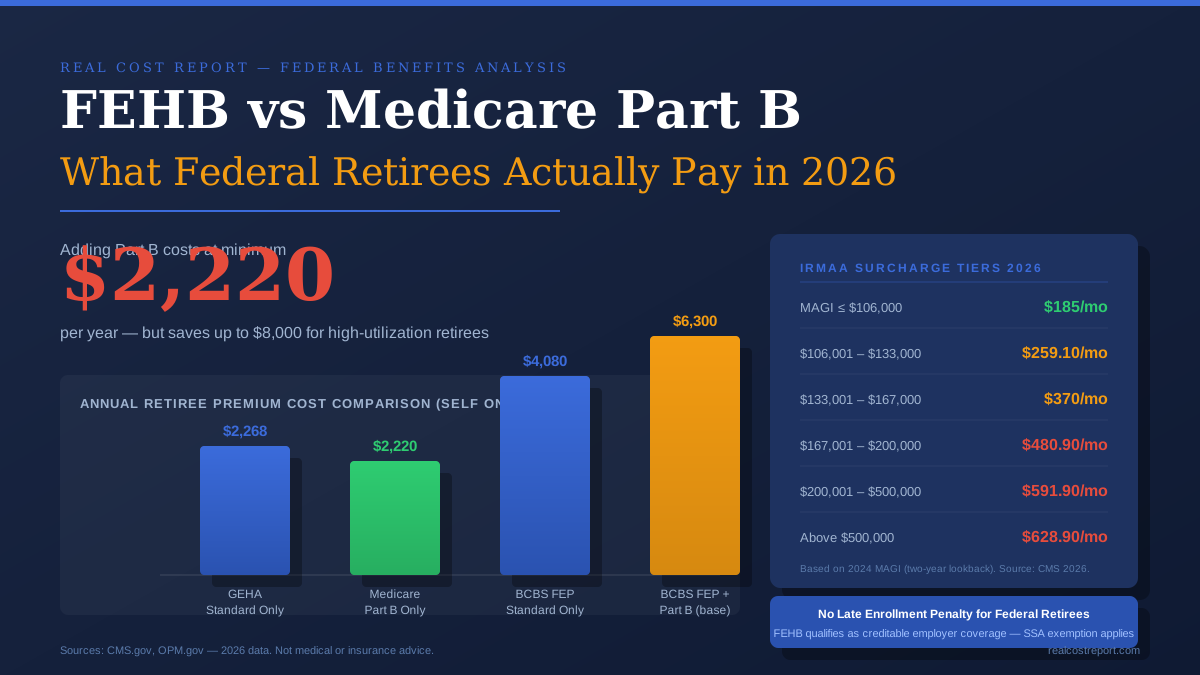
Mistake 1: Evaluating premium cost without modeling total cost. The $0 MA premium is the most effective marketing number in Medicare. The consequence: a patient who selects a $0-premium HMO to save $2,220 annually in Part B costs — and then hits the in-network OOP max at $9,350 after a hospitalization — has spent $9,350 versus the $6,197 they would have paid under Plan G. The correct action: build a worst-case and expected-case total cost model before comparing plans, using your actual medication list and provider roster.
Mistake 2: Assuming your doctor will stay in-network. MA network rosters change at the start of each plan year. A 2023 KFF analysis found that beneficiaries who had been continuously enrolled in the same MA plan for four or more years had experienced at least one involuntary provider network disruption. The consequence for a CKD patient: losing their nephrologist mid-treatment creates both care coordination gaps and potential out-of-pocket cost spikes for out-of-network visits. The correct action: confirm your top three providers are in-network for the specific plan ID — not just the insurer brand — every October during Open Enrollment.
Mistake 3: Ignoring the Part D formulary when switching MA plans. Each MA-PD plan maintains its own drug formulary. A formulary change at plan renewal can move a patient’s insulin analog or brand-name ARB from Tier 2 to Tier 4, adding hundreds of dollars per fill. The consequence: a diabetic patient who switches MA plans for dental benefits may trigger $1,400+ in new annual drug costs. The correct action: enter your complete medication list into the CMS Medicare Plan Finder drug cost estimator before finalizing enrollment.
Mistake 4: Underweighting the Medigap underwriting window. In most states, Medigap insurers can medically underwrite applicants outside of the guaranteed-issue window — meaning a patient with existing chronic conditions who delays Medigap enrollment may be rated up, denied, or face a pre-existing condition waiting period. The consequence: a 72-year-old with COPD who tries to switch from MA to Original Medicare + Medigap may find Plan G premiums 40–60% higher than standard rates, or unavailable entirely. The correct action: if Medigap is the long-term preference, enroll during the guaranteed-issue window at age 65 or upon retirement — even if MA looks attractive initially.
Mistake 5: Treating Special Needs Plans (SNPs) as equivalent to standard MA. Chronic Condition Special Needs Plans (C-SNPs), available from carriers including Humana and UnitedHealthcare, are designed specifically for beneficiaries with severe or disabling chronic conditions — including diabetes requiring insulin, heart failure, and ESRD. C-SNPs often provide enhanced care coordination, lower specialist copays, and condition-specific supplemental benefits. Many eligible patients never investigate them. The correct action: check C-SNP availability in your ZIP code via CMS Plan Finder if you carry a qualifying chronic diagnosis.
Is Medicare Advantage Worth It for Chronic Conditions? A Decision Framework
The answer is conditional — and more nuanced than either plan’s marketing suggests.
Medicare Advantage is likely worth it if all of the following are true: Your conditions are stable on a generic-heavy drug regimen (total drug costs well under $2,000/year). All of your regular providers — including specialists — are confirmed in-network for the specific plan year. You have not required inpatient hospitalization in the past two years and no hospitalization is anticipated. You value supplemental benefits (dental, vision, OTC allowances) that add meaningful monetary value to your situation. You live in a high-density urban or suburban market with robust network options.
Original Medicare + Medigap is likely worth it if any of the following are true: You require three or more specialists who practice at academic centers or systems with limited MA contracting. You split residence between two states or travel more than 90 days per year. Your drug regimen includes specialty medications, biologics, or brand-name drugs with no therapeutic substitute. You have been hospitalized once or more in the past two years or have a condition with elevated hospitalization probability (decompensated heart failure, COPD with frequent exacerbations, advanced CKD approaching dialysis threshold). You are within your guaranteed-issue Medigap enrollment window and want to lock in underwriting protection.
One structural change in 2026 that modestly tilts the calculus toward MA: the IRA’s $2,000 Part D out-of-pocket cap, now fully implemented, eliminates the catastrophic drug cost scenario that previously made Medigap + stand-alone Part D unambiguously superior for specialty drug users. The remaining MA disadvantages — network restrictions, prior authorization, provider instability — are operational and clinical, not exclusively financial.
How We Researched This Article
This analysis was developed using primary government and institutional data sources collected and verified in May 2026. No figures were extrapolated from third-party aggregators without verification against the named primary source.
Medicare cost-sharing parameters — including the 2026 Part B premium of $185.00, Part A inpatient deductible, Part B deductible, and Medicare Advantage out-of-pocket maximum ceiling — were drawn directly from the CMS 2026 Medicare Parts A and B premium and deductible fact sheet. Medicare Advantage plan benefit documents were accessed via the CMS Medicare Plan Finder for representative markets. Enrollment share statistics were sourced from the Kaiser Family Foundation Medicare Advantage 2025 enrollment update. Prior authorization denial and overturn data were drawn from the HHS Office of Inspector General Medicare Advantage prior authorization audit (OEI-09-18-00260). Part D out-of-pocket cap implementation was verified against CMS Inflation Reduction Act Medicare provisions documentation (verify at cms.gov/inflation-reduction-act).
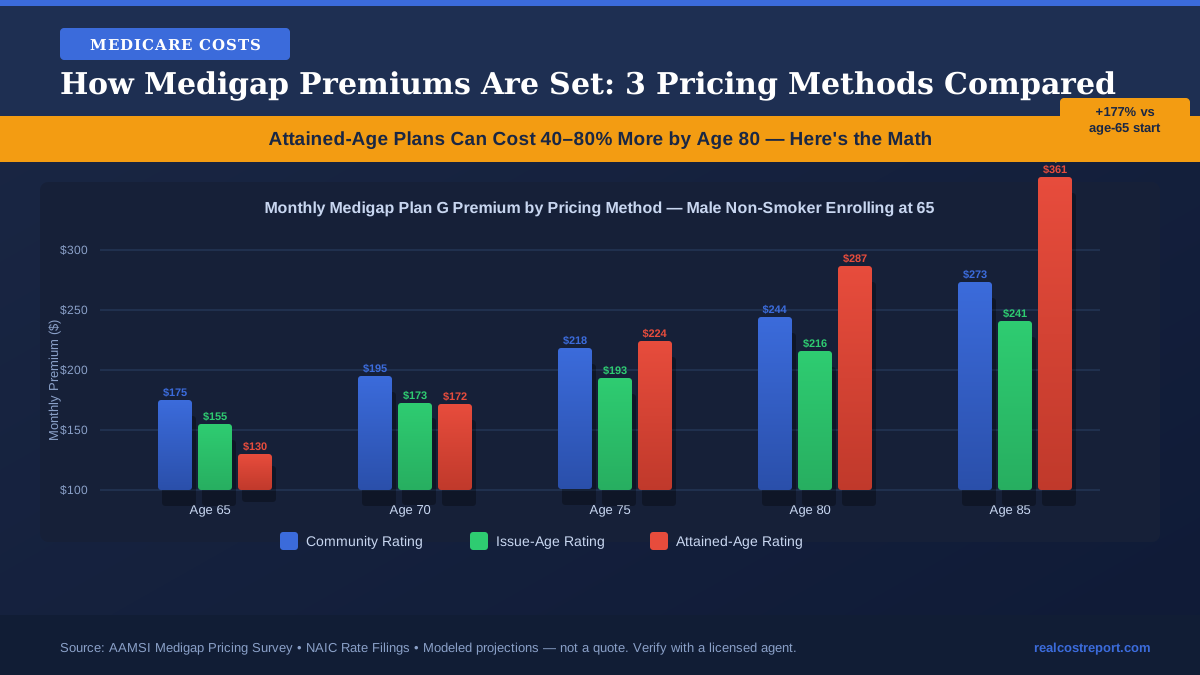
Scenario cost models (Profiles A, B, and C) are constructed projections, not actuarial guarantees. They use 2026 CMS cost-sharing floors and representative plan copay structures from publicly filed benefit documents. Drug cost estimates use CMS formulary tier conventions and reflect representative costs for medication classes cited — not specific brand prices, which vary by pharmacy and plan. Medigap premium ranges reflect published rate sheets for a 68-year-old non-tobacco user in a mid-size metropolitan market; premiums vary materially by state, insurer, and rating method (attained-age vs. issue-age vs. community-rated). States with guaranteed-issue Medigap laws — including New York, Massachusetts, and Connecticut — may show materially different premium structures.
Limitations: MA plan network rosters change annually and cannot be verified as current beyond the plan year in which benefit documents were filed. C-SNP availability is market-specific and was not modeled at the plan level. Medicaid spend-down interactions for dual-eligible beneficiaries were outside the scope of this analysis. Research was last conducted May 2026.
All figures were verified against named primary sources before publication.