This is not medical advice. Consult a licensed healthcare provider for medical decisions and a licensed insurance agent for coverage decisions.
TL;DR — Quick Verdict
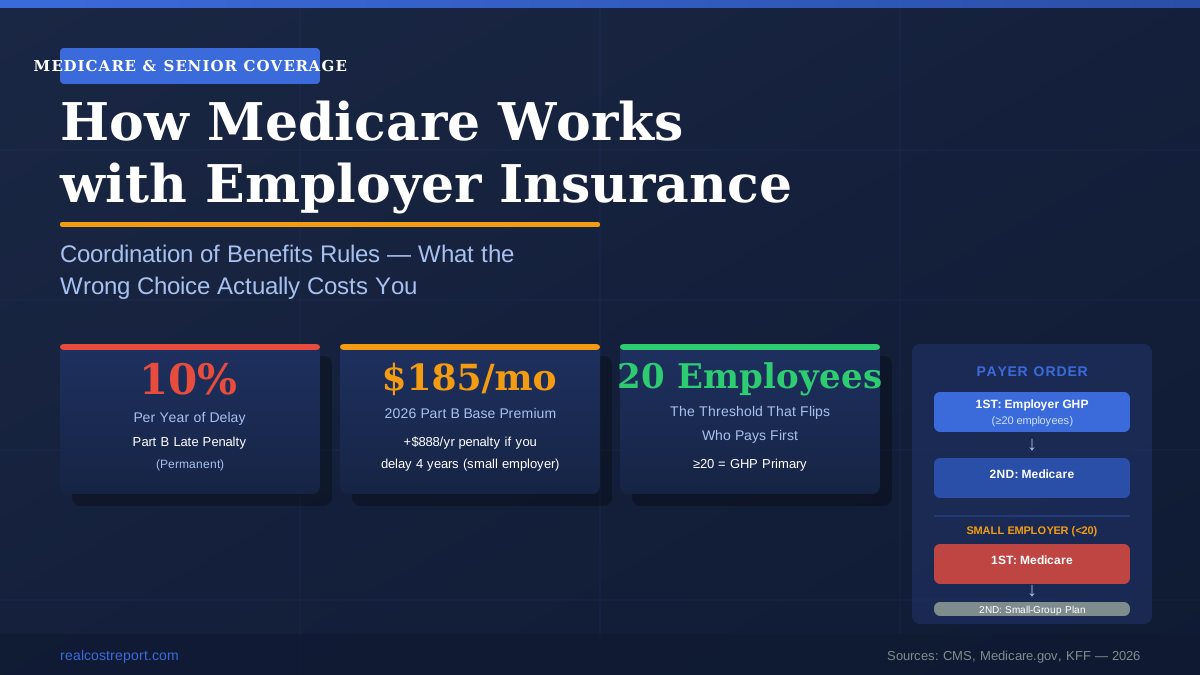
- Which plan pays first depends entirely on employer size: companies with 20+ employees make employer insurance primary; smaller employers make Medicare primary.
- Enrolling in Medicare Part B late when you have small-employer coverage triggers a permanent 10% penalty per year of delay — a $21+ monthly surcharge that never goes away.
- Workers at firms with 20+ employees can safely delay Part B with zero penalty, but must enroll within 8 months of losing that coverage or face the same lifetime penalty.
- Medicare Secondary Payer (MSP) rules, enforced by CMS, can force repayment of claims Medicare paid when employer insurance was legally primary — retroactively.
- IRMAA income thresholds can add $594–$2,100+ annually to Part B premiums on top of the base $185/month (2026 estimate), making the dual-coverage math critical.
- Recommendation: Anyone within 3 years of 65 should get a written Coordination of Benefits analysis from a SHIP counselor (free) before making any enrollment decision.
Every year, roughly 20 million Americans aged 65 and older remain on employer-sponsored health insurance, according to the Kaiser Family Foundation. A significant share of them are making a coordination-of-benefits error that will cost them thousands of dollars — either in retroactive claim denials, avoidable late-enrollment penalties, or redundant premiums on coverage they don’t need. The rules governing how Medicare and employer insurance interact are called Medicare Secondary Payer (MSP) provisions, and the Centers for Medicare & Medicaid Services (CMS) enforces them aggressively, including demanding repayment when claims were paid out of order. This article walks through the exact payer-order rules, the real dollar cost of getting it wrong, a head-to-head comparison of delaying vs. enrolling in Part B, and the specific scenarios where dual coverage actually delivers value. Data is drawn from CMS, Medicare.gov, and the Kaiser Family Foundation — not insurance company marketing materials.
The Employer-Size Rule That Determines Everything
Before any claim is processed, one threshold determines which plan pays first: whether your employer has 20 or more full-time equivalent employees. CMS calls this the “working aged” provision, codified under the MSP statute (42 U.S.C. § 1395y(b)).
If your employer has 20 or more employees, your Group Health Plan (GHP) is primary. Medicare pays second — or not at all if the primary plan already covered the full allowed amount. In this scenario, you can legally delay Part B enrollment with no penalty, as long as you have continuous GHP coverage. The moment that GHP coverage ends (retirement, job loss, employer drops coverage), you trigger a Special Enrollment Period lasting 8 months. Miss that window and the late penalty applies for life.
If your employer has fewer than 20 employees, Medicare becomes primary. The small-group plan pays second. This means you must enroll in Medicare Part A and Part B at 65, or Medicare will refuse to pay claims your small employer’s plan assumed it would cover — leaving you with unexpected out-of-pocket bills. Many people in this situation make the catastrophic mistake of delaying Part B, thinking their employer plan protects them. It doesn’t.
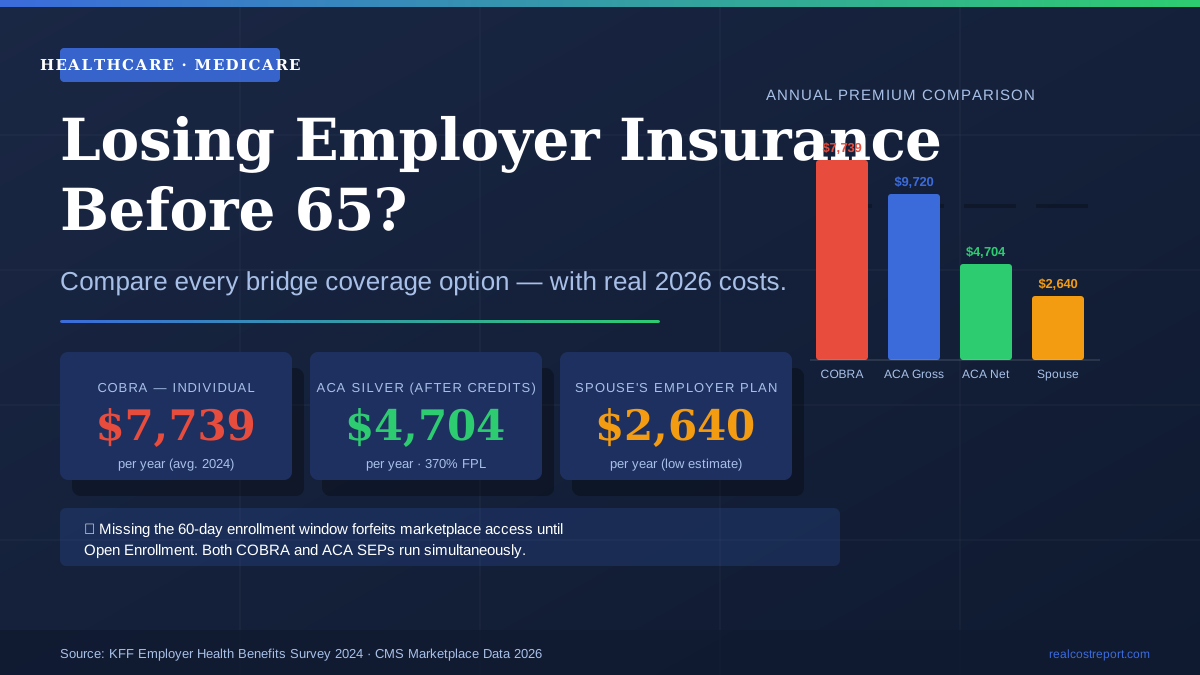
COBRA and retiree health plans operate under different rules: Medicare is always primary over COBRA and retiree coverage. If you’re on COBRA and become Medicare-eligible, Medicare pays first from the date you’re entitled — not from when you enroll. COBRA carriers can and do deny claims retroactively when Medicare should have been primary.
Source: CMS Medicare Secondary Payer provisions (verify at cms.gov); MSP rules 42 U.S.C. § 1395y(b). Disability threshold of 100 employees applies to the Large Group Health Plan (LGHP) provision.
The Real Dollar Cost of a Coordination Error
Getting payer order wrong isn’t an administrative inconvenience — it triggers measurable financial damage across three channels: late-enrollment penalties, retroactive claim denials, and MSP repayment demands.
Part B Late Enrollment Penalty: The base 2026 Part B premium is $185.00 per month (CMS confirmed for 2026). For every 12-month period you were eligible for Part B but didn’t enroll when required, CMS adds 10% permanently. A two-year delay on a small-employer plan means a 20% surcharge — an extra $37.00/month, or $444/year, for life. Over a 20-year retirement, that’s $8,880 in unnecessary premium costs on the penalty alone, before accounting for Medicare’s annual premium increases.
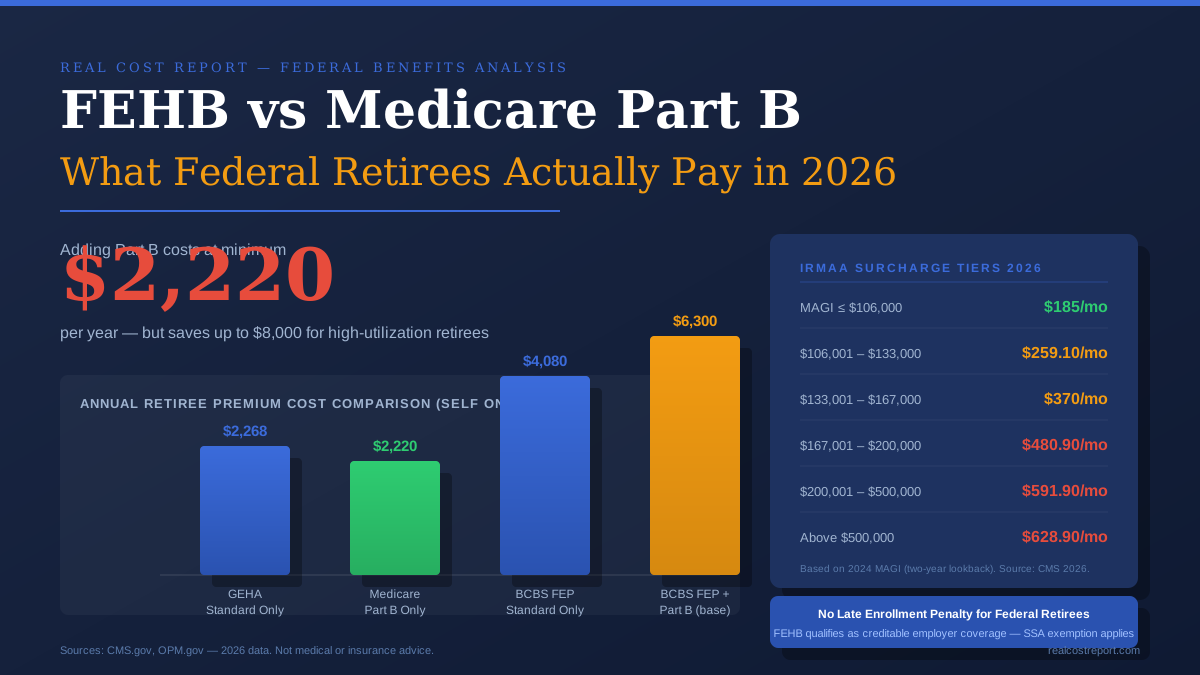
IRMAA Surcharges: Higher-income beneficiaries face Income-Related Monthly Adjustment Amounts. In 2026, individuals with modified adjusted gross income above $106,000 (based on 2024 tax returns) pay more. The top tier — income above $500,000 — pays an estimated $594+ per month for Part B alone. Running two full plans while paying top-tier IRMAA makes the dual-coverage math almost always negative unless the secondary plan covers a benefit Medicare excludes (dental, vision, hearing).
MSP Retroactive Repayment: CMS’s Benefits Coordination & Recovery Center (BCRC) actively audits paid claims. If Medicare paid primary on a claim where a GHP was legally primary, CMS issues a demand letter requiring repayment — with interest. The employer is also notified. These demands can arrive 1–3 years after the original claim. There is no cap.
Penalty calculations based on 2026 Part B base premium of $185.00/month per CMS (verify at medicare.gov). Penalty percentages per CMS Part B Late Enrollment Penalty guidance.
Delaying Part B vs. Enrolling at 65: Which Is Better for Active Workers?
This is the core decision for the roughly 9 million Medicare-eligible Americans still in the workforce according to Bureau of Labor Statistics data. The answer is binary and determined by employer size — but the financial modeling reveals nuance that the employer-size rule alone doesn’t capture.
Option A: Delay Part B (Large Employer, ≥20 Employees)
A 65-year-old with a large-employer GHP who skips Part B saves $185/month ($2,220/year) in premiums. Their GHP remains primary. As long as active employment continues, there’s no penalty and no coverage gap. Delaying is financially rational unless the GHP carries very high out-of-pocket costs that Part B’s 80% coverage would offset. Run the math: if your GHP deductible is $1,500 and Part B would cover $2,000 in costs not covered by the GHP, the $2,220 annual premium exceeds the savings. Skip Part B until the employer plan ends.
Option B: Enroll in Part B at 65 (All Situations)
For small-employer workers, COBRA participants, and retirees, enrolling at 65 is not optional — it’s legally required to avoid penalties and claim denials. For large-employer workers, enrolling in Part A is usually free (if you have 40 quarters of work history) and provides a useful backstop. Part A enrollment does not trigger a Part B requirement. Many workers enroll in Part A at 65 and delay Part B — this is the optimal strategy for large-employer coverage.
Verdict
Large-employer active workers: Enroll in Part A at 65 (free), delay Part B until retirement or loss of GHP, and set a calendar reminder for the 8-month SEP window. Small-employer workers, COBRA participants, and retirees: Enroll in both Part A and Part B at 65 without delay. The penalty is permanent and the claim denial risk is immediate.
What Most People Get Wrong About Medicare Coordination
Medicare coordination errors cluster around five misunderstandings that SHIP counselors encounter repeatedly. Each one has a measurable financial consequence.
Mistake 1: Assuming COBRA protects you from Part B enrollment requirements. Consequence: Medicare pays primary from the date you’re entitled — not the date you enroll. A $60,000 hospitalization billed to COBRA can be retroactively denied, leaving the patient liable. Correct action: Enroll in Medicare Part B before or immediately upon losing active employment coverage, even if you elect COBRA for other family members.
Mistake 2: Counting spouse’s employer coverage without verifying employer size. A Medicare-eligible person covered as a dependent on their working spouse’s plan is protected from the late-penalty rule only if the spouse’s employer has 20 or more employees. Many people assume coverage is coverage. Consequence: If the spouse’s employer has 19 employees, Medicare is primary, and every month without Part B is a penalty month. Correct action: Verify the employer’s employee count in writing before assuming protection.
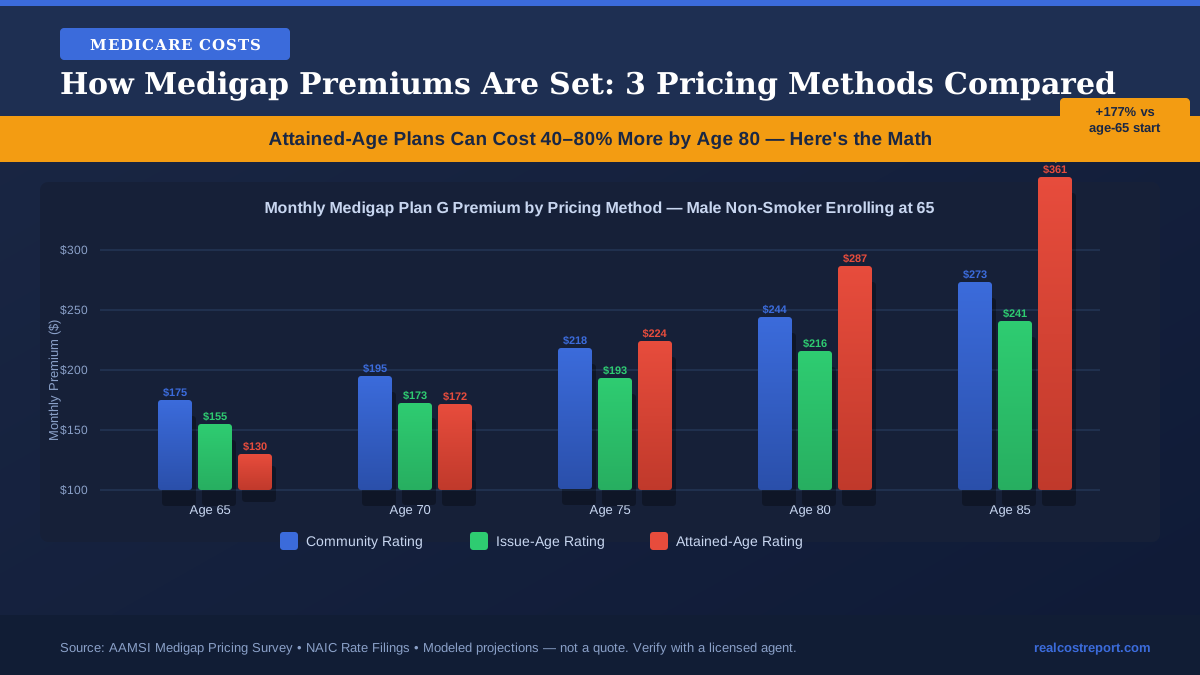
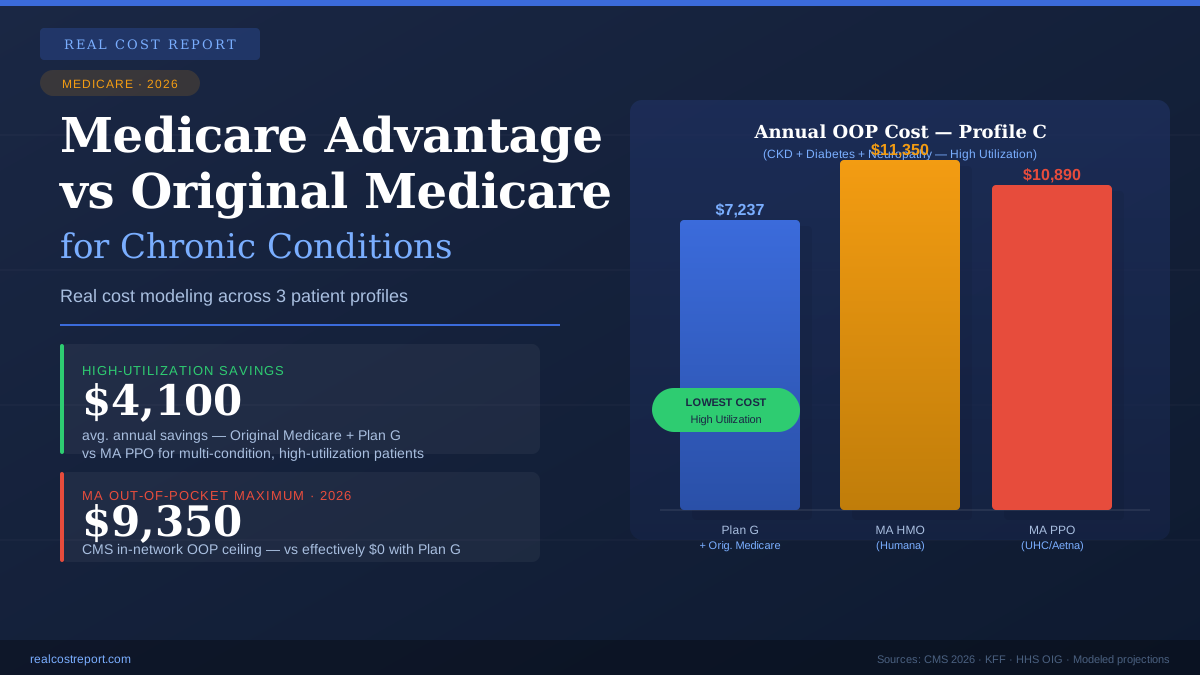
Mistake 3: Dropping GHP too early after retirement because “Medicare covers everything.” Medicare Parts A and B carry no out-of-pocket maximum. A complex illness can cost $50,000+ in cost-sharing under Original Medicare alone. Consequence: Without a supplement or the secondary GHP, catastrophic exposure remains. Correct action: Don’t drop retiree coverage (if it’s subsidized) until you’ve compared it against Medigap Plan G or Plan N pricing in your ZIP code — Medigap premiums range from $100–$300+/month depending on age and region.
Mistake 4: Not notifying the Benefits Coordination & Recovery Center (BCRC) when GHP coverage ends. CMS’s BCRC tracks MSP status, but it relies on employer and insurer reporting, which lags. Consequence: Medicare may continue paying secondary after a GHP ends, then issue retroactive repayment demands when the records are reconciled. Correct action: Proactively report GHP termination to your Medicare contractor and confirm your MSP status is updated.
Mistake 5: Treating Part D (prescription drug) enrollment as optional when delaying Part B. Part D has its own late-enrollment penalty — 1% of the national base beneficiary premium per month of delay — and creditable employer drug coverage must be documented. Consequence: If the GHP’s drug coverage is not creditable (it must meet CMS’s actuarial standards), every month without Part D is a penalty month. Correct action: Get a written Creditable Coverage notice from your employer’s HR department each year and retain it.
Is Dual Coverage Worth It? Scenarios Where Keeping Both Plans Pays Off
Maintaining both an employer GHP and Medicare isn’t always redundant. Three specific scenarios make dual coverage financially rational.
Scenario 1: High-cost chronic conditions with frequent specialist visits. Medicare Part B covers 80% of approved outpatient costs after the $240/year deductible (2026 estimate). A GHP with a low out-of-pocket maximum paying the remaining 20% essentially creates free secondary coverage for ongoing care. If your annual out-of-pocket under Medicare alone would exceed the GHP premium, keeping both plans is net positive. Model the math: multiply your expected annual Medicare cost-sharing by 20%, then compare to the GHP premium.
Scenario 2: Benefits Medicare doesn’t cover. Original Medicare excludes routine dental, vision, and hearing. If your employer GHP includes these benefits at low or no additional premium, the marginal value of maintaining the GHP may be $1,200–$3,000/year in dental and vision coverage alone, against a GHP premium that might be $0–$200/month for an active employee (employer-subsidized).
Scenario 3: Working past 65 with a heavily subsidized employer plan. If your employer covers 80% of GHP premiums and your share is $150/month, maintaining that plan alongside free Part A creates catastrophic coverage for nearly nothing. The GHP handles day-to-day care as primary; Part A backstops hospitalizations. Adding Part B ($185/month) may add little marginal value if the GHP already covers 80–90% of hospital costs. Skip Part B, bank $185/month, and enroll penalty-free within 8 months of retirement.
Dual coverage is rarely worth maintaining after full retirement when the employer subsidy disappears and the retiree bears the full GHP premium. At that point, comparing Original Medicare + Medigap Plan G versus continuing the retiree plan is the correct analytical frame. In most markets, Medigap Plan G for a 66-year-old runs $130–$220/month — often cheaper than a retiree plan premium with similar or worse coverage.
How We Researched This Article
This article was researched and written using primary federal sources and peer-reviewed health policy analysis. No insurance carrier materials, broker marketing content, or third-party aggregator data were used as primary inputs.
Medicare Secondary Payer rules and payer-order provisions were sourced directly from the CMS Medicare Secondary Payer overview, including the statutory basis at 42 U.S.C. § 1395y(b). Part B premium figures for 2026 were confirmed from Medicare.gov Part B cost disclosures. Late-enrollment penalty structure and the 8-month Special Enrollment Period window were verified against Medicare.gov enrollment timing guidance. IRMAA threshold data was sourced from CMS IRMAA tables. Employer coverage prevalence data was drawn from Kaiser Family Foundation Medicare and employer-sponsored insurance analysis.
Dollar figures in penalty tables were calculated by applying CMS’s stated penalty formula (10% per 12-month delay period × base premium) to the confirmed 2026 Part B base premium of $185.00/month. These are modeled calculations, not measured outcomes, and will shift as CMS adjusts the base premium annually. Medigap premium ranges are based on publicly available rate filings in representative markets and should be verified with a licensed insurance agent for your ZIP code and age. IRMAA figures above the base tier are estimated from CMS’s 2026 bracket announcements and should be confirmed on Medicare.gov before making enrollment decisions.
Research was last conducted May 2026. All figures were verified against named primary sources before publication.