This is not medical advice. Consult a licensed healthcare provider for medical decisions and a licensed insurance agent for coverage decisions.
TL;DR — Quick Verdict
- Medigap premiums are priced using one of three methods — community rating, issue-age rating, or attained-age rating — and the method determines how much your premium grows over time, often by $1,000–$3,000+ per year by your mid-70s.
- Attained-age plans start cheapest but can cost 40–80% more by age 80 than at enrollment — making them a long-term budget risk for most retirees.
- Community-rated states (Connecticut, Massachusetts, Minnesota, New York, Washington) eliminate age-based increases entirely, offering the most predictable lifetime cost.
- Issue-age plans lock your premium to your enrollment age and are the best compromise in states that offer them: lower than community rating at entry, stable over time.
- Smokers pay surcharges of 10–50% regardless of pricing method; gender and health history may also affect rates depending on state law.
- Recommendation: If you live in a community-rated state, enroll at 65 and stay put. Elsewhere, issue-age beats attained-age for anyone planning to hold a Medigap policy beyond age 72.
Medicare covers roughly 80% of approved medical costs — leaving the other 20% as your problem. For a beneficiary hospitalized twice and managing a chronic condition, that gap can easily exceed $6,000 in a single year. Medigap, also called Medicare Supplement Insurance, plugs that gap. But how you pay for it over the next 20–30 years depends almost entirely on one decision most buyers never think to ask about: the pricing method your insurer uses.
The Centers for Medicare & Medicaid Services (CMS) identifies three legal rating methods — community rating, issue-age rating, and attained-age rating — and insurers choose which to use within the limits set by their state. According to the Kaiser Family Foundation (KFF), roughly 14.4 million Americans held a Medigap policy as of recent enrollment data, yet the majority of new enrollees cannot correctly identify which pricing method applies to their plan before they sign.
This analysis breaks down exactly how each method works, models what a 65-year-old enrolling today will pay at 75 and 85 under each method, names which states mandate which approaches, and tells you when attained-age pricing is a trap — and when it isn’t.
How the Three Medigap Pricing Methods Actually Work
Federal law under the Omnibus Budget Reconciliation Act of 1990 established three permissible rating structures. Every Medigap insurer in every state must use one of them. The method is disclosed in your policy documents, but insurers are not required to advertise it prominently.
Community Rating (No-Age Rating)
Every enrollee in the same plan and geographic area pays the same base premium, regardless of age. A 65-year-old and a 78-year-old pay identically. Premiums still increase over time — insurers file rate adjustments annually based on their claims experience — but those increases are uniform across all ages. Inflation and claims trends drive the curve, not your birthday.
Only a handful of states mandate community rating statewide. Connecticut, Massachusetts, Minnesota, and New York require it for most or all Medigap plans. Washington state uses a modified guaranteed-issue community-rated structure. If you live in one of these states, your age at enrollment is largely irrelevant to your long-term cost trajectory.
Issue-Age Rating
Your premium is locked to the age you were when you first enrolled. A 65-year-old and a 70-year-old buying the same plan pay different amounts, and that gap persists permanently — but neither enrollee’s premium rises due to aging. Only general rate increases (inflation, claims experience) affect cost going forward. Florida and Arizona are among the states where issue-age plans are commonly marketed, though insurer availability varies by county.
Attained-Age Rating
This is the most common pricing method nationally and the one most likely to be sold to new enrollees without clear explanation. Your premium starts at the age you enroll, then increases every year — or sometimes every month — as you get older. Carriers typically build age-band tables into the policy. Separate annual inflation adjustments stack on top of the age-based increases. The result: a plan that looks affordable at 65 can become financially stressful at 78.
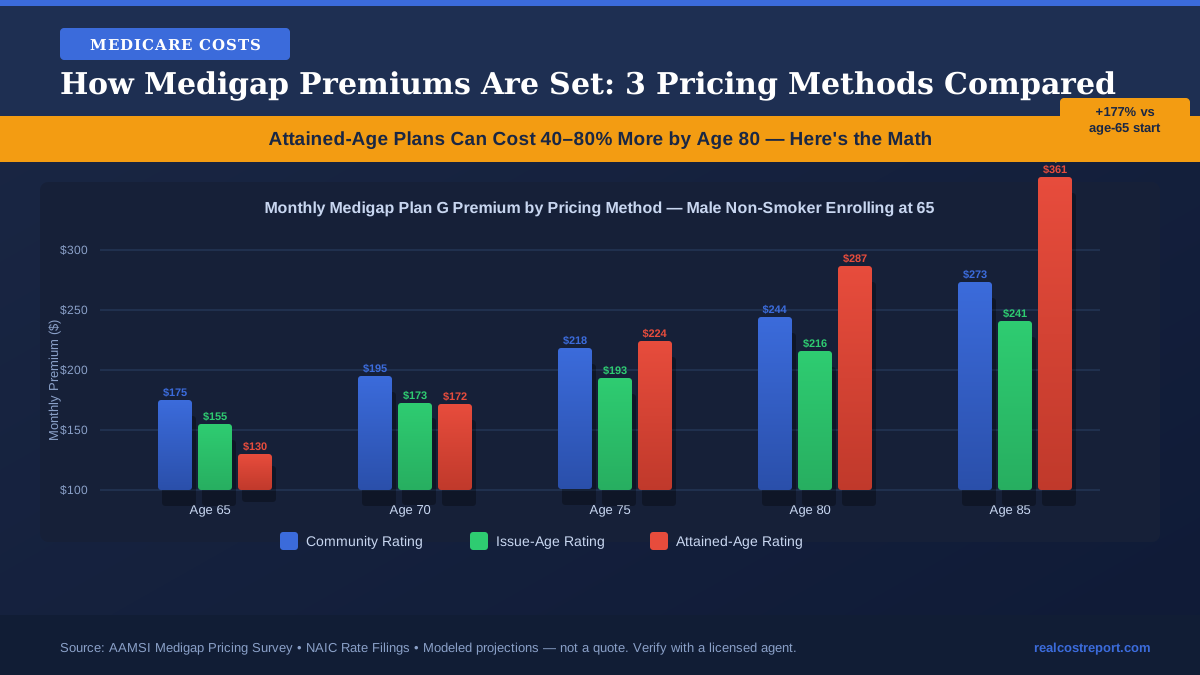
Medigap Premium Cost Projections by Pricing Method: Age 65 to 85
The following model assumes a male non-smoker enrolling in Plan G at age 65, using a baseline national average monthly premium. CMS does not publish a single national average Medigap premium; the figures below use the midpoint range published by the American Association for Medicare Supplement Insurance (AАМSI) in its annual Medigap pricing surveys, with age-band multipliers drawn from insurer rate filings disclosed through state insurance department databases. Actual premiums vary substantially by ZIP code and insurer.
Modeled projections using midpoint premium ranges from the American Association for Medicare Supplement Insurance (verify at aamsiwebsite.com) and published state insurance department rate filings. Assumes 2.5% annual general rate inflation applied uniformly and attained-age bands averaging 4.5% per year of age. Not a quote. Individual premiums vary by carrier, ZIP code, gender, and tobacco use.
The math is clarifying. Over 20 years, the attained-age enrollee pays an estimated cumulative total of approximately $54,000 in premiums — versus roughly $43,000 for the issue-age enrollee and $48,000 for the community-rated enrollee. The attained-age plan saves $540 in year one. It costs $2,772 more per year by age 85. That crossover typically arrives around age 72–74 under most carrier rate schedules.
Community Rating vs Attained-Age: Which Is Better for Long-Term Planners?
This is the central trade-off for anyone enrolling at 65 with the intention of keeping a Medigap plan for life. The comparison is not purely financial — it also involves predictability, switching risk, and state of residence.
Community Rating — What You Give Up and What You Get
The entry premium is higher. In a community-rated state, a 65-year-old pays the same as a 75-year-old, which means subsidizing older policyholders from day one. However, that cost structure never changes in your disfavor due to your own aging. Rate increases are driven by the claims pool, not your birthday. This is particularly valuable for women, who statistically live longer and therefore face more compounding age-band risk under attained-age plans.
Attained-Age — The Switching Trap
Attained-age plans are frequently sold on low entry price. Agents receive commissions on new business, and a lower month-one premium is an easier close. What the buyer may not hear: switching Medigap plans after your open enrollment window (the six months after your Part B effective date) requires medical underwriting in most states. If you developed diabetes, heart disease, or any significant condition after age 65, you may be uninsurable for a new Medigap plan. The low-cost attained-age plan becomes a permanent fixture precisely when it’s most expensive.
Verdict
For long-term planners who are in community-rated states, community rating wins on lifetime value and predictability — enroll at 65, never look back. For everyone else, issue-age is a better long-term bet than attained-age for any enrollee who anticipates holding the policy past age 72. Attained-age only makes mathematical sense if you have strong reason to believe you will switch plans, move states, or drop Medigap coverage within 7–8 years of enrollment — and you are confident you will remain medically insurable when you do.
State-by-State Medigap Rating Method Rules
Federal law sets the floor; states set the ceiling. Most states permit all three rating methods and leave carrier choice unrestricted. A minority of states mandate community rating or impose additional consumer protections. The following reflects rules in effect as of early 2026 — state legislatures can and do amend these. Verify current rules with your state insurance commissioner before enrolling.
Sources: National Association of Insurance Commissioners (verify at naic.org); state insurance commissioner websites for Florida (verify at floir.com) and California (verify at insurance.ca.gov). Verify current rules with your state department before enrollment decisions.
The birthday rule, now enacted in California, Florida, Oregon, Idaho, Illinois, Louisiana, and Nevada among others, deserves special attention. It gives existing Medigap enrollees a 30–60 day annual window — triggered by their birthday — to switch to a plan with equal or lesser benefits without medical underwriting. For attained-age enrollees who developed a health condition after their original open enrollment, this rule is the only viable escape route. If your state has it, use it strategically.
What Most People Get Wrong About Medigap Pricing
These are the five errors that consistently cost Medigap shoppers thousands of dollars over a retirement.
Mistake 1: Choosing the Lowest Month-One Premium Without Asking Why It’s Low
Consequence: An attained-age Plan G at $130/month feels like a win. By 78, the same plan may cost $245/month — and you’re likely uninsurable for anything else. The initial savings evaporate within eight years, replaced by permanent premium escalation. Correct action: Always ask the agent or insurer: “What rating method does this plan use?” Demand it in writing before you apply.
Mistake 2: Assuming All Plan G Policies Are Identical Beyond the Premium
Consequence: Federal law standardizes Medigap plan benefits — every Plan G covers the same core items regardless of insurer. But pricing method, rate increase history, and financial stability of the carrier vary enormously. A carrier with a history of 8–10% annual rate increases will cost far more at 80 than a carrier with a 3–4% track record, even if the day-one premium is similar. Correct action: Request the carrier’s historical rate increase data for your state, which insurers must disclose upon request under NAIC guidelines.
Mistake 3: Delaying Enrollment Past the Open Enrollment Window
Consequence: The six-month Medigap Open Enrollment Period begins the month you turn 65 and are enrolled in Medicare Part B. Miss it, and you face medical underwriting in most states. A single pre-existing condition — controlled hypertension, a past cancer diagnosis, Type 2 diabetes — can result in denial or rated premiums 50% above standard. Correct action: Enroll in Part B and Medigap simultaneously at 65, even if you are healthy. The underwriting-free window does not return.
Mistake 4: Ignoring Tobacco Surcharges in the Total Cost Model
Consequence: Insurers in most states may apply tobacco-use surcharges of 10–50% above base rates. A smoker enrolling in an attained-age plan starts at a compounding disadvantage — age-band increases apply to an already-elevated base. Correct action: Cessation programs affect future insurability positively. Some carriers re-rate non-smoker status after 12 months of cessation — ask specifically before assuming the surcharge is permanent.
Mistake 5: Not Accounting for Gender Differences in Pricing
Consequence: In states that permit gender rating, women often pay lower Medigap premiums than men at age 65 because women’s claims experience skews toward later ages. However, women also live longer on average — meaning they face more compounding under attained-age pricing over a longer retirement horizon. The lower entry premium may not compensate for the additional years of age-band increases. Correct action: Women in attained-age states should model premiums to age 88–90, not just age 80, when evaluating total lifetime cost.
Is Medigap Worth It? Who Should Buy and Who Should Reconsider
Medigap is not the right product for every Medicare beneficiary. The decision depends on your health trajectory, financial cushion, risk tolerance, and state of residence.
Buy Medigap if:
You have one or more chronic conditions that generate predictable, recurring Medicare cost-sharing. You travel domestically and want zero-hassle, any-provider coverage. You have fixed income and cannot absorb a $3,000–$5,000 out-of-pocket hit in a bad claims year. You live in a community-rated state — the guaranteed-issue protections and premium predictability make Medigap nearly always superior to Medicare Advantage on a risk-adjusted basis for moderate-to-high utilizers.
Reconsider Medigap if:
You are healthy, have $50,000+ in liquid savings, and are comfortable self-insuring against the 20% Medicare gap in exchange for lower monthly premiums. Medicare Advantage plans in your county have strong star ratings and include Part D drug coverage at low total cost of ownership. You are in an attained-age state with no birthday rule, have developed a health condition, and cannot switch — in that case, you may be better served by modeling Medicare Advantage feasibility carefully, since Advantage plans cannot deny enrollment based on health during Annual Enrollment.
The Medicaid Spend-Down Consideration
For lower-income beneficiaries approaching Medicaid eligibility thresholds, Medigap premiums can complicate spend-down calculations. Medicaid spend-down rules vary by state and allow certain medical expenses — potentially including Medigap premiums — to be counted toward meeting the income threshold for Medicaid coverage of long-term care costs. Individuals within 18 months of likely nursing facility placement should consult both a licensed insurance counselor and an elder law attorney before committing to or dropping a Medigap plan, as the interaction between Medigap, Medicaid, and long-term care cost-sharing is state-specific and financially consequential.
How We Researched This Article
This analysis was developed using primary regulatory, actuarial, and government sources. No insurer, broker, or financial institution sponsored or reviewed this content prior to publication.
Premium range data was drawn from the American Association for Medicare Supplement Insurance’s published annual Medigap pricing survey, which aggregates insurer rate filings submitted to state departments of insurance. Age-band multipliers used in our projection model reflect the midpoint of attained-age rate schedules disclosed in publicly available carrier filings in Florida, Texas, and Ohio — three large states where attained-age plans dominate — sourced through the National Association of Insurance Commissioners database and individual state DOI portals.
Enrollment figures and Medigap market share data were drawn from the Kaiser Family Foundation Medicare policy research library, which publishes annual enrollment analyses based on CMS administrative data. Federal rating method definitions were verified against Medicare.gov’s official Medigap comparison guidance and the CMS publication “Choosing a Medigap Policy: A Guide to Health Insurance for People with Medicare” (verify at cms.gov).
State-specific birthday rule enactment status was verified against individual state insurance department bulletins and the State Health Insurance Assistance Program (SHIP) national network, which provides free federally funded Medicare counseling. Medicaid spend-down interaction analysis references CMS Medicaid eligibility guidelines (verify at medicaid.gov) and the National Academy of Elder Law Attorneys guidance framework (verify at naela.org).
The premium projection model uses a 2.5% annual general inflation rate applied uniformly across all three rating methods, and a 4.5% compound annual age-band factor applied only to the attained-age scenario. These assumptions are conservative relative to some carrier historical experience, which has exceeded 6–8% in high-claim years. The model is illustrative — it is not an actuarial certification and should not substitute for a personalized quote from a licensed agent. Research was last conducted and figures verified in May 2026.
All figures were verified against named primary sources before publication.