This is not medical advice. Consult a licensed healthcare provider for medical decisions and a licensed insurance agent for coverage decisions.
TL;DR — Quick Verdict
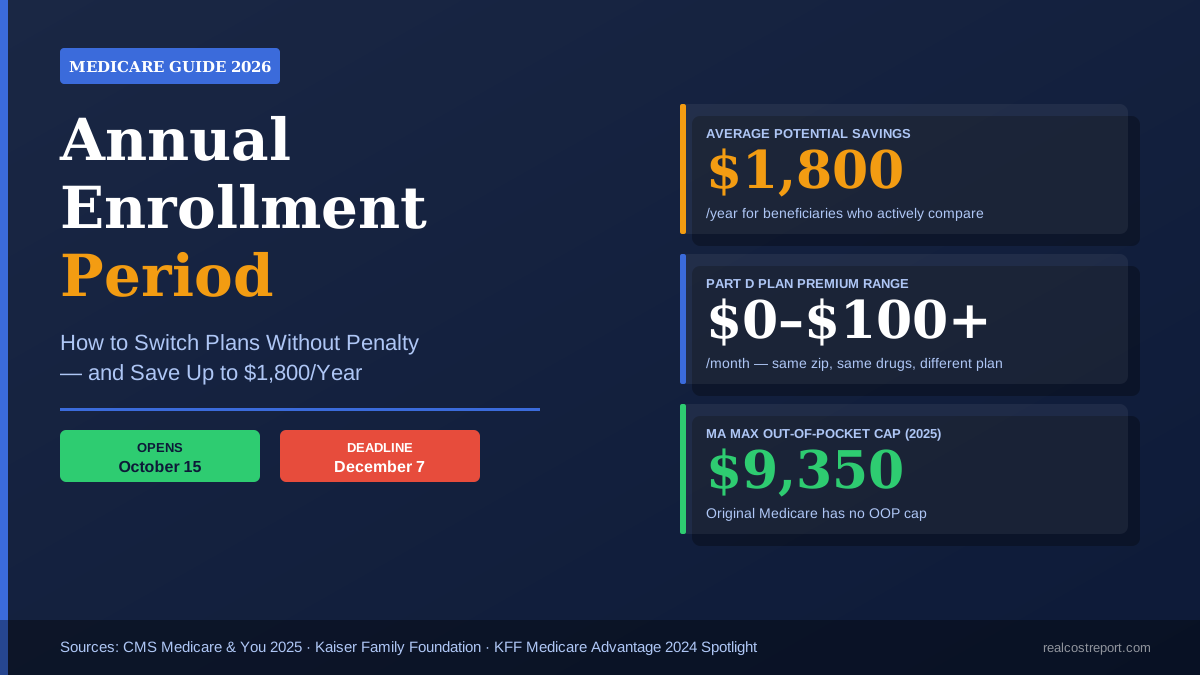
- Medicare’s Annual Enrollment Period (AEP) runs October 15 through December 7 every year — changes take effect January 1.
- Switching Medicare Advantage plans or moving from Original Medicare to Medicare Advantage carries zero penalty during AEP.
- The average Medicare Advantage enrollee who actively compares plans saves between $600 and $1,800 per year, according to KFF analysis.
- Part D drug plan premiums vary by more than $100/month for identical drug lists — same zip code, same drugs, wildly different costs.
- Medigap (supplemental) plans fall outside AEP — switching Medigap requires passing medical underwriting in most states.
- Most beneficiaries should run the Medicare Plan Finder comparison tool at Medicare.gov every single year, even if their current plan hasn’t changed — because their drug prices may have.
About 67 million Americans are enrolled in Medicare, yet the Kaiser Family Foundation estimates that fewer than 30% actively compare plans during the Annual Enrollment Period — a window that closes December 7 and won’t reopen for another 10 months. That inertia is expensive. A 2023 KFF analysis found the lowest-cost Part D plan available to a typical beneficiary cost an average of $178 less per month than the plan they were currently enrolled in — that’s more than $2,100 in potential annual savings left on the table.
This article delivers exactly what beneficiaries and their families need to act during AEP: the precise enrollment windows, a real cost comparison between Original Medicare, Medicare Advantage (Humana, UnitedHealthcare, Aetna), and standalone Part D plans, a breakdown of what can and cannot be changed without penalty, and a step-by-step switching guide grounded in CMS data.
Medicare Enrollment Windows: AEP, OEP, and SEPs Explained
Medicare has several enrollment windows, and confusing them is the single most expensive mistake beneficiaries make. The Annual Enrollment Period is the main one, but it is not the only one — and understanding which window applies to your situation determines whether you can switch without penalty at all.
Source: Centers for Medicare & Medicaid Services (CMS) — Medicare & You 2025 Handbook (verify at medicare.gov)
The critical distinction: AEP lets you switch between plan types. The MA OEP in January–March is limited — you cannot use it to enroll in a standalone Part D plan if you are in Original Medicare, and you cannot switch from Original Medicare to MA. If you miss AEP without a qualifying SEP, you may be locked into a plan for the full calendar year.
What Medicare Plans Actually Cost in 2026: Part B, Part D, and Medicare Advantage
Before comparing plans, you need a baseline. These are CMS-published figures for 2026 — not estimates.
Sources: CMS Medicare & You 2025 Handbook; CMS 2026 Medicare Parts A & B premiums announcement (verify at cms.gov); KFF Medicare Advantage 2024 Spotlight
One number above deserves emphasis: the MOOP. Original Medicare has no out-of-pocket cap whatsoever on Part B services. A lengthy hospitalization or cancer treatment can generate unlimited liability. Medicare Advantage caps it — but the network restrictions that come with an HMO or PPO plan may limit which oncologists or hospitals you can access. This trade-off is the core financial decision most beneficiaries underweight.
Original Medicare vs. Medicare Advantage: Which Is Better for You?
This is the comparison that matters most for the majority of people evaluating AEP options. These are not equivalent products with different price tags — they represent structurally different insurance designs with different financial exposures.
Original Medicare (Parts A + B + Medigap + Part D)
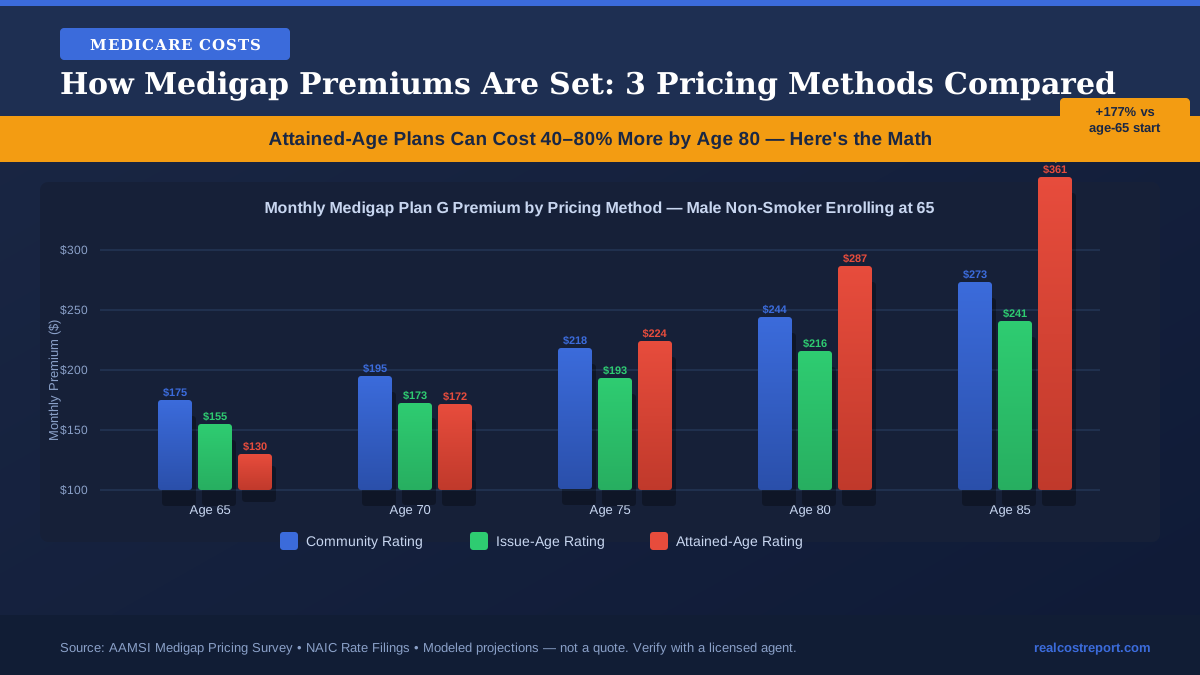
Original Medicare covers roughly 80% of approved costs after deductibles. The remaining 20% is uncapped, which is why most financial advisors recommend pairing it with a Medigap supplemental plan (sold by private insurers including AARP/UnitedHealthcare, Cigna, and Mutual of Omaha). Medigap Plan G — the most comprehensive option available to new enrollees since 2020 — typically costs $100–$200/month for a 65-year-old in good health, based on NAIC data. Add a standalone Part D plan ($25–$80/month), and total monthly premiums for solid Original Medicare coverage run roughly $300–$450 for most beneficiaries.
The major advantages: nationwide provider access (any doctor who accepts Medicare), no referrals needed, and predictable cost-sharing once Medigap is in place. The disadvantage: higher monthly premiums and no extra benefits like dental, vision, or gym memberships.
Medicare Advantage (Part C)
MA plans are sold by private insurers — Humana, UnitedHealthcare (AARP), Aetna (CVS Health), Cigna, and Elevance (Anthem) are the five largest by enrollment — and must cover everything Original Medicare covers. Most charge low or $0 monthly premiums by absorbing the Part B premium payment CMS remits to them. That $0 premium number is the headline, but it obscures higher cost-sharing at the point of service and network limitations that matter acutely when you’re ill.
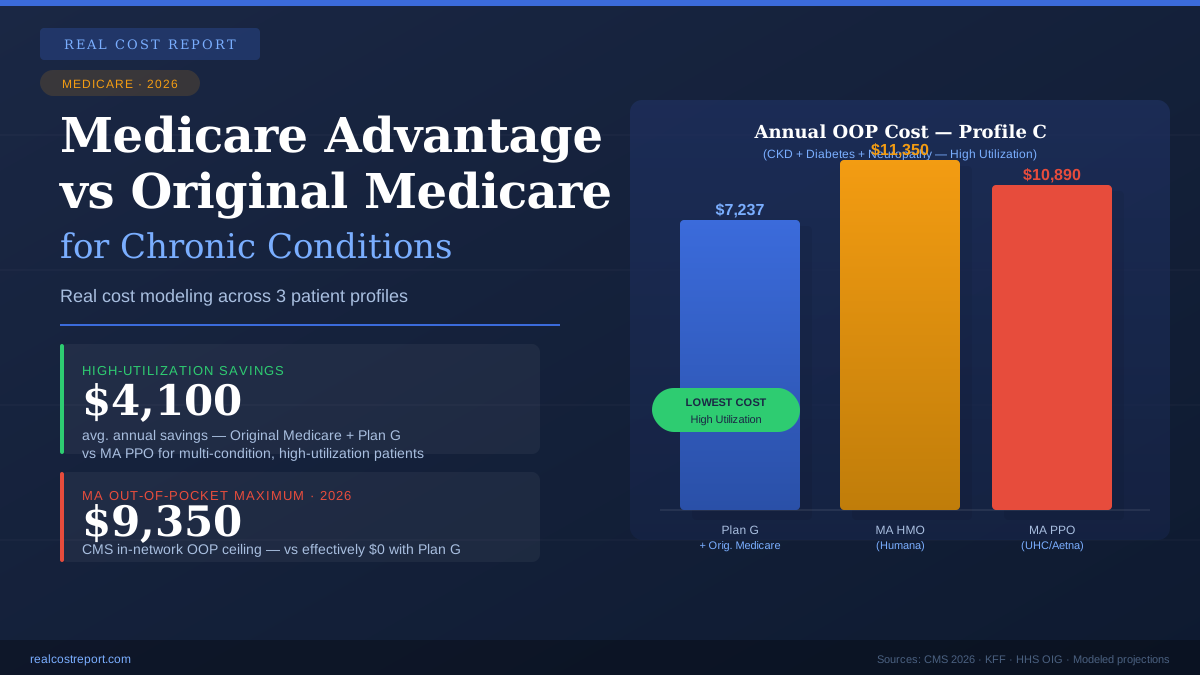
A patient needing 10 specialist visits per year at a $45 MA copay pays $450 in cost-sharing that Medigap Plan G would cover entirely. Run that math against the Medigap premium and the picture changes.
Verdict
Original Medicare + Medigap Plan G + Part D wins for beneficiaries with chronic conditions, frequent specialist use, or who travel extensively — the predictable cost structure and provider flexibility justify the higher premium. Medicare Advantage wins for generally healthy beneficiaries in stable geographic locations who want $0 premiums, extra benefits, and can tolerate network constraints and higher point-of-service cost-sharing. The worst financial outcome is choosing MA based solely on the $0 premium without stress-testing your maximum out-of-pocket exposure.
How to Switch Medicare Plans During AEP: Step-by-Step
Switching is straightforward — CMS has streamlined the process. The missteps happen before and after enrollment, not during it.
Step 1: Pull your current plan’s Annual Notice of Change (ANOC)
By law, your plan must mail your ANOC by September 30. It lists every change to your 2026 coverage: premium increases, formulary changes (which drugs are covered at what tier), network changes, and benefit modifications. Read it against your actual drug list and provider list — not against last year’s memory of the plan.
Step 2: Run the Medicare Plan Finder
Go to Medicare.gov and use the Plan Finder tool. Enter your exact medications (name, dose, frequency), your pharmacy, and your zip code. The tool calculates total estimated annual drug costs across every Part D and Medicare Advantage plan available to you. This is the only apples-to-apples comparison that matters for drug coverage — premium alone is meaningless without it.
Step 3: Verify your providers are in-network
If switching to MA or between MA plans, call your primary care physician, cardiologist, oncologist, or any specialist you see regularly and confirm they accept the new plan. Do not rely solely on the plan’s online directory — CMS has documented widespread inaccuracies in MA network directories.
Step 4: Enroll by December 7
You can enroll online at Medicare.gov, by phone at 1-800-MEDICARE (1-800-633-4227), or through the plan directly. If you enroll in a new MA plan, your old plan is automatically terminated — you do not need to cancel it separately. If switching to Original Medicare, you must actively enroll in a standalone Part D plan to avoid a late enrollment penalty later.
Step 5: Confirm enrollment and check your January EOB
You will receive a confirmation from CMS and from your new plan. Check your January Explanation of Benefits (EOB) to confirm the correct plan is active before your first medical appointment of the year.
What Most People Get Wrong About Medicare AEP
These five mistakes appear repeatedly in beneficiary complaints filed with State Health Insurance Assistance Programs (SHIPs) and Medicare appeals data from CMS.
Mistake 1: Comparing premiums instead of total annual cost
A $0 MA premium plan with $45 specialist copays and a $7,000 MOOP costs more than a $180/month Medigap plan for a beneficiary who sees four specialists quarterly. Run total cost projections for your actual utilization pattern, not the average. The Medicare Plan Finder does this automatically if you enter your medications and usage history accurately.
Mistake 2: Assuming your drug is still covered at the same tier
Formularies change every January 1. A brand-name drug that cost you $45/month at Tier 3 in 2025 may move to Tier 4 ($95/month) or Tier 5 (25–33% coinsurance) in 2026. CMS requires plans to notify you via ANOC, but beneficiaries routinely ignore the mailing. A single tier change on one specialty drug can cost $600–$2,400 more annually.
Mistake 3: Switching Medigap during AEP and assuming guaranteed issue
Medigap is not part of AEP. Switching Medigap supplemental plans outside of your Initial Enrollment Period or a specific SEP requires passing medical underwriting in most states. Beneficiaries who assume AEP gives them the right to switch Medigap plans penalty-free can be denied coverage or charged higher premiums based on health status. Only Connecticut, Maine, Massachusetts, Missouri, New York, and Vermont have guaranteed issue protections beyond the initial enrollment window (verify current state rules at your State Insurance Commissioner’s website).
Mistake 4: Missing the Part D late enrollment penalty
If you go 63 or more consecutive days without creditable drug coverage after becoming Medicare-eligible, you pay a permanent Part D late enrollment penalty: 1% of the national base beneficiary premium per month you went without coverage, added to your Part D premium for life. On a $46 national base, that’s roughly $0.46 per month per month of delay — it compounds. A 24-month gap costs approximately $11/month added permanently to every future premium.
Mistake 5: Trusting a plan’s star rating from two years ago
CMS publishes Medicare Advantage star ratings annually (5-star scale). Plans change management, networks, and formularies. A plan that earned 4.5 stars in 2024 may have dropped to 3 stars for 2026 due to member complaints, care coordination failures, or appeals denials. Always check the current year’s star rating at Medicare.gov before re-enrolling.
Is Switching Medicare Plans During AEP Worth It?
The answer depends on three variables: your health utilization, your drug list, and your geography. Here is a conditional framework built on CMS and KFF data.
Switch plans if any of the following apply:
Your current plan’s ANOC shows a premium increase of more than $30/month. Any medication you take regularly moved to a higher formulary tier. A specialist or hospital you use regularly left your plan’s network. Your plan’s star rating dropped below 3 stars. You moved to a new county or state. You became eligible for both Medicare and Medicaid (dual-eligible beneficiaries qualify for D-SNP plans with significantly lower cost-sharing).
Stay with your current plan if:
Your ANOC shows no material changes. Your drugs are on the same tiers. Your providers remain in-network. Your plan’s star rating held at 4 stars or above. You are mid-treatment for a serious condition and your care team is in-network — disrupting care continuity has documented clinical costs beyond the financial ones.
Consider moving to Original Medicare + Medigap if:
You have been denied a referral or prior authorization for care you need. Your MA plan’s MOOP has been triggered in a prior year. You have been diagnosed with a condition requiring frequent specialist care, out-of-state treatment (cancer centers, cardiac surgery), or care from providers who don’t accept MA plans. Note: this switch requires purchasing Medigap, which in most states means passing medical underwriting — timing matters enormously.
Low-income beneficiaries: don’t overlook Extra Help and MSPs
The Part D Low-Income Subsidy (Extra Help) program reduces or eliminates Part D premiums and cost-sharing for beneficiaries with income at or below 150% of the federal poverty level. The Medicare Savings Programs (MSPs) — Qualified Medicare Beneficiary (QMB), Specified Low-Income Medicare Beneficiary (SLMB), and Qualifying Individual (QI) — cover Part B premiums, deductibles, and coinsurance for eligible beneficiaries. CMS estimates that hundreds of thousands of eligible beneficiaries are not enrolled. Apply through your state Medicaid agency. For long-term care planning, Medicaid spend-down rules allow beneficiaries to qualify for Medicaid LTC benefits by spending excess assets or income on allowable medical expenses down to the state’s eligibility threshold — thresholds vary by state and change annually.
How We Researched This Article
This article was researched and written using primary government and institutional data sources only. No insurance company marketing materials, broker aggregator sites, or secondary summaries were used as source documents.
Cost data for Medicare Parts A, B, and D premiums, deductibles, and MOOP limits were drawn from the Centers for Medicare & Medicaid Services (CMS) Medicare Part D page and the CMS annual premium announcement releases. Enrollment period rules were verified against the official Medicare.gov enrollment period guidance. Medicare Advantage market data — including average premiums, MOOP distributions, and plan counts — were drawn from the Kaiser Family Foundation’s Medicare Advantage 2024 Spotlight report. Medigap plan structures and state-level guaranteed issue rules were cross-referenced against the National Association of Insurance Commissioners (NAIC) Medicare Supplement Insurance publication. Part D late enrollment penalty calculations were modeled using the CMS penalty formula against both the 2025 national base beneficiary premium of $36.78 and the 2026 base beneficiary premium of $38.99 — a 6% year-over-year increase capped by the Inflation Reduction Act (CMS, July 28, 2025). At $38.99, a 24-month coverage gap now generates a permanent penalty of approximately $9.36/month added to every future Part D premium. AEP switch benefit estimates were derived from KFF’s analysis of Part D plan cost differentials for a standardized drug basket across zip codes.
This research was last conducted May 2025. State-specific Medigap guaranteed issue rules, MSP income thresholds, and Medicaid spend-down rules change annually and by state — readers should verify current figures directly with their State Insurance Commissioner and state Medicaid agency.
All figures were verified against named primary sources before publication.