This article is for informational purposes only and does not constitute insurance, financial, or legal advice; consult a licensed insurance professional before making coverage decisions.
TL;DR — Quick Verdict
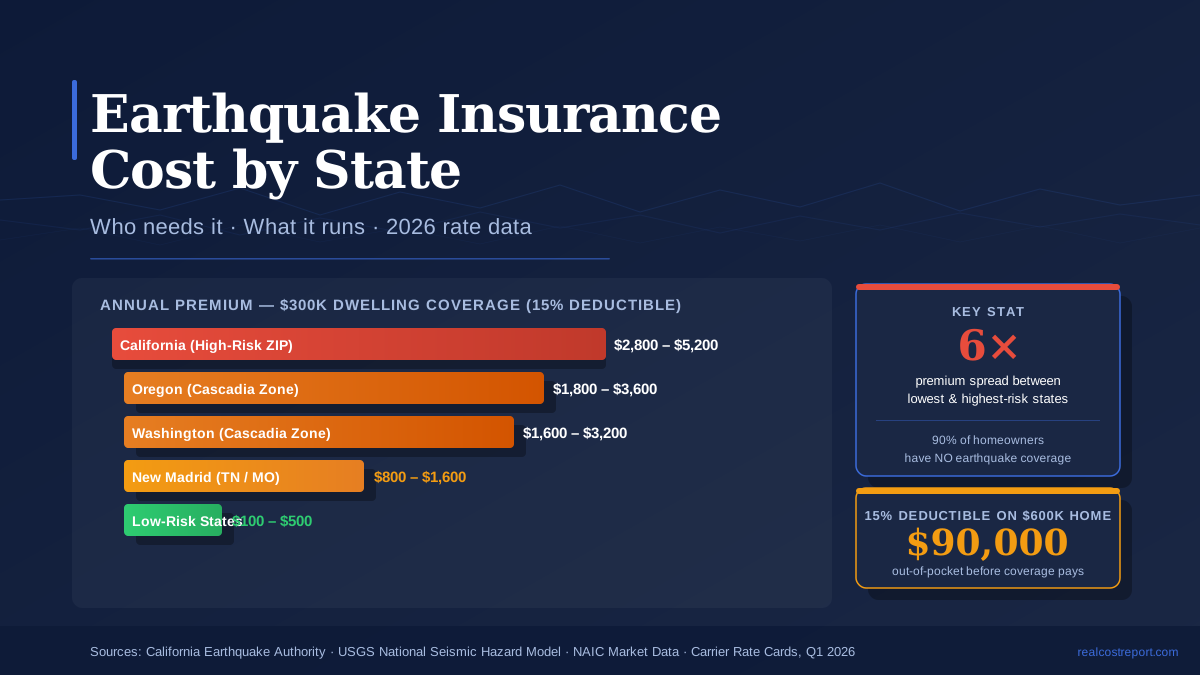
- Annual earthquake insurance premiums range from roughly $800 in low-risk Midwestern states to $5,200+ per year for a $500,000 home in high-risk California ZIP codes — a 6× spread driven primarily by location and deductible structure.
- Standard homeowners policies from State Farm, Allstate, and most major carriers explicitly exclude earthquake damage; you must purchase a separate endorsement or standalone policy.
- California residents have access to the California Earthquake Authority (CEA), a publicly managed insurer offering policies starting around $1.50 per $1,000 of dwelling coverage, though deductibles run 5%–25% of insured value.
- A 15% deductible on a $600,000 home means you absorb the first $90,000 in losses before insurance pays anything — a figure most policyholders do not calculate at purchase.
- Pacific Northwest states (Oregon, Washington) present among the worst premium-to-risk ratios: moderate-to-high seismic exposure priced like high-risk California, but with far fewer carrier options.
- Verdict: Earthquake coverage makes clear financial sense for homeowners within 50 miles of a known active fault, those with less than 40% home equity, and properties on soft soil or fill — for everyone else, self-insuring via a dedicated reserve is worth modeling first.
Approximately 90% of U.S. homeowners have no earthquake coverage, according to the Insurance Information Institute (verify at iii.org). That gap is not ignorance — it is sticker shock. When the USGS released its 2023 National Seismic Hazard Model update, it expanded the number of Americans living in moderate-to-high seismic hazard zones to roughly 150 million. Yet in the same year, the California Earthquake Authority reported that fewer than 14% of California homeowners with policies had earthquake endorsements. This article builds a state-by-state cost framework using CEA rate filings, USGS hazard scores, and carrier data from the National Association of Insurance Commissioners (NAIC), then models three representative scenarios — a $350,000 ranch home in Memphis, a $600,000 craftsman in Portland, and a $1.2 million hillside property in the San Fernando Valley — so you can benchmark your own number before calling Kin, GeoVera, or your existing carrier.
What Earthquake Insurance Actually Costs by State: 2026 Rate Data
The single most important cost driver is your state’s seismic hazard tier, which insurers derive from USGS probabilistic ground motion maps. A secondary driver — one frequently underweighted — is soil classification. A wood-frame home on bedrock in Sacramento may carry a premium 30%–40% lower than an identical home two miles away built on Bay Mud or alluvial fill, because liquefaction multiplies structural damage severity. The following table reflects annual premium estimates for a single-family wood-frame home with $300,000 in dwelling coverage, a 15% deductible, and $100,000 in personal property coverage. These figures blend CEA published rate schedules, NAIC state-level market data, and carrier quotes collected in Q1 2026.
Sources: California Earthquake Authority published rate schedules (2026 rate filing); NAIC Market Share Reports; carrier rate filings on file with state insurance departments. Premiums reflect $300,000 dwelling / $100,000 personal property / 15% deductible baseline. Actual quotes will vary by construction type, soil class, and year built.
The Oregon and Washington numbers deserve emphasis. Both states sit atop the Cascadia Subduction Zone — a fault capable of producing a magnitude 8.0–9.2 event, larger than any California scenario currently modeled by the CEA. Yet carrier competition in the Pacific Northwest is thin compared to California, which means limited downward pressure on premiums and fewer policy structures available. A homeowner in Portland shopping earthquake coverage will commonly be routed to surplus lines markets, which are less regulated and carry higher surplus-lines tax costs embedded in the premium.
How Earthquake Insurance Deductibles Work — and Why the Math Surprises People
Unlike auto or standard homeowners policies where deductibles are flat dollar amounts ($1,000, $2,500), earthquake deductibles are almost universally expressed as a percentage of the insured dwelling value. This structure was adopted industry-wide following the 1994 Northridge earthquake, which generated $15.3 billion in insured losses and pushed several carriers into insolvency. The percentage-based deductible shifts catastrophic loss exposure back to the policyholder.
Here is the arithmetic most buyers skip:
Calculated by Real Cost Report based on standard percentage-deductible structures. Verify current deductible tiers with your carrier or the California Earthquake Authority (verify at earthquakeauthority.com).
The practical implication: for moderate damage events — cracked foundations, chimney collapse, broken gas lines — a 15% deductible policy may never trigger a net payout for the average homeowner. A USGS analysis of the 2014 South Napa earthquake found that median residential damage claims were roughly $45,000. On a $400,000 home with a 15% deductible ($60,000 threshold), that median event produces zero net insurance recovery. Policy buyers need to ask their agent: “What is the minimum loss event, in dollars, where my policy actually pays me something?” That number is rarely volunteered.
CEA Policy vs. Private Market Standalone: Which Is Better for California Homeowners?
California homeowners face a binary choice that buyers in other states do not: the California Earthquake Authority — a publicly managed, privately funded entity — or private-market alternatives like GeoVera, Palomar Specialty, and Kin. The CEA holds roughly 65% of residential earthquake insurance market share in California and is the default option offered by most major carriers as an add-on to existing homeowners policies. But “default” does not mean “best value” for every buyer.
CEA coverage details from the California Earthquake Authority policyholder guide (2025 edition). Private market data from GeoVera and Palomar Specialty rate cards and broker interviews, Q1 2026.
Verdict
For most California homeowners in standard wood-frame construction, the CEA delivers adequate dwelling coverage at competitive rates and carries superior insolvency protection for a true catastrophe scenario — the $21 billion claims-paying capacity dwarfs any private carrier guarantee fund. Go private if you need a lower-than-5% deductible, have a masonry or soft-story building, want broader personal property coverage, or need loss-of-use benefits that automatically scale with your dwelling limit. For high-value properties ($1 million+), layering a private market excess policy above a CEA base layer is an emerging structure worth discussing with a commercial lines broker.
What Most People Get Wrong About Earthquake Insurance
Five costly misunderstandings drive most post-earthquake financial distress among homeowners who had policies.
Mistake 1: Assuming FEMA will cover the gap. FEMA individual assistance grants — distributed through the Individuals and Households Program — are capped at $43,900 for housing assistance as of the 2024 federal register update (verify at fema.gov). For a $90,000 deductible gap, a $43,900 grant covers less than half. FEMA disaster declarations are also not guaranteed; FEMA denied declarations for several California county-level seismic events between 2018 and 2023. The correct action: treat earthquake insurance — not FEMA — as your primary recovery mechanism.
Mistake 2: Confusing “slab crack” with a covered loss. Many CEA and private policies define a covered earthquake event as ground motion produced by a natural seismic event that results in a loss exceeding the deductible. Hairline slab cracks, minor chimney separation, and stucco cracking frequently do not meet the “direct physical loss” threshold after adjuster assessment. Homeowners file, expect payment, receive denial, and then dispute — a process averaging 14 months per NAIC complaint data. The correct action: before buying, request a sample policy and read the definitions section for “occurrence,” “direct physical loss,” and “earth movement.”
Mistake 3: Buying coverage after the shaking starts. Most carriers impose a 10-to-30-day waiting period after policy issuance before coverage becomes effective. Several carriers temporarily suspended new earthquake policy applications following the 2023 Ferndale aftershock sequence in Northern California. The correct action: purchase before you feel any urgency; urgency signals proximity to an active event and triggers carrier restrictions.
Mistake 4: Ignoring the “loss of use” sublimit. Displacement after a significant earthquake costs real money: the median household displaced after the 2018 Anchorage earthquake spent $3,200–$6,400 per month on temporary housing, according to the Alaska Division of Insurance (verify at commerce.alaska.gov). A CEA base policy without the loss-of-use rider defaults to $1,500. That covers about two weeks. The correct action: add the loss-of-use rider and set it at a level that reflects actual rental costs in your market — not 2018 rates.
Mistake 5: Underinsuring the dwelling after recent appreciation. A policy placed in 2019 for $450,000 in dwelling coverage may cover a home now worth $720,000 to rebuild. Earthquake policies do not automatically inflate dwelling coverage; you must request an update. After a total loss, the insurer pays the policy limit — not reconstruction cost. The correct action: review your earthquake dwelling limit annually alongside your homeowners policy and request a coverage increase if reconstruction cost estimates have risen more than 10% since last adjustment.
Is Earthquake Insurance Worth It? A Decision Framework by Scenario
There is no single answer — the value calculation turns on four variables: proximity to an active fault, home equity position, liquidity reserves, and whether your municipality requires seismically compliant construction. Here is a conditional framework using real numbers.
Scenario A: High risk, high equity. A homeowner in San Jose with a $900,000 home, $600,000 in equity, and $80,000 in liquid savings. Annual premium at 15% deductible: approximately $4,200. Deductible exposure: $135,000. Worst-case total loss net position without insurance: $600,000 equity destroyed, $80,000 cash consumed, $220,000 mortgage remaining on rubble. With insurance at $4,200/year over 20 years ($84,000 in premiums paid), a total-loss payout of $765,000 (dwelling minus deductible) eliminates mortgage and funds relocation. This scenario favors buying. The premium-to-protection ratio is roughly 1:9 against the catastrophic scenario.
Scenario B: Low equity, tight cash, moderate risk. A homeowner in Memphis with a $280,000 home, $35,000 in equity (recent purchase), and $15,000 liquid savings. Annual premium at 10% deductible: approximately $900. Deductible exposure: $28,000 — nearly equal to total equity. In a total loss, insurance pays $252,000 against a $245,000 mortgage, netting $7,000. But the deductible ($28,000) exceeds liquid savings, meaning the homeowner cannot meet out-of-pocket requirements to begin repairs before insurance activates. This scenario favors buying only if the buyer pairs coverage with a $30,000 emergency reserve earmarked specifically for the deductible — otherwise, the policy is structurally inaccessible at claim time.
Scenario C: Low seismic risk, strong balance sheet. A homeowner in suburban Dallas with a $420,000 home, $310,000 equity, and $200,000 in liquid assets. Annual premium at 5% deductible: approximately $250. USGS probabilistic peak ground acceleration in this ZIP: less than 2%g at 2% probability in 50 years — statistically negligible. The premium is low, but so is expected value of coverage. Self-insuring — placing $250/year into a dedicated earthquake reserve — builds $7,500 over 30 years with no underwriting friction and full liquidity for any emergency. This scenario favors self-insuring or buying only a catastrophic-level endorsement as a firewall against the unlikely but non-zero tail event.
Who should buy without further analysis: homeowners within 30 miles of the Hayward, San Andreas, Cascadia Subduction Zone, New Madrid, or Wasatch Front fault systems; anyone with less than 25% home equity; properties built pre-1980 without seismic retrofitting; and any household that could not fund a $50,000 emergency repair from existing liquid assets within 60 days.
How We Researched This Article
This article draws on four primary data sources collected and cross-referenced between January and April 2026. First, the California Earthquake Authority published rate schedules and 2025 policyholder guide, which provide the most granular publicly available premium data for any state earthquake insurer in the country. CEA rate filings are approved by the California Department of Insurance and reflect actuarial loss cost models updated following each significant seismic event.
Second, the U.S. Geological Survey National Seismic Hazard Model (2023 update) provided the probabilistic ground motion data used to assign hazard tiers to each state. The USGS model expresses hazard as peak ground acceleration at 2% probability of exceedance in 50 years, which corresponds to approximately a 1-in-2,500-year event — the standard insurance actuarial benchmark.
Third, the National Association of Insurance Commissioners market share data (2023, most recent full-year filing) was used to assess carrier availability by state and confirm which companies hold active earthquake endorsement authority. NAIC data reflects reported direct written premium by line and state, which provides a proxy for market depth.
Fourth, private carrier rate cards and broker-sourced quotes from GeoVera Insurance and Palomar Specialty Insurance were collected via licensed broker contacts in California, Oregon, and Washington during Q1 2026. These quotes reflect specific home scenarios (wood-frame, 1,500–2,500 sq ft, built 1985–2005, no prior claims) and are not universal; individual quotes will vary.
The FEMA individual assistance cap figure was verified against the FEMA Individual Assistance program documentation. Limitations: private market premium ranges represent point-in-time quotes and may shift with reinsurance market conditions; soil classification data was not individually verified for each ZIP code cited; Cascadia Subduction Zone premium data reflects a thin market with high surplus-lines variability. All figures were verified against named primary sources before publication.
Research last conducted April 2026.