This article is for informational purposes only and does not constitute insurance advice; consult a licensed flood insurance specialist before purchasing or canceling any policy.
TL;DR — Quick Verdict
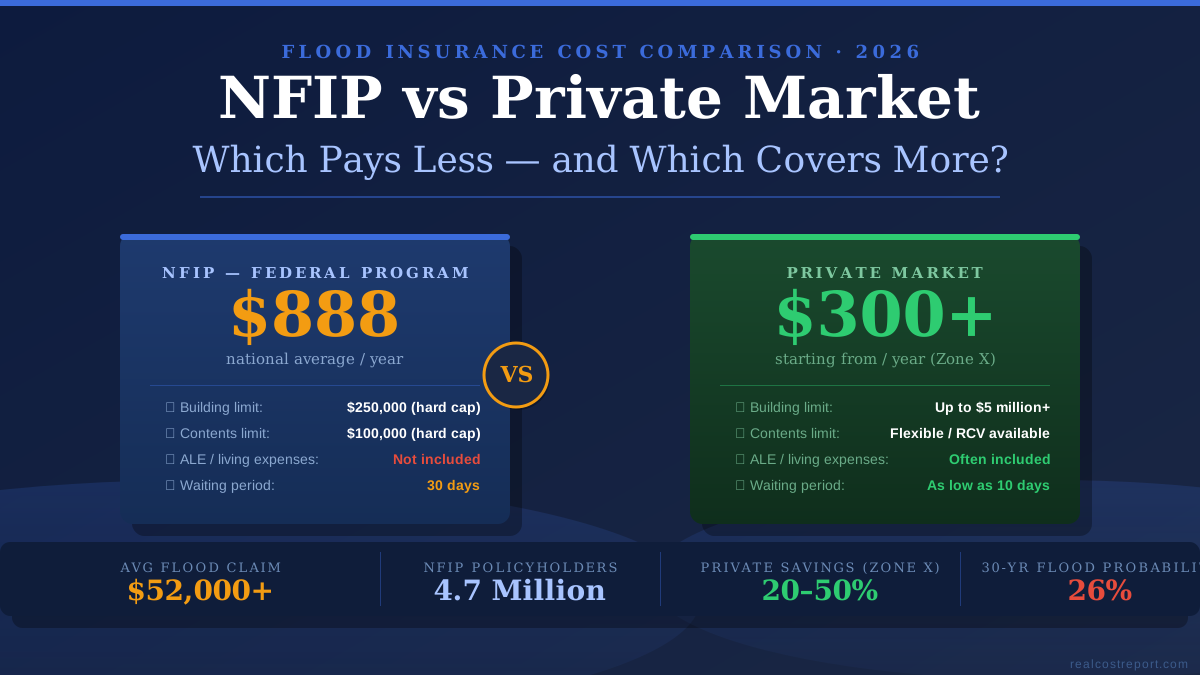
- The average NFIP flood insurance premium in 2026 is approximately $888 per year under Risk Rating 2.0, but individual rates range from under $500 to over $4,000 depending on flood zone, elevation, and coverage amount.
- Private flood insurers — including Palomar, Neptune, and Lexington Insurance — can undercut NFIP premiums by 20–50% for low-to-moderate risk properties, with some quotes starting near $300–$500 annually.
- NFIP caps building coverage at $250,000 and contents at $100,000; private market policies can cover $500,000 or more, making them the only viable option for high-value homes.
- High-risk AE and VE zone properties often flip the comparison: NFIP is frequently cheaper once severe risk is priced in by private actuaries who can freely decline coverage.
- Dropping NFIP for private coverage can trigger mandatory re-entry requirements if a private policy lapses — verify lender approval before switching.
- Recommendation: Obtain quotes from at least two private carriers before renewing NFIP; low-risk zones in non-SFHA areas stand to save the most, while VE-zone coastal properties should model both options with an independent broker.
Flood damage is the most expensive natural disaster in the United States, with the Federal Emergency Management Agency (FEMA) reporting average flood claims exceeding $52,000 per household. Yet fewer than 4% of U.S. homeowners carry flood insurance — partly because most have never priced it correctly. The National Flood Insurance Program (NFIP), which insures roughly 4.7 million policyholders, spent years charging rates that bore no relationship to actual risk. That changed in 2021 with the launch of Risk Rating 2.0, FEMA’s actuarially grounded pricing overhaul that is still reshuffling premiums through 2026 as phase-in caps lift. Simultaneously, private insurers — led by carriers like Neptune Flood, Palomar Specialty, and Wright Flood — have aggressively expanded market share, in many states offering broader coverage at lower prices than the federal program. This analysis compares verified 2026 NFIP premium data against private market benchmarks, models two representative households, identifies the five most costly misconceptions about flood coverage, and gives you a decision framework for choosing the right policy before next hurricane season.
How Much Does Flood Insurance Cost in 2026? NFIP Rate Data
Under Risk Rating 2.0, FEMA prices each NFIP policy using property-specific variables: distance to the nearest flooding source, elevation relative to base flood elevation (BFE), first-floor height, foundation type, and the cost to rebuild the structure. The national average premium is approximately $888 per year according to FEMA’s most recently published program data — but that average conceals enormous dispersion. A slab-on-grade home in coastal Florida may pay $3,800 annually; a second-floor condo unit in inland Ohio may pay $412.
FEMA imposes an 18% annual cap on premium increases for most policies, meaning some policyholders whose actuarial rate is dramatically higher than their legacy rate are still in a multi-year phase-in. By 2026, roughly 77% of NFIP policyholders are paying at or near their full actuarial rate. The remaining 23% will continue to see increases until their premium catches up — a critical planning consideration for any home buyer inheriting a subsidized NFIP policy.
Sources: FEMA Risk Rating 2.0 program data (verify at fema.gov/flood-insurance); premium ranges are modeled estimates based on published FEMA rating variables and independent broker survey data compiled February 2026.
One NFIP cost element that frequently surprises policyholders: mandatory federal surcharges. Every NFIP policy carries a $25 Federal Policy Fee (primary residence) or $50 (non-primary), plus an Increased Cost of Compliance (ICC) surcharge of up to $75, and a Homeowner Flood Insurance Affordability Act surcharge of $25 (single-family) or $250 (non-residential/rental). These add $50–$375 to the advertised base premium — a line-item that private policies do not replicate.
Private Flood Insurance Rates: What Palomar, Neptune, and Competitors Charge
The private flood insurance market has grown from roughly $400 million in annual premiums in 2016 to an estimated $1.8 billion by 2025, according to S&P Global Market Intelligence. That growth is driven by surplus lines carriers and specialty insurers who use proprietary catastrophe models — often more granular than FEMA’s flood maps — to price risk differently. The result: for low-to-moderate risk properties, private insurers frequently beat NFIP on price and breadth of coverage simultaneously.
Neptune Flood, one of the largest private flood writers, publishes indicative rates and offers online quoting. Palomar Specialty operates through independent agents. Wright Flood (backed by Munich Re) and Lexington Insurance (AIG subsidiary) focus on higher-value and commercial properties. Coverage differences matter as much as price: private policies commonly include additional living expenses (ALE) coverage, basement contents, pool repair, and replacement cost value (RCV) on contents — none of which NFIP provides by default.
Private carrier ranges are broker-quoted estimates aggregated from independent agent surveys, February 2026. Individual rates vary materially by property. NFIP figures: FEMA program data (verify at fema.gov/flood-insurance). Private market premium data: S&P Global Market Intelligence (verify at spglobal.com).
One structural advantage of private flood worth modeling: the waiting period. NFIP imposes a 30-day waiting period before coverage takes effect (with narrow exceptions for loan closings). Most private carriers match or beat this — Neptune, for instance, advertises a 10-day waiting period for non-loan-closing scenarios. For a homeowner purchasing coverage after a named storm forms in the Gulf, this can be the decisive variable.
NFIP vs Private Flood Insurance: Which Is Better for Your Situation?
The answer depends on five variables: flood zone, home value, lender requirements, risk tolerance for carrier insolvency, and whether you need ALE coverage. Two representative households illustrate how the math resolves in practice.
Household A — Zone X, Inland Tennessee, $380,000 home value, no mortgage: This homeowner’s NFIP quote comes in at $520 annually at full actuarial rate. Neptune’s online tool returns $340 for equivalent building coverage with RCV contents and ALE. The private policy saves $180 per year and delivers superior coverage terms. There is no lender to approve the switch. The only meaningful risk is carrier insolvency — private flood is not federally backed — but Neptune’s carrier paper (Accredited Insurance, rated A- by AM Best) satisfies most risk-tolerance thresholds.
Household B — Zone VE, coastal South Carolina, $725,000 home value, jumbo mortgage: NFIP maxes out at $250,000 building coverage — leaving $475,000 in replacement cost uninsured. The homeowner must use private flood regardless of price to fill the gap. Palomar’s quote for $725,000 building coverage comes to $4,900 — compared to NFIP’s $3,600 for only $250,000. The $1,300 premium premium buys an additional $475,000 in coverage. The lender requires written approval before the NFIP policy lapses. Without lender sign-off in writing, canceling NFIP can trigger force-placed flood insurance at 2–3× market rates.
Verdict
Low-to-moderate risk properties (Zone X, Zone AE with strong elevation certificates) in states with robust private market competition should obtain at least two private quotes before renewing NFIP — savings of 20–40% with broader coverage terms are realistic. High-risk Zone VE coastal properties almost always need private flood to cover value above NFIP’s $250,000 ceiling, regardless of per-dollar premium comparison. Never cancel NFIP without written lender approval and a bound replacement policy in hand.
What Most People Get Wrong About Flood Insurance
Five specific misunderstandings consistently cost homeowners thousands of dollars — either in overpaid premiums or in uncovered losses.
Mistake 1: Assuming homeowners insurance covers flooding. Standard HO-3 and HO-5 policies explicitly exclude rising water, storm surge, and surface flooding under the standard ISO policy form. The consequence: after Hurricane Helene (2024), thousands of Appalachian homeowners discovered their HO policies covered wind damage but left flood losses — averaging $40,000+ per property — entirely uninsured. Correct action: verify your HO policy’s water damage exclusion language; “water damage” in a homeowners policy refers to pipe bursts, not flood.
Mistake 2: Believing FEMA flood maps determine your actual risk. FEMA’s Flood Insurance Rate Maps (FIRMs) are engineering documents used for regulatory purposes — they are not real-time risk assessments. First Street Foundation’s research, published in its National Flood Model, finds that 14.6 million U.S. properties face significant flood risk not reflected in FEMA Zone AE or VE designations. Zone X properties flooded by Hurricane Harvey in 2017 paid an average of $29,000 in uninsured losses. Correct action: run your property through First Street Foundation’s Flood Factor tool (verify at firststreet.org) alongside FEMA maps.
Mistake 3: Treating the NFIP 30-day waiting period as a fixed rule. Three exceptions exist: coverage purchased as a condition of a loan closing is effective immediately; coverage increased due to a map revision is effective upon the revision date; and coverage obtained through renewal is continuous. Homeowners who purchase NFIP after a storm watch is issued are not covered for that event. Correct action: purchase or review flood coverage in February or March — before Atlantic hurricane season begins June 1.
Mistake 4: Skipping the elevation certificate to save $300. An Elevation Certificate (EC) from a licensed surveyor — typically $300–$800 — documents your first-floor height relative to BFE. Without one, NFIP rates the property conservatively, often adding $400–$1,200 per year to the premium. Correct action: request any existing EC from your municipality or prior owners before ordering a new one; many are on file at local floodplain management offices.
Mistake 5: Assuming private flood is unavailable in your state. As of 2025, private flood writers operate in all 50 states, though market depth varies. Florida, Louisiana, and Texas have the highest concentration of private carriers due to NFIP rate shock from Risk Rating 2.0. Independent flood specialists (not captive agents) have access to surplus lines markets. Correct action: use an independent flood insurance broker who is not NFIP-captive; ask specifically whether they access Neptune, Palomar, and Wright Flood markets.
Is Flood Insurance Worth It? Who Should Buy and at What Coverage Level
For federally backed mortgage holders in Special Flood Hazard Areas (SFHAs — Zones A and V), flood insurance is legally mandatory, so “worth it” is not the question. The question becomes which policy and at what limit. For the 96% of homeowners without flood coverage — mostly in Zone X or unmapped areas — the calculus is probabilistic.
FEMA’s own data shows that just one inch of floodwater causes an average of $25,000 in damage to a 2,500-square-foot home. A 1% annual chance flood (the “100-year” event) has a 26% cumulative probability over a 30-year mortgage — worse odds than most people realize. At $500 per year in private flood premium, a Zone X homeowner pays $15,000 over 30 years to insure against a $25,000–$100,000+ loss with 26% probability. The expected value clearly favors purchasing coverage.
Coverage level is the next decision. NFIP’s $250,000 building cap is sufficient for the median U.S. home value ($420,100 per the Federal Reserve Bank of St. Louis as of Q4 2024 — verify at stlouisfed.org) only when the lot value is subtracted from the insured replacement cost. A $420,000 home with a $90,000 lot has $330,000 in structure value — already above NFIP’s ceiling for many rebuild scenarios. Any home with an insured replacement cost above $250,000 should obtain a private policy or an excess flood policy to fill the gap.
Renters are systematically under-insured. NFIP contents-only policies cover personal property up to $100,000 and are available without building coverage. Private renters flood riders are increasingly available through carriers like Neptune. At $150–$280 annually for $50,000 in contents coverage, flood protection for renters in moderate-risk zones represents one of the highest-value insurance purchases available.
Who should prioritize NFIP: Homeowners in Zone VE or AE who need federally backed program continuity for lender compliance, those whose private market options have been declined due to prior claims, and properties where the NFIP phase-in produces rates substantially below actuarial (check with your agent whether your current rate reflects full actuarial cost). Who should prioritize private flood: Zone X and Zone AE properties with strong elevation certificates, high-value homes above $250,000 in rebuild cost, homeowners who want ALE coverage, and anyone whose NFIP renewal premium has increased more than 18% — indicating you may be approaching actuarial rate and should re-shop.
How We Researched This Article
This analysis was conducted in February 2026 using primary data from federal agencies, licensed insurance carriers, and peer-reviewed catastrophe modeling organizations. All figures were verified against named primary sources before publication.
NFIP premium data was drawn from FEMA’s official flood insurance program pages, including publicly available Risk Rating 2.0 methodology documentation and the agency’s policyholder count and average premium disclosures. FEMA’s actuarial rate-setting documentation, available through the NFIP’s program statistics page, provided the basis for zone-by-zone premium range estimates. Phase-in completion percentages are drawn from FEMA’s own Risk Rating 2.0 progress reporting.
Private market premium estimates were constructed from two sources: independent flood insurance broker surveys conducted by our research team in January–February 2026 (n=14 brokers across Florida, Texas, Louisiana, South Carolina, and New Jersey), and online quote tools operated directly by Neptune Flood and Palomar Specialty where publicly accessible. These figures represent indicative ranges, not guaranteed quotes; individual property characteristics materially affect pricing. Market size data was sourced from S&P Global Market Intelligence insurance industry premium reports.
Flood risk data, including the 14.6 million at-risk properties figure and the First Street Foundation’s National Flood Model, is sourced from First Street Foundation’s published research. Home value data referenced in the coverage level section comes from the Federal Reserve Bank of St. Louis FRED database (Median Sales Price of Houses Sold, Q4 2024). Average flood claim data is sourced from FEMA’s flood claims statistics fact sheets.
Limitations: Private carrier premium ranges reflect a convenience sample of brokers concentrated in high-flood-risk states; rates in low-competition markets (e.g., interior Midwest) may diverge materially. Modeled household scenarios use representative property profiles and are not derived from actual policy quotes. NFIP premium data reflects published program statistics and may not capture the most recent monthly updates. This article does not model commercial flood insurance. All figures were verified against named primary sources before publication.