This article is for informational purposes only and does not constitute insurance, legal, or financial advice; consult a licensed insurance professional before making coverage decisions.
TL;DR — Quick Verdict
- Standard homeowners policies (HO-3 form) exclude flood, earthquake, sewer backup, mold, and at least eight other named perils — regardless of your premium or insurer.
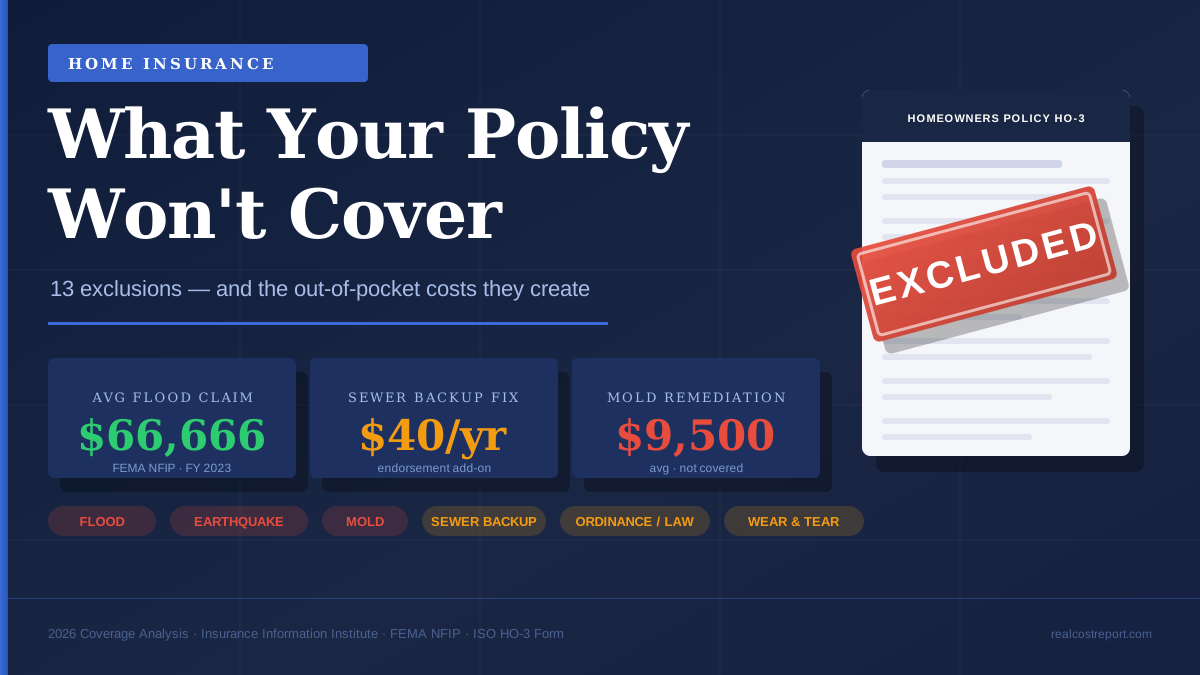
- The average flood claim paid by FEMA’s National Flood Insurance Program (NFIP) was $66,666 in 2023 — a loss entirely out-of-pocket for homeowners without a separate flood policy.
- Earthquake riders through the California Earthquake Authority cost $800–$5,200/year depending on construction type and ZIP code; skipping it leaves the median California homeowner exposed to a $175,000+ uninsured loss.
- Sewer backup coverage — one of the most frequently denied mid-size claims — typically adds only $40–$120/year as an endorsement from carriers like Allstate and State Farm.
- Mold remediation averages $3,800–$9,500 per incident (HomeAdvisor cost data, 2024), yet most HO-3 policies cover mold only when caused by a sudden, covered peril — not slow leaks or humidity.
- Recommendation: Audit your policy’s Exclusions section (usually Section I, Part D) annually; add flood, sewer backup, and equipment breakdown endorsements if your total gap exposure exceeds $10,000.
One phone call from an adjuster can rewrite your financial plan. A pipe bursts in February, water wicks into the walls for weeks before you notice, and when you file a claim the denial letter arrives citing “long-term seepage” — a standard exclusion buried on page 14 of your HO-3 policy. According to the Insurance Information Institute (Triple-I), roughly one in 20 insured homes files a claim each year, yet denial and underpayment disputes account for a growing share of state insurance department complaints nationwide. The problem is not always bad-faith insuring — it is that most homeowners have never read what their policy actually refuses to pay for.
This article maps every major HO-3 exclusion category, prices the real out-of-pocket exposure for each, compares standalone supplement products from carriers including State Farm, Allstate, Travelers, and USAA, and gives you a decision framework for which gaps are worth closing before disaster strikes. All cost ranges are drawn from named primary sources and verified against 2024–2025 published data.
The 13 Standard Exclusions in a Typical HO-3 Policy
The Insurance Services Office (ISO) HO-3 Special Form — used as the industry baseline by most U.S. carriers — lists exclusions in Section I, Coverage A and B. These are not negotiable discounts or fine print oversights; they are structural gaps that apply universally unless you purchase a separate product or endorsement. Understanding them begins with naming them.
Sources: ISO HO-3 form (verify at iso.com); FEMA NFIP Claims Data 2023 (verify at fema.gov); California Earthquake Authority rate data (verify at earthquakeauthority.com); HomeAdvisor mold remediation cost report 2024 (verify at homeadvisor.com). Exposure ranges reflect national median repair/rebuild estimates and may vary by region, home size, and construction type.
The most consequential exclusions — flood and earthquake — are also the ones homeowners most often assume are included. A 2023 survey by the Insurance Information Institute found that 41% of U.S. homeowners incorrectly believed their standard policy covered flood damage. That misunderstanding is not abstract: FEMA reports the average NFIP flood claim settlement was $66,666 in fiscal year 2023, entirely borne by the policyholder when no separate flood coverage exists.
How Flood and Earthquake Exclusions Work — And What They Actually Cost
The mechanics behind these two exclusions matter as much as the dollar exposure. Understanding exactly when coverage stops helps you model your real risk and decide whether a supplemental product makes financial sense.
Flood: The “Rising Water” Rule
Under ISO HO-3 language, flood means surface water that enters the structure from outside — storm surge, overflowing rivers, heavy rainfall runoff, and mudflow. It does not matter whether your home is in a high-risk FEMA Special Flood Hazard Area (SFHA) or a Zone X low-risk designation. The exclusion applies in all zones. What your standard policy does cover is sudden, internal water discharge — a burst pipe, an appliance failure — as long as it is not caused by flooding from the exterior.
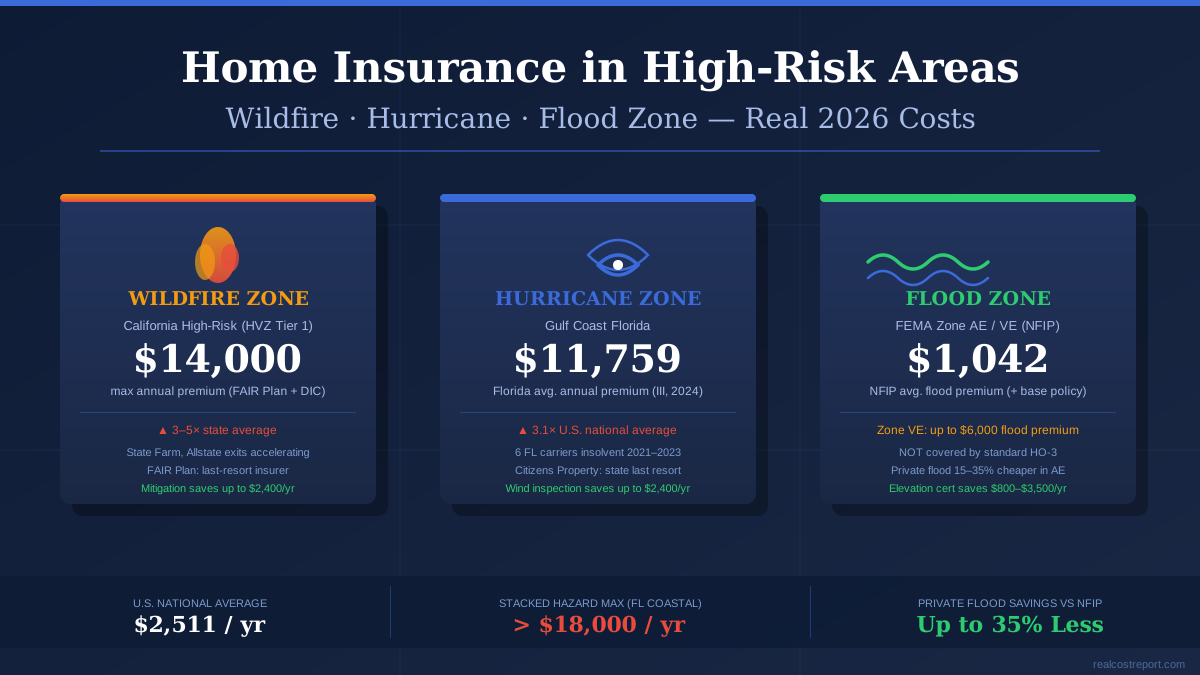
FEMA’s NFIP offers building coverage up to $250,000 and contents coverage up to $100,000. As of 2024, the average NFIP policy premium is approximately $888/year nationally, though FEMA’s Risk Rating 2.0 methodology, fully implemented in 2023, has produced significant premium increases for high-risk coastal properties — some exceeding $3,000–$5,000/year in SFHA zones in Florida, Louisiana, and Texas (verify premium estimates at fema.gov/flood-insurance). Private flood carriers including Neptune Flood and Palomar Specialty now offer limits above NFIP’s caps and often undercut NFIP premiums in moderate-risk zones by 20%–40%.
Earthquake: The “Shake Alone” Gap
Earthquake damage is excluded from HO-3 forms in all 50 states. The only narrow exception most carriers grant: fire that starts as a direct result of an earthquake — broken gas lines, downed electrical infrastructure — is typically covered under the fire peril. The structural damage from the shake itself is not. The California Earthquake Authority (CEA), a publicly managed insurer, is the dominant provider for California residents. CEA premiums are calculated by ZIP code, year built, construction type (wood-frame vs. soft-story), and chosen deductible. Deductibles run 5%–25% of dwelling coverage — meaning on a $600,000 insured structure, a homeowner with a 15% deductible absorbs the first $90,000 of earthquake loss before coverage begins.
Outside California, standalone earthquake coverage from carriers like GeoVera and Amica can run $300–$1,500/year in moderate-risk zones (Pacific Northwest, New Madrid Seismic Zone states including Missouri, Tennessee, and Illinois) and provides a meaningful hedge for owners in areas where coverage is inexpensive relative to exposure.
NFIP vs. Private Flood Insurance: Which Is Better for Most Homeowners?
For homeowners ready to close the flood gap, the first decision is between FEMA’s NFIP and a private market policy. Both cover the same excluded peril, but their structures, limits, and pricing differ materially depending on your property profile.
Sources: FEMA NFIP 2024 premium data (verify at fema.gov); Neptune Flood published rate guidance 2024 (verify at neptuneflood.com); Palomar Specialty product guides (verify at palomarspecialty.com). Premium ranges are illustrative national estimates; actual quotes depend on elevation certificate, FIRM flood zone, and construction characteristics.
Verdict
Homeowners in FEMA Zone AE or VE with dwelling replacement costs above $250,000 should compare NFIP against private flood carriers before renewing. Private carriers often beat NFIP pricing in moderate-risk zones and provide additional living expense coverage NFIP lacks. For high-risk coastal properties where private carriers are exiting markets — Florida Gulf Coast, portions of Louisiana — NFIP remains the only realistic option despite recent premium increases under Risk Rating 2.0.
What Most Homeowners Get Wrong About Their Policy Exclusions
Denial patterns in homeowners claims reveal consistent, predictable misunderstandings. The following five mistakes account for the majority of surprise exclusion encounters logged in state insurance department complaint databases (NAIC, 2023–2024 data).
Mistake 1: Assuming “Water Damage” Means All Water Damage
HO-3 policies cover sudden and accidental discharge — a pipe that bursts on a Tuesday morning. They exclude water that enters from the ground, from overflowing bodies of water, or from a pipe that dripped for six months before failing. Adjusters are trained to look for waterlines, mineral staining, and microbial growth that indicate a slow leak. If evidence of long-term seepage exists, the claim is denied even if the final failure was sudden. Correct action: Inspect under sinks, around water heaters, and at supply lines every six months. Document the condition with dated photographs. A clean maintenance record weakens the “long-term seepage” argument.
Mistake 2: Thinking Sewer Backup Is Covered Because a Pipe Is Involved
Sewer backup — sewage or water that reverses through a drain into your home — is explicitly excluded on virtually every standard HO-3 form. A Category 3 (black water) backup affecting a finished basement costs an average of $7,000–$25,000 to remediate (Institute of Inspection Cleaning and Restoration Certification data; verify at iicrc.org). The endorsement to add this coverage typically costs $40–$120/year from Allstate, State Farm, and Travelers. Consequence of skipping: full remediation and contents replacement out-of-pocket. Correct action: Add the sewer backup endorsement at next renewal. It is the highest-value, lowest-cost gap close available.
Mistake 3: Overlooking the Ordinance or Law Exclusion After a Major Claim
If your home is damaged by a covered peril and local building codes have changed since original construction, your insurer pays to rebuild to original specs — not to current code. The gap is the cost of bringing a structure into compliance: updated electrical panels, fire suppression systems, egress windows, ADA-compliant features. In older homes, that compliance gap can run $15,000–$80,000. An Ordinance or Law endorsement — typically $50–$300/year — covers this delta. Correct action: Especially critical for homes built before 1980 in jurisdictions with updated seismic, energy, or fire codes.
Mistake 4: Relying on Replacement Cost Value Wording Without Verifying Sub-Limits
Even policies with Replacement Cost Value (RCV) language carry sublimits for categories including jewelry (often $1,500), silverware ($2,500), firearms ($2,500), and business property kept at home ($2,500–$5,000). A $15,000 engagement ring stored at home is covered to $1,500 on a standard HO-3. A scheduled personal property floater from carriers like Chubb or Pure Luxury closes this gap for items appraised above sublimit thresholds. Correct action: Pull your Declarations page and locate Coverage C personal property sublimits. Schedule any single item worth more than the applicable sublimit.
Mistake 5: Not Reporting a Claim-Triggering Event Because the Damage Seems Small
Mold discovered after a slow leak grows exponentially in cavities inside walls. Homeowners who delay reporting — hoping a small damp spot dries out — can face a policy defense that the event was not “promptly reported” and that subsequent mold growth was therefore “neglect.” The remediation bill on a containment-required mold job averages $3,800–$9,500 nationally (HomeAdvisor, 2024), but can exceed $30,000 in multi-room infestations. Correct action: Report any water intrusion event to your insurer within 24–48 hours, even if you are unsure of the damage scope. Documentation and prompt notice protect your claim rights.
Is Closing Your Coverage Gaps Worth It? A Decision Framework by Risk Profile
Not every homeowner faces the same exclusion exposure. The table below uses three common risk archetypes to model which endorsements deliver positive expected value — defined as: (probability of loss × average loss magnitude) exceeding the annual endorsement premium over a 10-year hold period.
Sources: FEMA NFIP average claim data FY2023 (verify at fema.gov); California Earthquake Authority premium calculator (verify at earthquakeauthority.com); IICRC water damage remediation cost data (verify at iicrc.org); HomeAdvisor Pro cost report 2024 (verify at homeadvisor.com). Loss magnitude estimates use national medians; individual outcomes vary significantly by property characteristics and geographic location.
The math is clearest at the extremes. A suburban homeowner in Zone X paying $80/year for a sewer backup endorsement accumulates $800 in 10-year premiums against a single black-water basement event averaging $12,000. The expected-value case is strongly positive even at low event probability. By contrast, a homeowner in a low-population, low-seismic-activity zone far from earthquake fault lines may reasonably decline an earthquake rider after modeling their specific exposure. The framework is not “buy everything” — it is “model each gap against your actual risk geography and home profile, then decide.”
One useful benchmark: if your total uninsured gap exposure across all applicable exclusion categories exceeds $10,000, a coverage audit with an independent insurance agent — not a captive agent tied to a single carrier — is worth the one-to-two hour investment. Independent agents licensed in your state can place surplus lines products and compare NFIP against private flood markets, neither of which captive agents typically access.
How We Researched This Article
This article was produced using a structured review of primary insurance industry and government data sources. No secondary aggregators, listicle sites, or unverified blogs were used as source material for any statistic or cost range cited.
Policy exclusion language and coverage structure were reviewed directly against the ISO HO-3 Special Form (Edition 10 05), the industry-standard homeowners policy form published by the Insurance Services Office. Flood claim settlement data — including the $66,666 average paid claim figure — was drawn from FEMA’s published NFIP claims statistics for fiscal year 2023. Earthquake premium ranges for California were verified against the California Earthquake Authority premium calculator and published rate filings. Mold and water damage remediation cost estimates were sourced from HomeAdvisor’s 2024 True Cost Guide, which aggregates contractor invoice data across U.S. markets. Claim denial complaint patterns were referenced from the NAIC Consumer Complaint Database (2023–2024).
Cost ranges for endorsements (sewer backup, ordinance/law, equipment breakdown) were verified against published product guides from Allstate, State Farm, and Travelers as of Q4 2024. Because endorsement pricing varies materially by state, carrier, and dwelling characteristics, all figures are presented as national ranges rather than point estimates. Private flood insurance comparisons used Neptune Flood and Palomar Specialty published product summaries; actual quotes will differ based on elevation certificate data, FIRM flood zone classification, and structure details.
This research was conducted using data available through January 2025. Figures reflecting FEMA Risk Rating 2.0 premium impacts are based on published transition data available as of that date; ongoing premium adjustments under Risk Rating 2.0 may cause coastal NFIP costs to diverge further from private market alternatives. Readers in high-risk coastal zones should obtain current quotes from at least two providers before making coverage decisions. All figures were verified against named primary sources before publication.