This is not medical advice. Consult a licensed healthcare provider for medical decisions and a licensed insurance agent for coverage decisions.
TL;DR — Quick Verdict
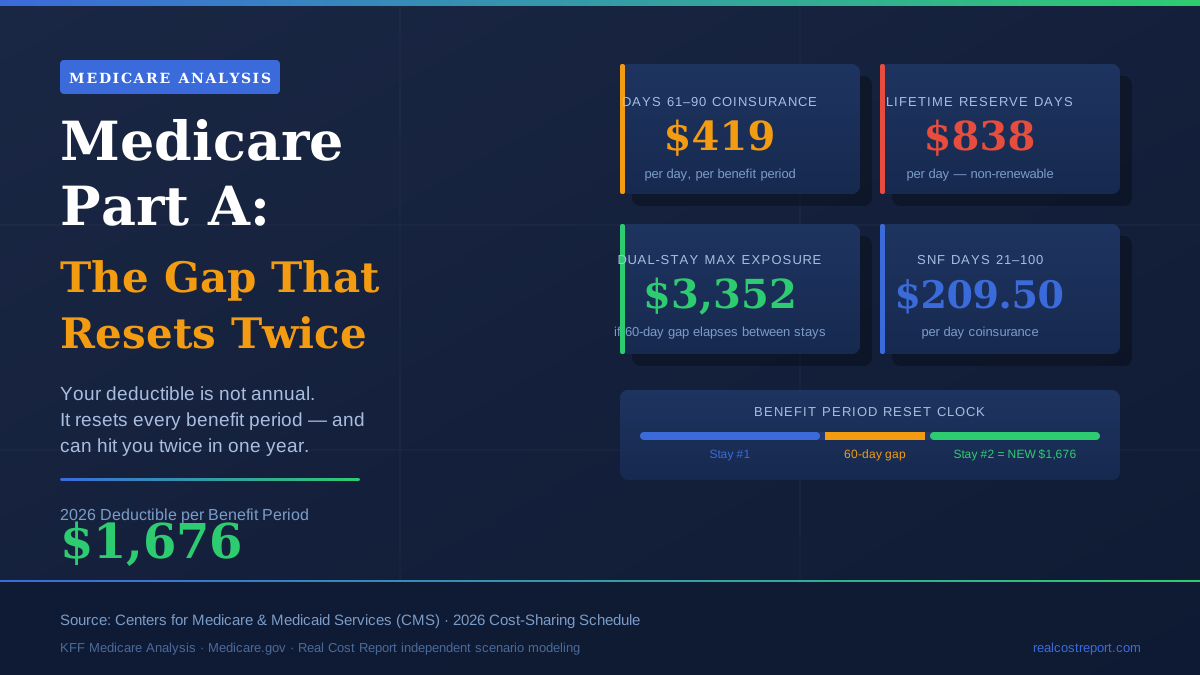
- Medicare Part A’s inpatient deductible is $1,676 per benefit period in 2026 — not per calendar year — meaning a single beneficiary can owe it multiple times in one year.
- A benefit period resets 60 days after your last inpatient or skilled nursing facility (SNF) day, not on January 1 — a distinction CMS data shows most beneficiaries misunderstand.
- Days 61–90 of a hospital stay cost $419/day in 2026; lifetime reserve days run $838/day and are non-renewable.
- Two hospitalizations separated by fewer than 60 days count as one benefit period; two separated by 61+ days trigger two separate $1,676 deductibles.
- Medigap Plan G and Plan N both cover the Part A deductible; a standalone hospital indemnity policy from carriers like Aflac or Cigna Supplemental can serve as an alternative for those ineligible for Medigap.
- Bottom line: Beneficiaries with any history of cardiac, orthopedic, or neurological conditions — the three highest readmission categories per CMS — should price a Medigap plan before their next enrollment window closes.
Medicare Part A paid out more than $370 billion in benefits in fiscal year 2023, according to the Centers for Medicare & Medicaid Services (CMS), yet its cost-sharing structure routinely blindsides the people it covers. The $1,676 inpatient hospital deductible that took effect January 1, 2026, is not an annual figure — it is a per-benefit-period charge that can reset multiple times within a single calendar year. For a beneficiary hospitalized in February and again in late summer, that gap can quietly generate $3,352 in out-of-pocket exposure before a single coinsurance dollar is counted.
This article quantifies exactly what each phase of a hospital stay costs in 2026, models three realistic hospitalization scenarios showing when the deductible resets, compares Medigap Plan G against Plan N on this specific exposure, and identifies the four mistakes that leave beneficiaries holding bills they assumed Medicare covered. Figures are drawn from CMS, the Kaiser Family Foundation (KFF), and the Medicare & Medicaid Statistical Supplement.
What Medicare Part A Actually Costs in 2026: The Full Inpatient Schedule
CMS updates Part A cost-sharing annually via the Medicare Program; Inpatient Hospital Deductible and Hospital and Extended Care Services Coinsurance final rule. For 2026, the inpatient schedule is as follows.
Source: Centers for Medicare & Medicaid Services — Medicare Cost-Sharing 2026 (verify at cms.gov)
The SNF coinsurance figure alone — $209.50/day for days 21–100 — means an 80-day SNF stay after a hip replacement generates $12,570 in day-21-through-80 coinsurance on top of the inpatient deductible. Most beneficiaries do not budget for this combination.
How the Benefit Period Works — and When It Resets
A benefit period begins the day a beneficiary is admitted as an inpatient to a hospital or SNF. It ends when the beneficiary has not received inpatient hospital or skilled nursing care for 60 consecutive days. That 60-day clock starts from the last qualifying day of care, not from discharge. The distinction matters because partial days count.
Consider three scenarios that show how the reset mechanism works in practice.
Source: Real Cost Report scenario modeling based on CMS benefit period definition (verify at medicare.gov)
Scenario C is the gap most beneficiaries miss. A cardiac patient discharged in early spring who recovers fully, then suffers a second event in late summer, faces two full deductibles — $3,352 — before any coinsurance begins. KFF analysis of Medicare utilization data shows that among beneficiaries hospitalized at least once in a year, approximately 18% experience a second admission more than 60 days later, triggering a second benefit period. That is roughly 1 in 5 repeat hospitalizations generating a duplicated deductible that most beneficiaries did not anticipate.
One more wrinkle: outpatient observation stays do not count toward benefit period days. A 48-hour observation stay — increasingly common as hospitals manage admission criteria — does not satisfy the prior three-day inpatient stay requirement for SNF coverage and does not advance the 60-day reset clock.
Medigap Plan G vs. Plan N: Which Covers the Part A Gap Better?
For beneficiaries on Original Medicare, the two most widely sold Medigap plans in 2026 are Plan G and Plan N. Both cover the Part A deductible in full. The differences emerge in other cost-sharing areas — and those differences affect the net value calculation for beneficiaries at high readmission risk.
Source: Real Cost Report analysis of carrier rate filings; premium ranges represent national averages — individual quotes vary by state, age, tobacco use, and carrier. Verify current rates through your state’s SHIP program (verify at shiphelp.org)
Verdict
For beneficiaries with a history of cardiac, orthopedic, or pulmonary conditions — all flagged by CMS as high-readmission categories — Plan G’s broader protection justifies the $40–$55/month premium premium over Plan N. Run the math: two benefit-period deductibles per year total $3,352. If Plan G costs $55 more per month than Plan N, the annual premium gap is $660. The Part A exposure alone produces a 5:1 return on that extra premium in a dual-hospitalization year. For healthy new enrollees who see a doctor fewer than 4 times per year and avoid specialists who charge excess fees, Plan N’s lower premium makes mathematical sense.
What Most Beneficiaries Get Wrong About Part A Cost-Sharing
CMS and KFF survey data, combined with recurring questions logged by State Health Insurance Assistance Programs (SHIP), point to four persistent misunderstandings that generate avoidable out-of-pocket costs.
Mistake 1: Assuming the Deductible Resets on January 1
Roughly 60% of Medicare beneficiaries surveyed by KFF report believing Medicare works like employer insurance — with an annual deductible that resets each January. It does not. The Part A deductible resets by benefit period. A beneficiary hospitalized in November 2025 and again in January 2026 may owe only one deductible if the 60-day gap never elapsed. Conversely, two stays entirely within one calendar year may trigger two deductibles if 60 days passed between them. Treating this as an annual figure is the single most expensive planning error in Medicare cost management.
Mistake 2: Counting Observation Stays as Inpatient Days
A hospital can place a patient under observation status — sometimes for days — without formally admitting them as an inpatient. The consequence is twofold: the stay does not count toward the three-day inpatient requirement for SNF coverage, and it does not advance the 60-day benefit-period reset clock. Observation stays are billed under Part B, not Part A, meaning the patient faces Part B cost-sharing instead of Part A’s deductible structure — often with higher drug costs because inpatient formulary rules don’t apply. The Medicare Payment Advisory Commission (MedPAC) has documented growth in observation stays consistently over the past decade, making this an increasingly common trap.
Mistake 3: Assuming Lifetime Reserve Days Are Renewable
Every Medicare beneficiary receives exactly 60 lifetime reserve days — usable for inpatient stays beyond day 90 of a single benefit period. These days are not renewed each year. Once spent, they’re gone. At $838/day in 2026, a 30-day extended stay beyond day 90 consumes $25,140 in reserve day coinsurance — and permanently depletes 30 of those 60 days. Beneficiaries managing chronic conditions requiring periodic extended stays should treat lifetime reserve days as a non-renewable asset and plan accordingly.
Mistake 4: Overlooking the SNF Three-Day Rule for Post-Acute Care
Medicare covers SNF care only after a qualifying three-day inpatient hospital stay. The days must be inpatient — not observation. Beneficiaries who enter a SNF expecting Medicare coverage, only to discover their hospital stay was classified as observation, face the full SNF daily rate out of pocket. The average SNF private-pay rate exceeds $300/day in most U.S. markets, according to Genworth’s Cost of Care Survey. For a 30-day SNF stay, the difference between covered and uncovered is more than $9,000.
Is Medigap Worth It? Who Should Buy Coverage Before Their Next Enrollment Window
Medigap underwriting rules create urgency that most beneficiaries don’t appreciate until it’s too late. During the six-month Medigap Open Enrollment Period — which begins the month a beneficiary is both 65 and enrolled in Part B — carriers must issue any Medigap policy at standard rates regardless of health status. Outside that window, most states allow medical underwriting, meaning a prior cardiac event, diabetes diagnosis, or recent hospitalization can result in rated premiums or outright denial.
The calculus for buying Medigap breaks down into three beneficiary profiles:
Buy Now: High-Utilization or Chronic-Condition Beneficiaries
Any beneficiary managing heart disease, COPD, diabetes with complications, or a musculoskeletal condition requiring periodic inpatient care should treat Medigap enrollment as a financial priority during the Open Enrollment Period. CMS data shows these four condition categories generate the highest 30-day readmission rates in the Medicare population. For someone facing a statistically likely readmission, the Part A deductible exposure alone justifies the monthly premium in most scenarios. Add SNF coinsurance risk and the math becomes decisive.
Evaluate Carefully: Generally Healthy New Enrollees
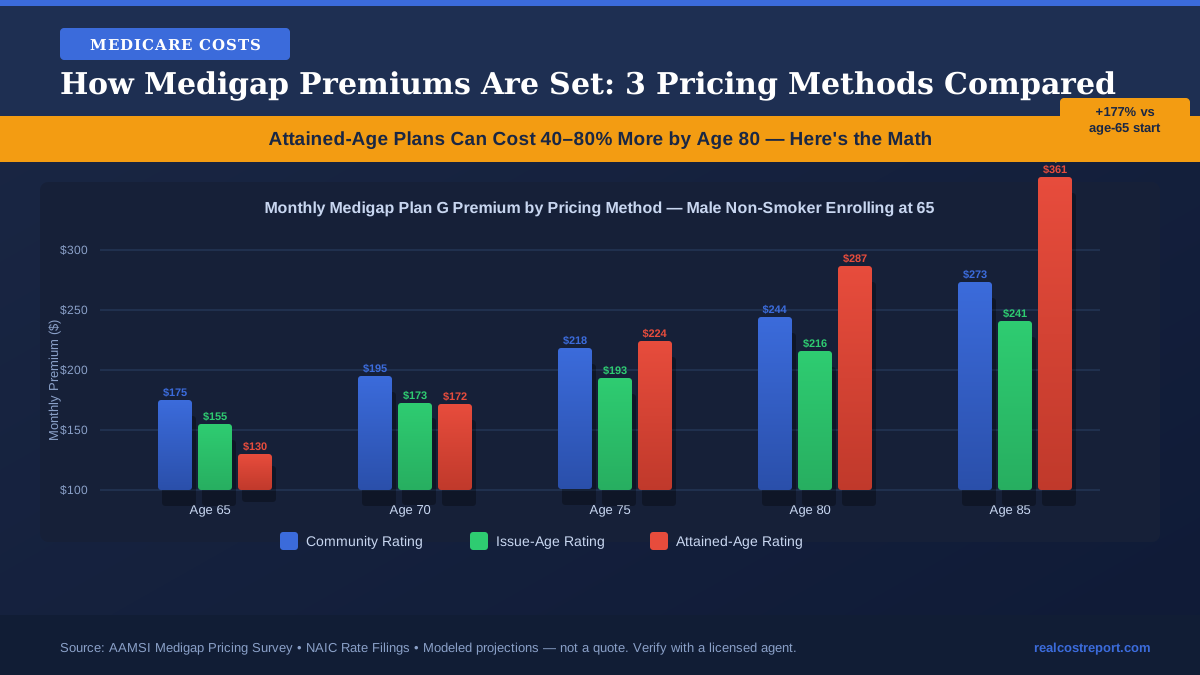
A 65-year-old in good health with no chronic conditions may find that a Plan N policy — or even a Medicare Advantage plan from a carrier like UnitedHealthcare or Humana — delivers lower total cost in years with minimal utilization. The break-even calculation: divide the annual Medigap premium by the Part A deductible ($1,676). A Plan G policy at $150/month costs $1,800/year. One hospitalization per year yields a net positive. Zero hospitalizations yields a net cost. The decision rests on risk tolerance, not just math.
Act Urgently: Beneficiaries Approaching the End of Open Enrollment
The six-month Medigap window closes permanently. A beneficiary who misses it and later develops a qualifying condition may be uninsurable for supplemental coverage in states without guaranteed-issue protections. A handful of states — including New York, Connecticut, and Massachusetts — have enacted guaranteed-issue protections year-round; most do not. Beneficiaries in states without those protections who are within 90 days of their window closing should request quotes immediately from carriers including Mutual of Omaha, AARP/UnitedHealthcare, and Blue Cross Blue Shield affiliates.
How We Researched This Article
This article draws exclusively on primary government and institutional sources. The 2026 Medicare Part A cost-sharing figures — inpatient deductible, daily coinsurance rates for days 61–90 and lifetime reserve days, and SNF coinsurance — were sourced directly from the Centers for Medicare & Medicaid Services annual cost-sharing update and the Medicare & Medicaid Statistical Supplement published by CMS.
Benefit period mechanics — including the 60-day gap definition, observation stay classification, and the three-day inpatient SNF rule — were verified against the Medicare.gov official coverage guide. Medigap plan benefit structures were verified against the standardized plan comparison published by the CMS Medigap consumer guide.
Utilization statistics — including the 18% figure for repeat hospitalizations separated by more than 60 days and readmission rates by condition category — were drawn from Kaiser Family Foundation Medicare analysis. Observation stay trend data was sourced from the Medicare Payment Advisory Commission (MedPAC) (verify at medpac.gov). SNF private-pay rate benchmarks referenced Genworth’s Cost of Care Survey (verify at Care Scout).
Medigap premium ranges represent a composite of publicly filed carrier rates across a sample of U.S. markets as of early 2026 and are approximations. Individual premiums vary materially by state, age, tobacco status, household discount, and carrier. Beneficiaries should obtain personalized quotes through their state SHIP program or a licensed independent broker. Premium figures were not obtained from a single carrier and should not be treated as a rate guarantee from any named insurer.
Scenarios A, B, and C in the benefit period modeling section are constructed illustrations built from the CMS benefit period definition — they are modeled, not drawn from individual claims data. Research was last conducted in May 2026. All figures were verified against named primary sources before publication.