This is not medical advice. Consult a licensed healthcare provider for medical decisions and a licensed insurance agent for coverage decisions.
TL;DR — Quick Verdict
- The average Medicare Part D premium in 2026 is approximately $46.50/month, but plans in the same county range from under $1 to over $120/month — formulary match determines whether that premium is money well spent.
- CMS capped out-of-pocket drug costs at $2,000 for 2025 and 2026 under the Inflation Reduction Act; once you hit that ceiling, covered drugs cost $0 for the rest of the year.
- Choosing a plan based solely on the lowest premium is the single most expensive mistake enrollees make — a $12/month plan can charge $180 for a Tier 3 generic your $45/month plan covers at $10.
- Plans from SilverScript (CVS Health), Humana, and UnitedHealthcare dominate Part D enrollment but differ sharply by formulary depth, pharmacy network, and preferred cost-sharing tiers.
- Run Medicare’s Plan Finder tool every October during Open Enrollment — plan formularies change annually and your cheapest plan in 2024 may not cover your drug at all in 2026.
- Recommendation: Enter your exact drugs into Medicare Plan Finder, sort by “estimated annual drug + premium cost,” and verify your preferred pharmacy is in-network before enrolling.
Medicare beneficiaries collectively leave hundreds of millions of dollars on the table each year by choosing Part D drug plans without checking whether their specific medications are even on the formulary. According to the Kaiser Family Foundation, the average enrollee in a stand-alone Prescription Drug Plan (PDP) pays $541 in annual premiums — yet total annual drug costs including cost-sharing can vary by $1,500 or more between two plans covering the same zip code. The Centers for Medicare and Medicaid Services (CMS) reported that 50.5 million people were enrolled in Part D as of 2024, making it one of the most consequential — and most misunderstood — enrollment decisions in retirement. This article shows you how formularies work, what drives cost differences between plans from SilverScript, Humana, and Wellcare, how to model your actual out-of-pocket costs before you enroll, and the five mistakes that turn a low-premium plan into a high-cost disaster.
What Medicare Part D Actually Costs in 2026: Premiums, Deductibles, and the New $2,000 Cap
Part D cost structure has three layers: the monthly premium, the annual deductible, and cost-sharing at the pharmacy counter. In 2026, the CMS-set standard deductible is $590 — meaning you pay full drug costs until you’ve spent $590 out of pocket, after which cost-sharing kicks in. Not every plan uses the standard deductible; many waive it for lower tiers. Understanding all three layers together is what separates informed enrollees from those who discover a surprise bill in February.
The most consequential change in recent memory took effect January 1, 2025: the Inflation Reduction Act’s $2,000 annual out-of-pocket cap on covered Part D drugs. Before this change, catastrophic drug costs could run $7,000 or higher per year. Now, once your spending reaches $2,000 — counting deductible, copays, and coinsurance — covered drugs cost you nothing for the remainder of the calendar year. This cap resets every January 1.
Source: Centers for Medicare and Medicaid Services (CMS) — Medicare Part D 2025 Landscape Source Files and CMS IRMAA tables (verify at cms.gov); IRA $2,000 cap per the Inflation Reduction Act, Public Law 117-169. Data last verified May 2025.
IRMAA is the hidden surcharge most pre-retirees fail to anticipate. If your Modified Adjusted Gross Income in 2023 exceeded $106,000 as an individual (or $212,000 as a couple), you owe an additional monthly surcharge on top of your plan’s premium — paid directly to Medicare, not your plan. At the highest income bracket, that surcharge exceeds $81/month in 2025, added to whatever premium your chosen plan charges. Plan accordingly if a one-time capital gain or Roth conversion bumped your income two years prior.
How Formularies Work: Tiers, Exceptions, and Step Therapy
A formulary is a plan’s list of covered drugs, organized into tiers that determine your cost-sharing. Every Part D formulary must cover at least two drugs in each therapeutic category and all drugs in six “protected” classes: immunosuppressants, antidepressants, antipsychotics, anticonvulsants, antiretrovirals, and antineoplastics. Beyond those minimums, plans have wide latitude — and they use it aggressively to steer enrollees toward lower-cost alternatives.
Standard tiering structures run five levels, though some plans use six. Your drug’s tier assignment is the single biggest driver of what you pay per fill. A drug your doctor has prescribed for years can be on Tier 2 at one plan and Tier 4 at another — a difference of $80 or more per 30-day supply.
Source: CMS Part D formulary tier design guidance (verify at cms.gov); copay ranges reflect 2025 CMS landscape data aggregated across stand-alone PDPs nationally.
Step therapy is a formulary management tool that requires you to try a lower-cost drug before the plan will cover your prescribed medication. If you’re already stable on a drug that requires step therapy under a new plan, you can request an exception — and Medicare requires plans to have a formulary exception process. The catch: exceptions are not guaranteed, they require physician documentation of medical necessity, and processing takes up to 72 hours (24 hours for expedited requests). Never switch plans assuming your current drug regimen will be automatically covered at the same tier.
Mid-year formulary changes are also legal under CMS rules, with restrictions. Plans can move a drug to a higher tier or add prior authorization requirements mid-year — but only if the drug is new to market or the FDA changes its approval status. If your drug is already on the formulary at enrollment, the plan must maintain that coverage for you through December 31. Enrollees who understand this rule can push back against mid-year cost increases.
SilverScript vs Humana vs Wellcare: Which Part D Plan Is Cheaper for Real Drug Regimens?
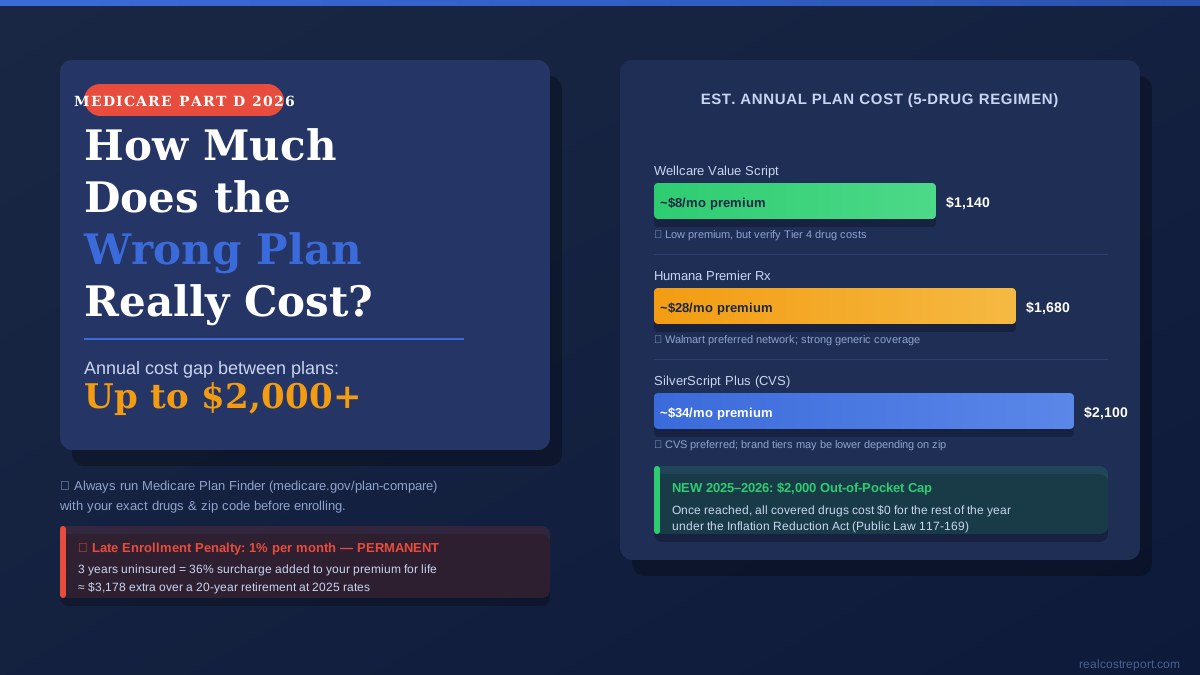
The three largest stand-alone Part D prescription drug plan sponsors — SilverScript (backed by CVS Health), Humana, and Wellcare (backed by Centene) — collectively cover a majority of PDP enrollees nationwide. Premium comparisons alone are meaningless. The right comparison models total annual cost — premium + deductible + cost-sharing — against a specific drug list in a specific zip code. Below is a modeled scenario for a common five-drug regimen for a beneficiary in a mid-sized metro market (scenario only; run Medicare Plan Finder for your specific zip code and drug list).
Sample regimen modeled: Lisinopril 10mg (generic antihypertensive), Atorvastatin 40mg (generic statin), Metformin 1000mg (generic diabetes), Eliquis 5mg (brand anticoagulant), Jardiance 10mg (brand diabetes). This combination represents one of the most common five-drug profiles among Medicare beneficiaries aged 65–74.
Source: CMS Medicare Plan Finder (verify at medicare.gov/plan-compare); premium figures are national representative averages from the 2025 CMS PDP Landscape Source File — individual plan costs vary by zip code. Always run Plan Finder with your specific drugs and zip code for accurate cost modeling. Figures verified May 2025.
The critical variable above is Eliquis placement. Bristol-Myers Squibb’s Eliquis (apixaban) is one of the most widely prescribed anticoagulants among seniors, and its formulary tier varies significantly across plans. On a plan where Eliquis sits at Tier 4 with no deductible waiver, a beneficiary filling 90-day supplies could pay $300–$400 per fill out of pocket before reaching the $2,000 cap — after which it’s free. On a plan that has negotiated preferred status for Eliquis, cost-sharing may be substantially lower. A $90/year premium difference disappears fast when one drug fill costs $250 more per quarter.
Verdict
For a beneficiary taking three or more brand or specialty drugs, plan premium is a poor proxy for total cost. Run Medicare Plan Finder with your actual drug list, select your preferred pharmacy, and compare “estimated annual drug cost + premium” as a single number. For enrollees taking only Tier 1–2 generics, the lowest-premium plan with a preferred pharmacy at your preferred chain (CVS for SilverScript, Walmart for Wellcare) often wins. Never choose based on premium alone.
What Most Medicare Enrollees Get Wrong About Part D
After analyzing common enrollment errors documented by the Medicare Rights Center and the CMS annual beneficiary survey, five mistakes account for the majority of avoidable overspending on Part D. Each carries a measurable financial consequence.
Mistake 1: Enrolling in the cheapest-premium plan without checking the formulary. A $9/month plan that doesn’t cover your statin at Tier 1 — or lists your brand anticoagulant as a non-formulary drug — can cost $400–$800 more per year in cost-sharing than a $45/month plan that covers both drugs preferentially. The correct action: enter every drug you take, including dose and frequency, into Medicare Plan Finder before selecting a plan. Filter by “lowest estimated annual drug + premium cost,” not premium alone.
Mistake 2: Assuming your pharmacy is in-network. Part D plans use tiered pharmacy networks — preferred, standard, and out-of-network. Filling a Tier 3 brand drug at an out-of-network pharmacy can cost two to three times more than at a preferred pharmacy. Many plans now require mail-order for 90-day supplies of maintenance drugs to get preferred pricing. Confirm your specific pharmacy is listed as preferred in the plan’s network directory before enrolling.
Mistake 3: Missing Extra Help eligibility. CMS’s Low Income Subsidy (LIS) program — informally called Extra Help — eliminates or substantially reduces Part D premiums, deductibles, and cost-sharing for beneficiaries with limited income and resources. In 2025, individuals with income below approximately 150% of the federal poverty level may qualify. The Social Security Administration (SSA) administers applications. Millions of eligible enrollees never apply. The correct action: apply through SSA (verify at ssa.gov) before or during initial enrollment.
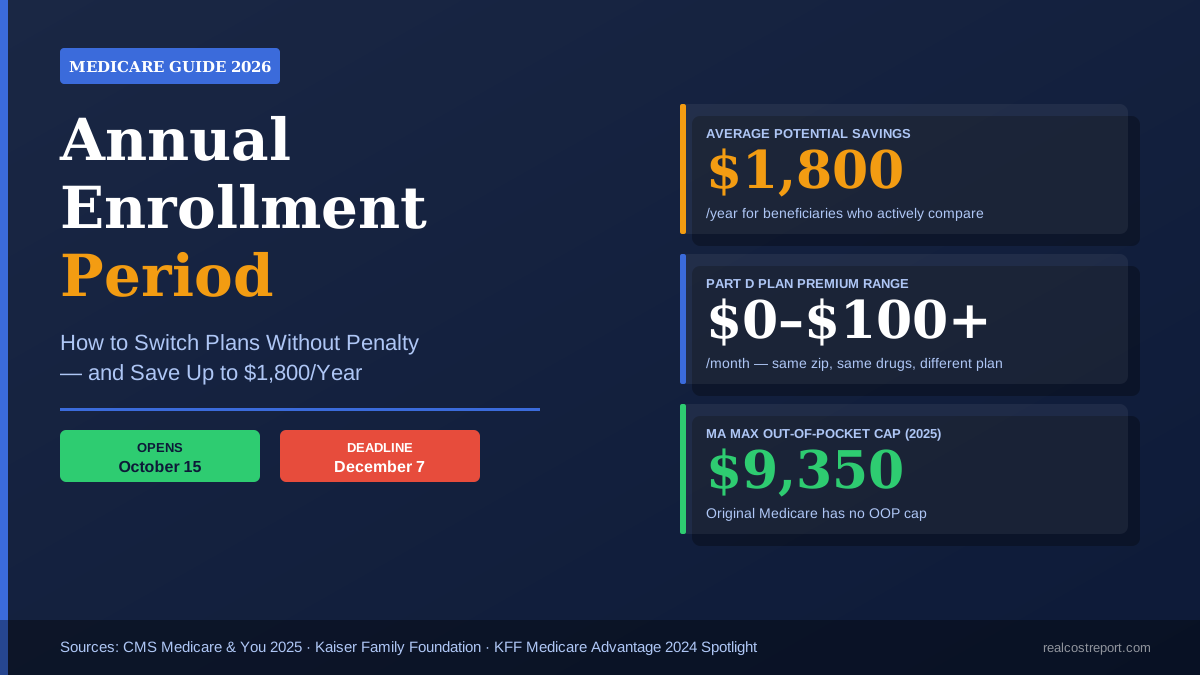
Mistake 4: Failing to re-shop during Annual Open Enrollment (October 15–December 7). Part D plans change formularies, premiums, deductibles, and pharmacy networks every January 1. Your current plan may have moved your drug to a higher tier or dropped it from the formulary entirely. CMS mails an Annual Notice of Change (ANOC) by September 30 each year — read it. Then run Plan Finder in October. Switching plans takes 10 minutes and can save $500–$2,000 per year for high-drug-cost enrollees.
Mistake 5: Ignoring the Medicare Prescription Payment Plan (M3P) for cash flow. Beginning in 2025, the Inflation Reduction Act also introduced the Medicare Prescription Payment Plan, which allows enrollees to spread out-of-pocket drug costs over the calendar year in equal monthly installments rather than paying large sums at the pharmacy counter in January. This is not a discount — total annual cost is the same — but it eliminates the front-loaded cost burden that causes many enrollees to skip doses in Q1. Opt in through your plan’s enrollment portal.
Is Medicare Part D Worth It If You Take No Drugs? The Late Penalty Math
This is one of the most debated questions in Medicare planning, and the math is unambiguous: for most beneficiaries, declining Part D at 65 because they take no prescriptions is a financially dangerous gamble. The late enrollment penalty — 1% of the national base beneficiary premium for every month you go without creditable coverage — is permanent. It attaches to your premium for life and increases as the national base premium rises each year.
Here’s the scenario: a beneficiary declines Part D at 65 and remains uninsured for drugs for three years before developing a chronic condition and enrolling at 68. Their penalty: 36 months × 1% = 36% surcharge. In 2025, the national base beneficiary premium is $36.78 (verify at CMS). That’s a penalty of approximately $13.24/month — added to every plan’s premium — forever. Over a 20-year retirement, that one decision costs roughly $3,178 in penalties alone, before premiums or drug costs.
Verdict
If you have creditable drug coverage through an employer, union, or TRICARE plan, you can delay Part D without penalty. If you don’t, enroll in the lowest-cost plan available in your area — even a $9/month plan with minimal drug coverage protects you from the permanent late penalty. Treat it as penalty insurance, not a drug benefit. Upgrade when your health situation changes during Open Enrollment.
Beneficiaries with employer retiree coverage must verify annually that their employer plan qualifies as “creditable coverage” — meaning it’s at least as good as standard Part D. Employers are required to provide a written notice of creditable coverage status annually and upon request. If your retiree plan is not creditable, enroll in Part D during your Special Enrollment Period to avoid the penalty clock.
How We Researched This Article
This article draws exclusively on primary government and nonprofit sources with direct regulatory or research authority over Medicare Part D. No data was sourced from insurance plan marketing materials, broker comparison sites, or secondary aggregators.
Premium and deductible figures were sourced from the CMS Prescription Drug Coverage Data and Statistics page, specifically the 2025 PDP Landscape Source File, which contains plan-level data for every approved stand-alone Part D plan in the United States. The $2,000 out-of-pocket cap and Medicare Prescription Payment Plan provisions were verified against Kaiser Family Foundation’s IRA Medicare analysis, one of the most authoritative independent health policy research organizations in the United States.
Formulary tier structure and CMS coverage requirements — including protected drug class rules and mid-year formulary change restrictions — were verified against the CMS 2025 Final Call Letter, the binding regulatory document governing Part D plan design for the 2025 plan year. IRMAA surcharge brackets and thresholds were sourced from the Social Security Administration’s Medicare Premiums page. Late enrollment penalty calculation methodology follows CMS published guidance (verify at cms.gov/medicare).
Plan-level comparisons — SilverScript, Humana, Wellcare — used plan structures and network descriptions publicly available through Medicare Plan Finder (medicare.gov/plan-compare), the CMS-operated official enrollment tool. Because plan premiums, formularies, and pharmacy networks vary by zip code and change annually, plan-specific cost figures in this article are illustrative national averages drawn from the 2025 Landscape Source File — not binding quotes. All readers must run Plan Finder with their specific drugs, doses, and zip code to obtain accurate annual cost estimates.
Enrollment figures (50.5 million Part D enrollees) were sourced from CMS Medicare Enrollment Dashboard data for 2024. Research was last conducted and all figures verified against named primary sources in May 2025. All figures were verified against named primary sources before publication.