This article is for general educational purposes only and does not constitute legal advice; consult a licensed employment attorney about your specific situation.
TL;DR — Quick Verdict
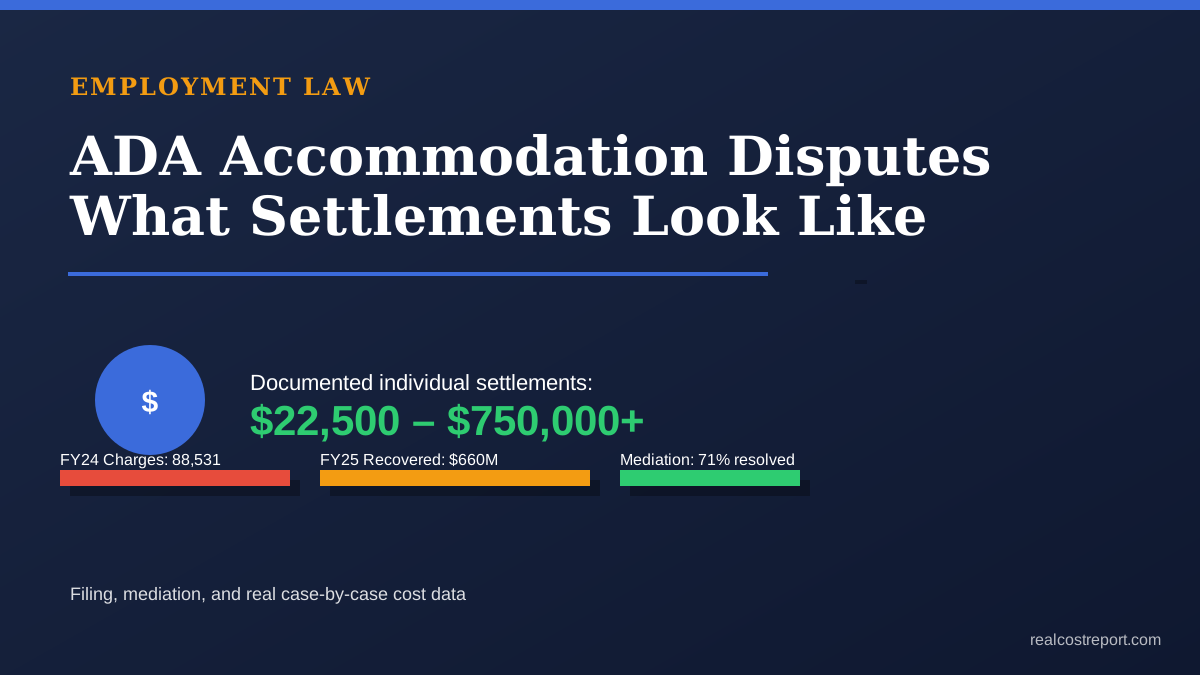
- The EEOC secured $660 million for 17,680 disability and other discrimination victims in fiscal year 2025, with $528 million of that coming through pre-litigation settlements rather than court verdicts.
- Documented individual ADA accommodation settlements typically range from $22,500 to $750,000, depending on whether the case involves one worker or a class.
- Mediation resolves roughly 71% of private-sector EEOC cases and moves far faster than litigation — often in weeks instead of years.
- ADA claims made up 43.2% of all EEOC merits lawsuits in fiscal year 2024, more than any other statute the agency enforces.
- Filing directly with the EEOC costs nothing, but hiring an employment attorney for a full accommodation dispute typically runs $2,500 to $10,000+ in contingency or hourly fees.
- Verdict: mediation first, litigation only if the employer refuses a reasonable settlement offer.
A single denied wheelchair ramp request or an ignored request for modified scheduling can turn into a six-figure legal exposure for an employer — and a life-changing recovery for a worker. In fiscal year 2025, the U.S. Equal Employment Opportunity Commission (EEOC) recovered $660 million for 17,680 victims of employment discrimination, and disability claims under the Americans with Disabilities Act (ADA) accounted for the largest single category of merits lawsuits the agency filed. Employers like Dollar General and PNM Resources have paid seven-figure settlements over accommodation failures, while smaller individual disputes have closed for $22,500 to $65,000. This article breaks down exactly how ADA accommodation charges move through the EEOC process, what real settlements have looked like, and what determines whether your case is worth pursuing through mediation, conciliation, or federal litigation.
What an ADA Accommodation Dispute Actually Involves
An ADA accommodation dispute arises when a qualified employee or applicant with a disability requests a workplace change — modified hours, assistive equipment, remote work, leave extensions, or reassignment — and the employer denies it, delays it unreasonably, or retaliates after the request. Title I of the ADA covers employers with 15 or more employees and requires reasonable accommodation unless the employer can prove undue hardship.
Disputes typically start with informal requests to HR. When those fail, the worker files a charge with the EEOC or a state fair employment practices agency (FEPA), which triggers a formal investigation. According to the EEOC’s own enforcement data, disability charges have grown from just over 15,000 in fiscal year 1993, shortly after the ADA took effect, to close to 26,000 in a recent fiscal year — a trajectory that reflects both wider disability awareness and an aging, chronic-illness-affected workforce.
Common accommodation triggers include denial of intermittent medical leave, refusal to allow remote work for mobility or immune-compromised conditions, inflexible “100% healed” return-to-work policies, and failure to provide interpreters or assistive technology. Many of the largest EEOC settlements — including a recent case against a health-and-human-services company for denying medical leave as an accommodation — stem from blanket leave policies that don’t account for individual medical circumstances.
What ADA Settlements Actually Cost: Real Case Data
Settlement figures vary enormously by whether a case involves one worker, a small group, or a company-wide class. Below are documented, publicly reported EEOC ADA resolutions spanning individual and class cases.
Source: U.S. Equal Employment Opportunity Commission, EEOC Newsroom press releases (verify at eeoc.gov/newsroom).
How the Filing Timeline Works
Consider Maria, a warehouse worker with a herniated disc who requests a modified lifting duty. Her employer denies the request without discussing alternatives and terminates her within six weeks. Here’s how her claim would typically move through the system.
Maria has 180 days from the discriminatory act to file an EEOC charge (300 days in states with their own FEPA, which covers most states with fair employment agencies). Filing is free and can be done online, by phone, or in person at a field office. Within roughly 10 days, the EEOC notifies the employer. The agency then offers mediation — a voluntary, confidential session with a neutral mediator — before opening a full investigation. If mediation fails or isn’t accepted, the EEOC investigates, which the agency’s own data shows can take months given a pending caseload that exceeded 52,000 charges at the close of a recent fiscal year.
If the EEOC finds reasonable cause, it attempts conciliation — a settlement negotiation — before deciding whether to litigate on the worker’s behalf or issue a “right to sue” letter allowing the worker to hire a private attorney and sue independently within 90 days.
Mediation vs. Litigation: Which Path Gets Better Results?
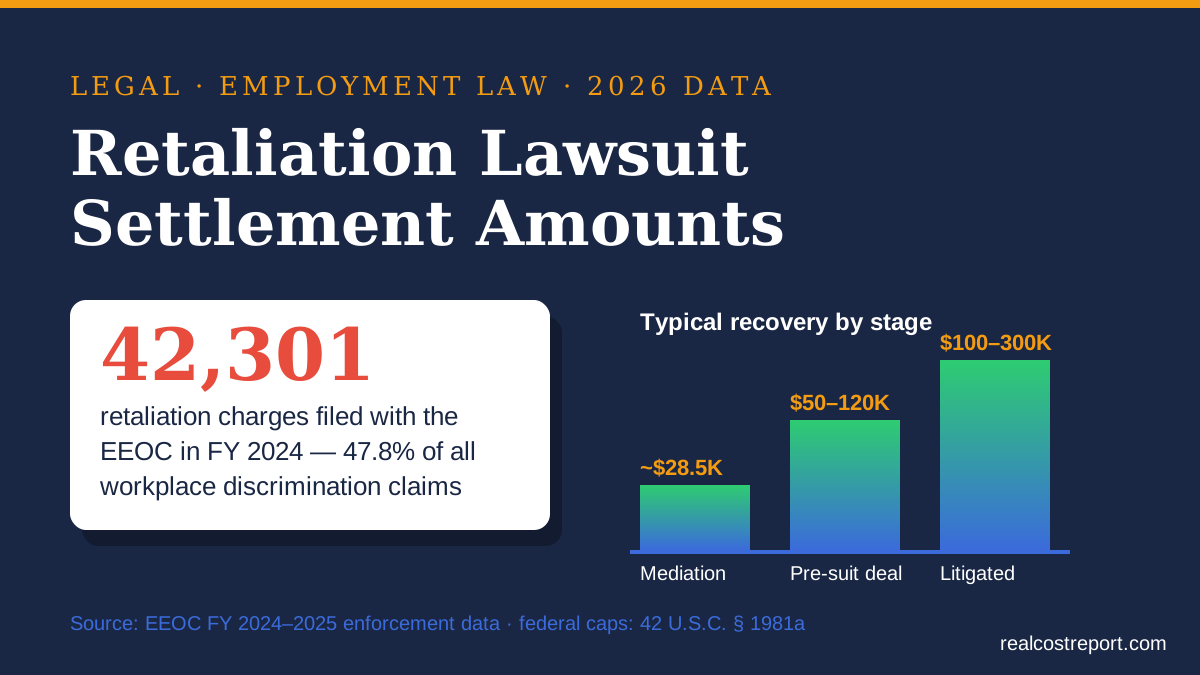
Workers and employers alike default to assuming a lawsuit is the “serious” path, but the EEOC’s own performance data tells a different story. In fiscal year 2024, the agency successfully resolved more than 71% of private-sector mediations, an increase of over 14 percentage points from the prior year, securing $243.2 million in benefits for charging parties through that process alone. Litigation, by contrast, produced roughly $40 million for about 4,300 individuals in the same year — a fraction of what mediation delivered, spread across dramatically more cases relative to dollars recovered per case.
Verdict
Mediation is the better first move for the large majority of accommodation disputes: it’s faster, confidential, and statistically more likely to produce a resolved outcome than waiting for a full investigation or lawsuit. Litigation makes sense only when the employer refuses a reasonable conciliation offer, the case involves a systemic policy affecting many workers, or damages are large enough that a jury trial’s higher ceiling outweighs the years of delay and legal cost involved.
What Most People Get Wrong About ADA Claims
Workers and even employers routinely misjudge how these disputes actually play out. Five mistakes come up repeatedly in EEOC case files and litigation summaries.
Mistake 1: Assuming any accommodation request must be granted exactly as asked. Consequence: workers overestimate their leverage and reject reasonable alternatives. Correct action: the ADA requires an “interactive process” — the employer can offer an equally effective alternative accommodation instead of the exact one requested.
Mistake 2: Waiting too long to file after a denial or termination. Consequence: the 180- or 300-day window lapses and the charge is barred. Correct action: file the EEOC charge immediately after the adverse action, even while still negotiating informally with HR.
Mistake 3: Treating a doctor’s note as automatically sufficient documentation. Consequence: employers request more medical detail than provided, causing delay disputes. Correct action: proactively provide functional limitation details, not just a diagnosis, to specify to the employer what tasks are affected.
Mistake 4: Employers applying a rigid “100% healed” return-to-work policy. Consequence: this is one of the most frequently litigated ADA theories and has produced some of the largest settlements on record, including multimillion-dollar systemic conciliations. Correct action: employers must evaluate each return individually, not apply blanket no-restriction rules.
Mistake 5: Assuming the EEOC will file a lawsuit on the worker’s behalf. Consequence: workers wait passively and miss their own filing deadline. Correct action: the EEOC litigates only a small share of charges directly (94 merits suits agency-wide in fiscal year 2025) — most workers need a private attorney and a right-to-sue letter to proceed to court.
Is Filing Worth It? Who Should Pursue a Claim
Filing makes sense when the accommodation denial caused documented harm: lost wages, a formal termination, or a clear paper trail showing the request was ignored rather than discussed. It’s especially worth pursuing when the employer has 15 or more employees (satisfying ADA coverage thresholds) and when a pattern exists — multiple employees denied similar accommodations, which raises the case toward systemic status and historically produces the largest recoveries.
Filing is less likely to pay off when the “disability” doesn’t meet the ADA’s legal definition of substantially limiting a major life activity, when the employer offered a genuinely equivalent alternative accommodation that was refused without reason, or when the adverse action clearly predates the accommodation request and was documented as unrelated (a performance issue, for example). In those situations, a consultation with an employment attorney before filing — often free for an initial case review — can save months of pursuing a charge unlikely to result in a cause finding.
What’s Changed in 2026
Charge volume has climbed for two consecutive years: 88,531 new discrimination charges in fiscal year 2024 and 88,201 in fiscal year 2025, alongside record pre-litigation recoveries of $528 million in fiscal year 2025 — 12% higher than the prior year. At the same time, EEOC merits litigation activity dropped to a reported 93 to 94 lawsuits filed agency-wide in fiscal year 2025, a ten-year low, even as ADA cases remained the agency’s single most litigated statute. The practical takeaway for 2026 filers: the agency is resolving more disputes through negotiated settlement and fewer through courtroom litigation, reinforcing that mediation and conciliation — not trial — are where most accommodation disputes actually end.
How We Researched This Article
This article draws on primary enforcement data published directly by the U.S. Equal Employment Opportunity Commission, including its Fiscal Year 2024 and Fiscal Year 2025 Annual Performance Reports, Office of General Counsel Annual Reports, historical ADA charge-data tables, and individual case press releases documenting settlement amounts. Settlement figures cited are drawn exclusively from EEOC newsroom press releases naming the employer, dollar amount, and number of affected workers — not from secondary aggregators or law-firm marketing pages. Charge-volume and monetary-recovery figures are measured data reported by the agency itself, not modeled estimates. Limitations: EEOC charge and settlement data reflects agency-involved resolutions only and does not capture private settlements reached before or without an EEOC charge being filed, which are typically confidential and unreported; state FEPA-only cases are also not fully reflected in federal EEOC totals. This research was last conducted July 2026. Readers should consult the EEOC’s official website for the most current charge-filing procedures, review the agency’s Enforcement and Litigation Statistics for updated annual figures, examine EEOC guidance on ADA enforcement for accommodation standards, and reference the EEOC Newsroom for ongoing case resolutions. All figures were verified against named primary sources before publication.