This article provides general legal and tax information, not legal or tax advice — consult a licensed employment attorney or CPA before acting on your specific situation.
TL;DR — Quick Verdict
- Federal back-tax exposure for a misclassified worker runs roughly 10.7% of everything you paid them — about $5,554 per year on a $52,000 contractor — before interest, penalties, or state assessments.
- A 12-worker, 3-year IRS audit in our model produces $199,930 in federal employment tax liability alone; overtime back pay under the FLSA can double on top via liquidated damages.
- W-2 vs 1099 comparison: converting a $52,000 contractor to W-2 costs roughly $8,000–$13,900 per year in employer taxes, workers’ comp, and benefits — a fraction of audit exposure.
- California’s willful misclassification penalty runs $5,000–$25,000 per violation under Labor Code Section 226.8, stacked on top of federal liability; the federal FLSA civil penalty for repeated or willful wage violations holds at $2,515 per violation in 2026.
- Recommendation: if your contractors work set hours, use your equipment, and serve only you, price out the IRS Voluntary Classification Settlement Program now — in our model it cuts a six-figure exposure to about $6,664.
State-level audit studies cited by the National Employment Law Project have found that between 10% and 30% of audited employers misclassified at least one worker — and the U.S. Government Accountability Office has repeatedly flagged misclassification as a multi-billion-dollar annual drain on federal payroll tax revenue. If you pay people on 1099s who work like employees, you are not saving money. You are borrowing it from the IRS, your state unemployment agency, and the workers themselves — at penalty-rate interest. This report shows the actual math: what federal reclassification costs per worker, how the three competing legal tests decide status, a line-by-line model of a 12-worker audit, and the break-even on voluntary correction through the IRS settlement program. We also compare the true annual cost of a W-2 employee against a 1099 contractor using payroll pricing from providers like ADP, Gusto, and QuickBooks Payroll, so you can decide whether reclassifying now beats getting audited later.
What Misclassification Actually Costs: The Federal Penalty Stack
When the IRS reclassifies a contractor as an employee, it does not simply send a warning letter. It rebuilds three years of payroll tax history and bills you for it. If you filed Forms 1099 for the workers, Internal Revenue Code Section 3509 applies reduced rates. If you filed nothing, every rate doubles. Here is the stack for a cooperating employer who filed 1099s:
Source: Internal Revenue Service, Internal Revenue Code Section 3509 and Publication 15 (verify at irs.gov). Dollar figures are author calculations on $52,000 in annual payments.
Add it up: 10.68% of gross payments — $5,554 per worker per year — under the favorable rates. Employers who never issued 1099s face 13.71%, and employers the IRS deems intentionally evasive lose Section 3509 relief entirely, owing full withholding amounts plus fraud penalties of up to 75%. Separately, the Department of Labor can assess civil money penalties of up to $2,515 per violation for repeated or willful minimum wage or overtime violations — typically applied per worker — on top of the back wages themselves.
How Regulators Decide: Three Tests, Three Different Answers
The same worker can be a contractor under one test and an employee under another, which is why multi-state employers get whipsawed. Three frameworks dominate.
The IRS common law test
The IRS weighs behavioral control, financial control, and the relationship of the parties — the modern condensation of its historical 20-factor analysis. Either party can request a formal determination by filing Form SS-8, though a ruling typically takes six months or longer.
The DOL economic reality test
The U.S. Department of Labor asks whether the worker is economically dependent on your business, using factors like opportunity for profit or loss, investment, permanence, and control. The department’s 2024 independent contractor rule remains on the books, but in 2025 the DOL announced it would not apply that rule in its own enforcement actions while reconsidering it — private FLSA lawsuits, however, proceed under whatever standard the relevant federal circuit applies.
The ABC test
California, Massachusetts, New Jersey, and other states presume employee status unless the business proves all three prongs: the worker is (A) free from control, (B) performing work outside the usual course of the hiring entity’s business, and (C) engaged in an independently established trade. Prong B is the killer — a delivery company using 1099 drivers fails it almost automatically.
Real-world scenario: a Sacramento marketing agency pays a full-time designer $65,000 on a 1099. The designer works 9-to-5 in company software, on company accounts. Under the IRS test this is arguable; under California’s ABC test it fails prongs A and B outright, triggering Labor Code Section 226.8 penalties of $5,000 to $15,000 per willful violation — $10,000 to $25,000 if a pattern is found.
1099 Contractor vs W-2 Employee: Which Structure Costs the Business Less?
Businesses misclassify because the sticker price of a contractor looks 20%–30% cheaper. Here is the honest annual comparison for one worker paid $52,000 in gross compensation:
Sources: Internal Revenue Service Publication 15 (verify at irs.gov); state unemployment and workers’ compensation ranges are author-modeled from published state agency rate schedules. Payroll pricing reflects publicly listed vendor plans as of July 2026.
Verdict
For a worker who genuinely runs an independent business, the 1099 structure is legitimately cheaper — roughly $7,500–$13,900 per year on these numbers. For a worker who functions like staff, the W-2 premium is the cheapest insurance you will ever buy: one audit year of federal liability ($5,554) plus a single California Section 226.8 penalty ($5,000 minimum) already exceeds the annual savings, and that ignores back pay, liquidated damages, and attorney fees.
Back Pay Math: What a 12-Worker Audit Actually Looks Like
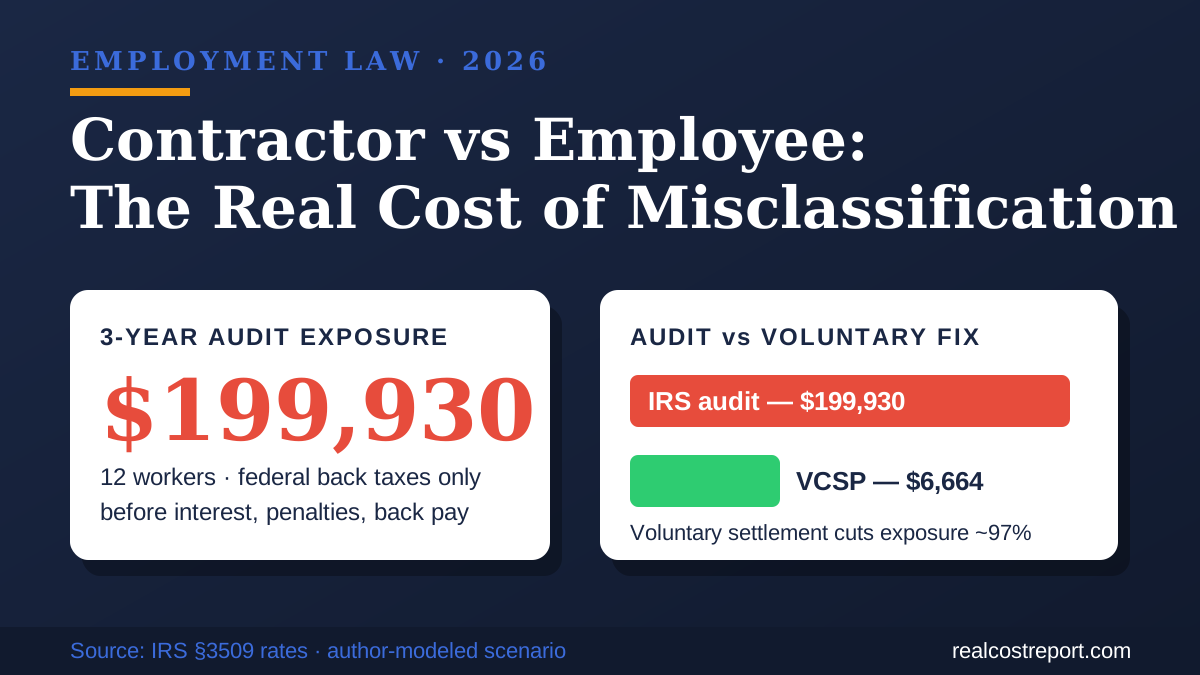
Model a services firm that paid 12 contractors an average of $52,000 per year for three years, with 1099s filed. Federal employment tax under Section 3509: 10.68% × $52,000 = $5,554 per worker, per year. Multiply: $5,554 × 12 workers × 3 years = $199,930 before interest and deposit penalties, which routinely add 20% or more.
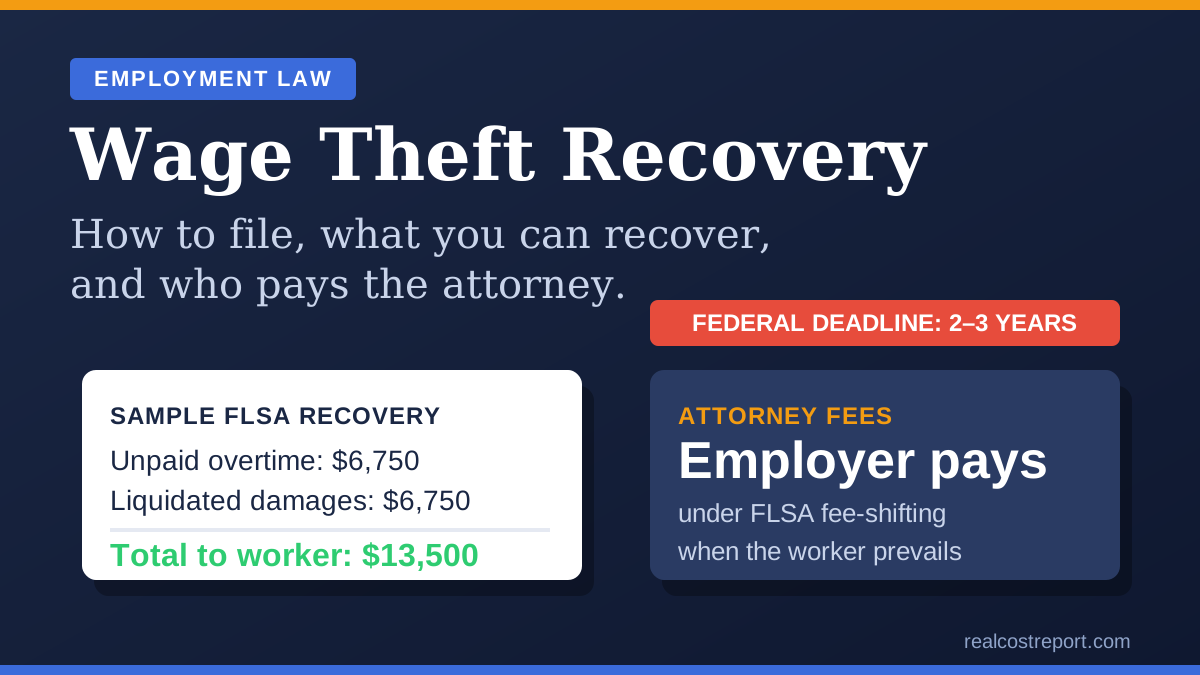
Now layer on wage-and-hour exposure. Suppose four of those workers averaged five overtime hours a week that were paid at straight time. At an effective $25 per hour, the unpaid half-time premium is $12.50 × 5 hours × 50 weeks = $3,125 per worker, per year. The Fair Labor Standards Act allows a two-year lookback — three if the violation is willful — and liquidated (double) damages by default. Willful, three years, four workers: $3,125 × 3 × 2 × 4 = $75,000, plus the workers’ attorney fees, which employers typically must pay on top when they lose. If the DOL deems the violations repeated or willful, civil money penalties of up to $2,515 per violation stack on that figure — $10,060 across four workers at the maximum.
State exposure stacks separately. In California, meal and rest break premiums, unreimbursed business expenses under Labor Code Section 2802, and Section 226.8 civil penalties can rival the federal bill. Total realistic exposure for this modest 12-worker firm: $275,000 to $400,000. Legal defense through audit and litigation commonly adds $50,000–$150,000 at employment-defense rates of $350–$700 per hour.
What Most People Get Wrong
Mistake 1: “They signed a contractor agreement, so we’re covered.” Consequence: none whatsoever — every test looks at the working relationship, not the label. Correct action: audit actual working conditions annually against the ABC and IRS factors, and fix the facts, not the paperwork.
Mistake 2: “We filed the 1099s, so the IRS knows and approves.” Consequence: 1099 filings only preserve reduced Section 3509 rates; they are not a safe harbor. Correct action: if status is doubtful, file Form SS-8 or price the Voluntary Classification Settlement Program before an agency prices it for you.
Mistake 3: Assuming federal deregulation protects you in ABC-test states. Consequence: the DOL’s 2025 enforcement pullback changed nothing in California, New Jersey, Massachusetts, or Illinois, where state agencies and private plaintiffs drive most cases. Correct action: classify to the strictest test that applies to any worker’s location.
Mistake 4: Reclassifying quietly and hoping nobody notices the past. Consequence: a sudden mass W-2 conversion is itself an audit flag, and prior-year liability survives. Correct action: pair reclassification with the VCSP or a state amnesty program so the lookback is settled, not deferred.
Mistake 5: Ignoring the workers’ side of the ledger. Consequence: misclassified workers who realize they overpaid 7.65% in self-employment tax and missed unemployment coverage become motivated plaintiffs. Correct action: when converting, communicate the benefits gain clearly — it converts potential claimants into satisfied employees.
Should You Reclassify Voluntarily? The VCSP Break-Even
The IRS Voluntary Classification Settlement Program lets eligible employers — those who filed 1099s consistently and are not currently under employment tax audit — reclassify prospectively by paying just 10% of the Section 3509 liability for the most recent year, with no interest, no penalties, and no audit of prior years for those workers.
Run it against our 12-worker model. One year of Section 3509 liability: $5,554 × 12 = $66,646. VCSP payment: 10% of that, roughly $6,664 — against $199,930 in raw audit exposure, a 97% discount. Even adding the ongoing $8,000–$13,900 per-worker annual cost of proper W-2 employment, the program pays for itself if there was any realistic audit probability at all.
Who should act: reclassify if your contractors work set schedules you assign, use your tools and accounts, serve you exclusively, or perform your core business function — especially anywhere an ABC test governs. Who can reasonably hold: businesses using genuinely independent vendors with their own entities, insurance, multiple clients, and negotiated project pricing. Who should call an employment attorney this week: anyone who has already received a state unemployment claim from a 1099 worker, because a single benefits claim is the most common audit trigger, and VCSP eligibility ends the moment an audit letter arrives.
What’s Changed in 2026
Three shifts matter this year. First, federal enforcement has softened while state enforcement has not: the DOL’s 2025 field guidance stepped back from the 2024 economic reality rule in agency enforcement, but private FLSA suits and ABC-test states continue full speed. Second, the reporting threshold moved — under 2025 federal tax legislation, the Form 1099-NEC reporting threshold rises from $600 to $2,000 for payments made beginning in 2026, indexed thereafter, which changes paperwork but not classification law. Third, penalty amounts did not index upward this year — an unusual break in a decade-long pattern. Because the late-2025 government shutdown prevented release of the October Consumer Price Index data, the Office of Management and Budget canceled the 2026 penalty inflation adjustment in April 2026 and directed agencies to keep using 2025 levels; the DOL’s 2026 final rule, published in the Federal Register on May 27, 2026, accordingly holds the maximum civil money penalty for repeated or willful minimum wage or overtime violations at $2,515 per violation, unchanged from 2025 (verify at dol.gov). Normal inflation indexing is expected to resume in 2027. The strategic takeaway: the gap between federal leniency and state aggression is the widest it has been in a decade, and businesses that calibrate to federal enforcement alone are mispricing their risk.
How We Researched This Article
This analysis was last conducted in July 2026. Federal employment tax rates, Section 3509 reduced rates, and Voluntary Classification Settlement Program terms were taken directly from the Internal Revenue Service, including Publication 15 (Employer’s Tax Guide) and IRS guidance on worker classification, available at irs.gov. Fair Labor Standards Act back pay rules, the two- and three-year limitations periods, liquidated damages provisions, and the status of the 2024 independent contractor rule were sourced from the U.S. Department of Labor Wage and Hour Division at dol.gov, including the department’s civil money penalty schedule and its Civil Penalties Inflation Adjustment Act final rule for 2026 (91 FR 31358), which confirmed that penalty levels remain at 2025 amounts. The $2,515 per-violation maximum for repeated or willful minimum wage and overtime violations was cross-checked against 29 CFR Part 578 at ecfr.gov. California penalty ranges under Labor Code Sections 226.8 and 2802 were verified against the California Department of Industrial Relations at dir.ca.gov. Aggregate misclassification prevalence estimates draw on audit studies summarized in reports by the U.S. Government Accountability Office at gao.gov and the National Employment Law Project.
Important limitations: the $199,930 audit scenario, the $75,000 overtime model, and all per-worker dollar figures are modeled calculations built from published statutory rates applied to hypothetical wages — they are not measured outcomes from actual cases, and real assessments vary with state, industry, worker mix, and examiner discretion. Civil money penalties are assessed at examiner discretion up to the statutory maximum; the $2,515 figure is a ceiling, not a typical assessment. State unemployment insurance and workers’ compensation ranges are typical bands, not quotes; actual rates depend on experience ratings and classification codes. Payroll vendor pricing reflects publicly listed plans and changes frequently. All figures were verified against named primary sources before publication.