This article is general legal information, not legal advice; whistleblower and retaliation claims are deadline-sensitive, so consult a licensed employment or securities attorney before acting.
TL;DR — Quick Verdict
- Filing costs you nothing upfront: both an OSHA retaliation complaint and an SEC tip (Form TCR) are free, and most whistleblower attorneys work on contingency of roughly 20%–40%.
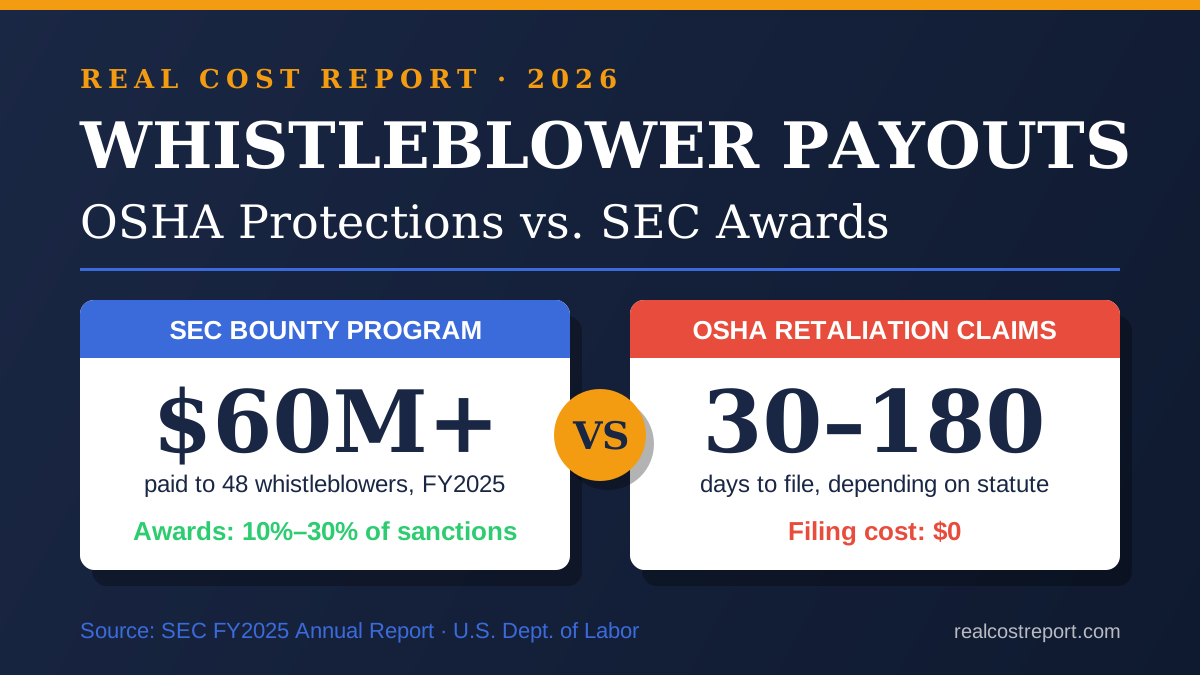
- The SEC paid more than $60 million to 48 whistleblowers in fiscal year 2025 — a sharp drop from $255 million in FY2024 — with awards set at 10%–30% of sanctions above $1 million.
- OSHA’s biggest trap is timing: the core OSH Act safety statute gives you only 30 days to file after retaliation, while Sarbanes-Oxley and most transportation statutes allow 180 days.
- Head-to-head result: the SEC program wins for financial fraud with large dollar exposure; OSHA is the only route for safety, transportation, environmental, and most healthcare retaliation.
- Recommendation: preserve documents on day one, calendar every applicable deadline, and get a contingency consultation (typically free) before telling your employer anything.
The SEC’s Office of the Whistleblower reported paying more than $60 million to 48 individuals in fiscal year 2025, out of roughly 27,000 tips received — meaning fewer than 2 in 1,000 tipsters were paid that year. One fiscal year earlier, the same program paid $255 million. That volatility is the single most misunderstood fact in whistleblower economics, and it changes the math for anyone deciding whether to report securities fraud, a safety hazard, or healthcare retaliation. This guide breaks down what a whistleblower case actually costs in 2026 — filing fees, contingency percentages, litigation expenses — and compares the two dominant federal channels: OSHA’s Whistleblower Protection Program, which enforces the anti-retaliation provisions of more than 20 statutes, and the SEC’s bounty program under Dodd-Frank. Prominent whistleblower firms such as Phillips & Cohen and Kohn, Kohn & Colapinto publish fee structures and award data we reference below, alongside primary figures from the SEC’s FY2025 Annual Report to Congress.
What a Whistleblower Case Actually Costs in 2026
The out-of-pocket cost of starting is $0 on both tracks. OSHA accepts retaliation complaints online, by phone, by mail, or in person, in any language, with no filing fee and no attorney requirement. The SEC’s tip, complaint, and referral (TCR) form is likewise free and can be filed anonymously — though anonymity requires attorney representation under SEC rules, which is where costs enter.
Nearly all whistleblower representation is contingency-based. For SEC award claims, firms commonly advertise contingency rates between 20% and 40% of any award, with the percentage typically negotiated based on case complexity and how far along an SEC investigation already is. For retaliation lawsuits — wrongful termination, demotion, blacklisting — employment litigators typically charge 33%–40% of recovery, or $300–$700 per hour in major metros for clients who prefer hourly billing.
Litigation expenses are the hidden layer. If your statute allows a private federal lawsuit (Sarbanes-Oxley does, after 180 days of agency inaction; OSH Act Section 11(c) does not), expect a federal district court filing fee of roughly $405, deposition transcripts commonly running $500–$1,500 each, and expert witnesses — forensic accountants, economists calculating front pay — billing $300–$500 per hour. A retaliation case that reaches trial can accumulate $25,000–$100,000 in expenses alone, which contingency firms usually advance and recoup from any recovery.
Filing fee: Administrative Office of the U.S. Courts fee schedule (verify at uscourts.gov). Attorney fee ranges reflect rates publicly advertised by national whistleblower and employment firms; agency filing costs confirmed with the U.S. Department of Labor (verify at whistleblowers.gov) and the SEC (verify at sec.gov).
How the SEC Whistleblower Program Pays — and Why FY2025 Was Different
The SEC program, created by the Dodd-Frank Act in 2010, is a bounty system: if your original information leads to an enforcement action with monetary sanctions above $1 million, you are entitled to 10%–30% of what the government collects. Awards are paid from an Investor Protection Fund financed entirely by violators’ sanctions — the fund closed FY2025 holding nearly $319 million — not by taxpayers.
Run the math on a mid-size case. If your tip leads to $20 million in collected sanctions and the Commission sets your award at 20%, you receive $4 million before attorney fees. At a 30% contingency rate, you net $2.8 million. The largest award in program history reached approximately $279 million in 2023; the program has paid over $2 billion total since 2012.
FY2025 broke the trend. Total awards fell to just over $60 million across 48 individuals, the lowest annual figure since 2017, and the largest single award was $12 million — versus a $98 million top award the prior year. The Commission also issued a record number of denial orders, and analysts at Better Markets calculated the FY2025 grant rate at 17.8% of determinations, a five-year low. Two takeaways matter for prospective filers: first, the SEC’s own financial reporting still projects $218 million–$655 million in probable award liabilities from FY2025 cases, so pipeline value remains large; second, denial risk has measurably increased, which raises the value of experienced counsel who can document that your information was original, voluntary, and causally linked to the enforcement outcome.
OSHA Protections: 20+ Statutes, One 30-Day Trap
OSHA’s Whistleblower Protection Program is not a bounty system. It is a retaliation-remedy system: it investigates whether your employer punished you for protected activity and can order reinstatement, back pay, restored benefits, and record expungement. The Department of Labor reported handling more than 3,300 whistleblower complaints in a recent year across construction, energy, transportation, healthcare, and finance.
The decisive variable is the deadline, which depends entirely on which statute covers your report. The core Occupational Safety and Health Act — the one covering ordinary workplace-hazard reports — allows only 30 days from the retaliatory act. Miss it and, with narrow equitable exceptions OSHA has outlined (employer concealment, misleading reinstatement promises, filing with the wrong agency), the claim dies. Sarbanes-Oxley and most transportation statutes allow 180 days.
U.S. Department of Labor, OSHA Whistleblower Protection Program statute summary (verify at whistleblowers.gov). Kick-out periods are statute-specific; confirm your statute’s current text before relying on any deadline.
One structural weakness deserves emphasis: Section 11(c) grants no private right of action. If OSHA declines to litigate your safety-retaliation case, you cannot independently sue under that statute, though state law claims may remain available.
OSHA Complaint vs. SEC Tip: Which Is Better for Your Situation?
These programs answer different questions. OSHA asks: were you punished for speaking up? The SEC asks: did your information help the government collect money from a violator? Many securities-industry employees can — and should — use both simultaneously, because Dodd-Frank’s separate anti-retaliation provision protects SEC reporters while the bounty claim proceeds independently.
On dollars, the comparison is lopsided. A successful OSHA outcome typically means reinstatement plus back pay — for a $90,000-a-year employee out of work 14 months, roughly $105,000 plus benefits, sometimes with compensatory or punitive damages under specific statutes. A successful SEC claim averaged around $2 million per award order in FY2025 even in a down year. On probability, OSHA is more accessible: it investigates every timely, facially valid complaint, whereas fewer than 1% of SEC tips ever produce an award. On speed, neither is fast — OSHA investigations frequently run 1–3 years, and SEC award payment often lands 5–8 years after the original tip because sanctions must first be collected.
Verdict
If your evidence involves securities fraud at a public company or investment firm and plausible sanctions above $1 million, the SEC program is better: the payout ceiling is orders of magnitude higher and anonymous filing through counsel protects your career. If your issue is safety, transportation, environmental, or healthcare retaliation — or your priority is getting your job and wages back rather than a bounty — OSHA is the correct and often only federal channel. Fraud-adjacent employees at public companies should file both: a SOX retaliation complaint with OSHA within 180 days and an SEC TCR for the underlying fraud.
What Most People Get Wrong
Mistake 1: Reporting internally and assuming the clock hasn’t started. Consequence: the 30- or 180-day deadline runs from the retaliatory act, not from when internal HR finishes “investigating,” and cases die on timeliness. Correct action: calendar the deadline the day anything adverse happens — demotion, schedule cut, suspension — and file with OSHA even while internal processes continue.
Mistake 2: Signing a severance agreement without reading the whistleblower clauses. Consequence: you may trade away leverage cheaply — though not your SEC rights; in 2025 two investment advisers paid a combined $90 million to settle SEC charges that their separation agreements unlawfully impeded whistleblowing. Correct action: have counsel review any severance before signing; SEC Rule 21F-17 makes agreements that block SEC reporting unenforceable.
Mistake 3: Taking documents indiscriminately. Consequence: mass-downloading files beyond what supports your claim can trigger counterclaims and undercut credibility. Correct action: preserve materials you lawfully accessed in your role, keep them narrow and relevant, and let your attorney manage production.
Mistake 4: Expecting SEC money on a retaliation timeline. Consequence: whistleblowers budget around an award that may arrive 5+ years later or never — 275 individuals received final denial orders in FY2025 alone. Correct action: treat any bounty as upside, and build your financial plan around employment remedies and continued earnings.
Mistake 5: Filing an SEC tip without establishing “original information.” Consequence: if the SEC already possessed your facts, you get nothing. Correct action: document precisely what you know, how you know it, and when — independent analysis of public data can qualify, but generic suspicion cannot.
Is Filing Worth It? Who Should — and Who Should Wait
File promptly if any of these apply: you have already suffered retaliation (deadlines are running whether you act or not); you hold documentary evidence of fraud plausibly exceeding $1 million in sanctions; or you work in a safety-critical role — trucking, rail, aviation, nuclear — where 180-day statutes with private lawsuit kick-outs give you genuine litigation leverage. In each scenario, the expected value is positive because filing is free, consultations are free, and contingency representation means you pay only from recovery.
Think harder before filing if your evidence is secondhand or speculative — SEC denial rates hit five-year highs in FY2025, and a weak tip earns nothing while potentially complicating your employment; if your only claim is under Section 11(c) and you missed the 30-day window, where resources are better spent on state-law wrongful termination theories; or if you would need to breach attorney-client privilege to make your case, since privileged information is generally excluded from award eligibility. Retirees and pre-retirees weighing a claim against a former employer should note that retaliation remedies shrink when there is no job to reinstate and limited front pay to claim — for that group, the SEC bounty route or a False Claims Act case (which paid the year’s largest whistleblower shares in 2025) usually dominates. The consistent rule across every scenario: the consultation costs nothing, and the deadlines forgive nothing.
How We Researched This Article
This analysis was last conducted in July 2026. Award totals, tip volumes, denial counts, and Investor Protection Fund balances come from the SEC Office of the Whistleblower’s FY2025 Annual Report to Congress and the program overview at the SEC Whistleblower Program page. Filing deadlines, covered statutes, and complaint procedures were verified against the Department of Labor’s Whistleblower Protection Program materials and OSHA’s complaint filing guidance, including OSHA’s published memorandum on equitable tolling of limitation periods.
Grant-rate analysis (17.8% of FY2025 determinations) reflects calculations published by Better Markets from SEC award orders; per-award averages were computed by dividing total FY2025 award dollars by the number of award orders. Attorney fee ranges are modeled, not measured: they synthesize contingency percentages and hourly rates publicly advertised by national whistleblower and employment litigation firms, and individual engagements vary. Litigation expense estimates ($25,000–$100,000 through trial) are modeled from court reporter rate cards and expert-witness billing norms rather than a controlled dataset, and should be treated as planning ranges. Limitations: SEC award timing is inherently unpredictable because payment follows collection of sanctions; OSHA investigation durations vary by regional office backlog; and both programs’ outcomes shifted materially between FY2024 and FY2025, so historical averages may not predict future results. All figures were verified against named primary sources before publication.