This article is for informational purposes only and is not legal advice; settlement outcomes vary by case, and you should consult a licensed employment attorney in your state before acting on any figure presented here.
TL;DR — Quick Verdict
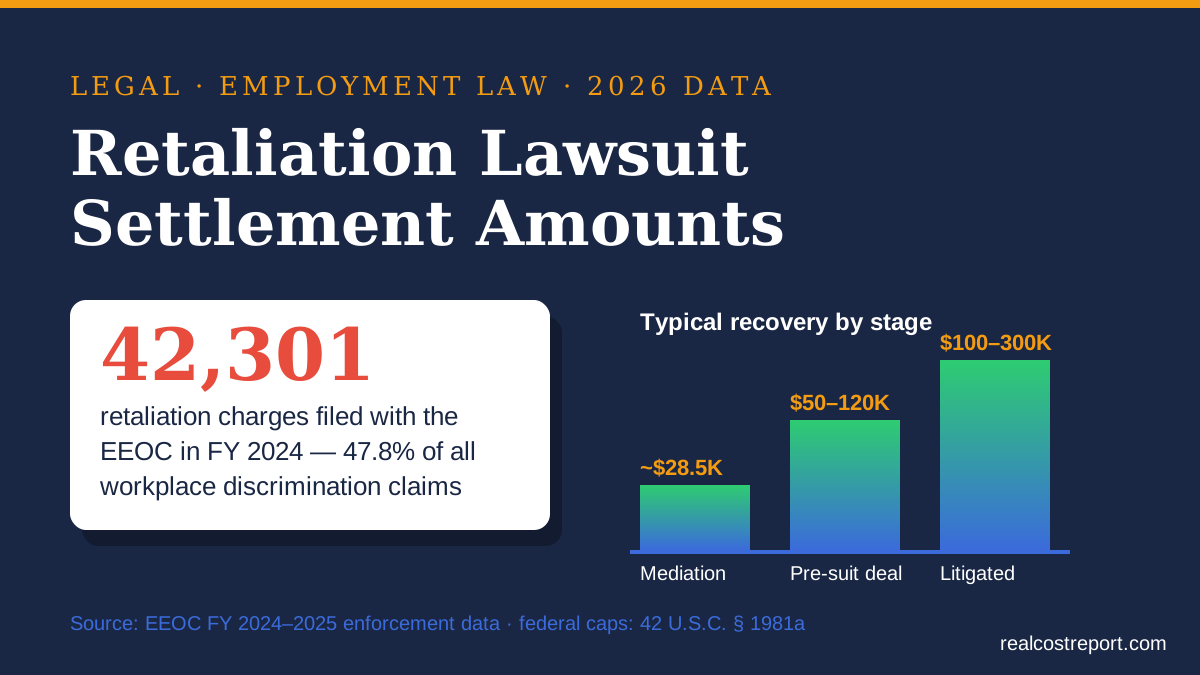
- Retaliation is the most common workplace claim in America: 42,301 EEOC charges in FY 2024, appearing in 47.8% of all filings, per the U.S. Equal Employment Opportunity Commission.
- Federal law caps compensatory and punitive damages between $50,000 and $300,000 depending on employer size — but back pay, front pay, and attorney’s fees sit outside those caps.
- Our calculations from EEOC data show pre-litigation recoveries averaged roughly $39,500 per person in FY 2025, while resolved EEOC mediations averaged about $28,500 each in FY 2024.
- EEOC mediation vs. private lawsuit: mediation resolves in 3–4 months at zero cost but pays less; private litigation takes 12–30 months and typically nets 2–5x more for documented claims.
- Bottom line: file the EEOC charge to preserve your rights, then get a contingency-fee employment attorney’s case valuation before accepting any early offer.
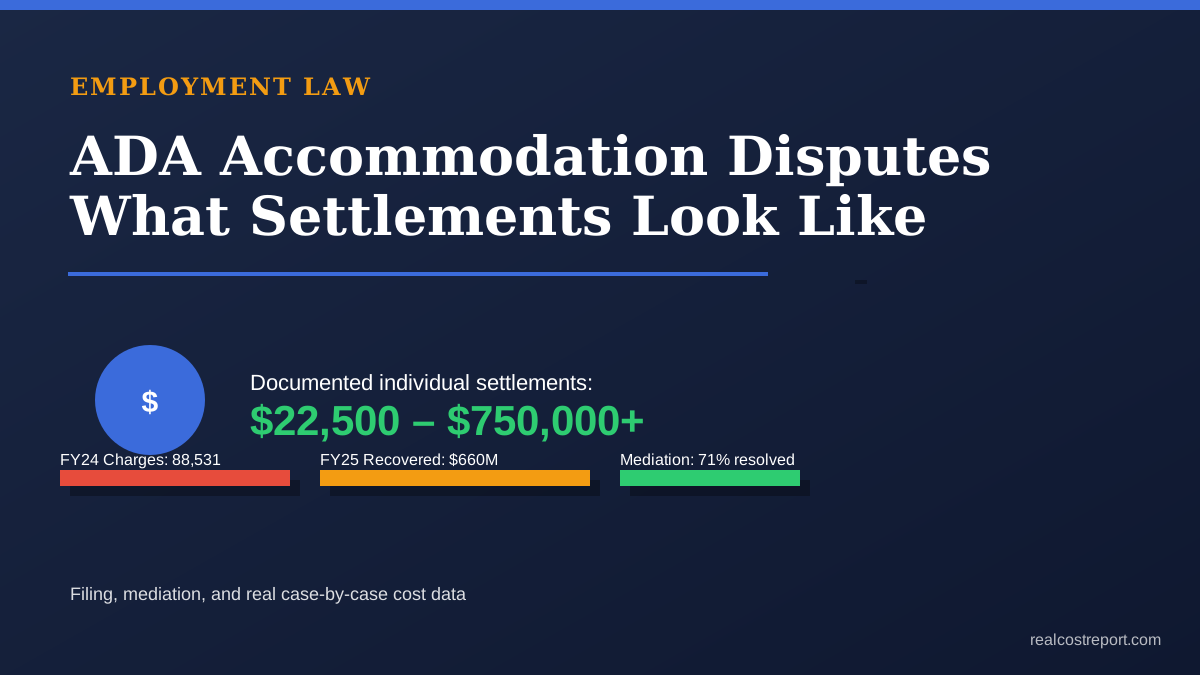
Retaliation has been the most frequently filed workplace discrimination charge in the United States for seventeen consecutive years. In fiscal year 2024, the U.S. Equal Employment Opportunity Commission received 42,301 retaliation charges — 47.8% of all 88,531 charges filed — and in FY 2025 the agency secured almost $660 million in monetary relief across all claim types, its third-highest recovery in recent history. Yet workers researching what a retaliation case is actually worth encounter a swamp of vague “every case is different” answers from law firm marketing pages run by Morgan & Morgan, Ottinger, and hundreds of regional competitors.
This report does the math those pages avoid. Below, you will find the federal damage caps that hard-limit part of every settlement, per-person recovery figures calculated directly from EEOC enforcement data, a head-to-head comparison of EEOC mediation versus private litigation, modeled settlement ranges by claim strength and industry, and the five valuation mistakes that cost claimants the most money.
What Retaliation Settlements Actually Pay: The Verified Numbers
No government agency publishes a single “average retaliation settlement” figure, because most private settlements are confidential. What we can do is calculate per-person recoveries from the EEOC’s own published totals, which represent the largest verified dataset of retaliation-adjacent outcomes in the country.
In FY 2025, the EEOC recovered $528 million for 13,351 workers in private-sector and state and local government workplaces through mediation, conciliation, and settlements during the pre-litigation process — the highest such figure in the agency’s 60-year history and an average of roughly $39,500 per person. Litigation produced $27 million for 2,505 individuals, a lower per-person average of about $10,800, heavily skewed by class cases where thousands split a single fund. Federal-sector workers recovered $104.6 million across 1,824 individuals.
Source: U.S. Equal Employment Opportunity Commission, FY 2025 Agency Performance Report (verify at eeoc.gov). Per-person averages calculated by Real Cost Report.
The agency’s dedicated mediation program adds a second reference point. In FY 2024, the EEOC held 11,998 mediations, successfully resolved 8,543 of them (a 71.2% success rate), and obtained $243.2 million in benefits — roughly $28,500 per resolved mediation. Mediation benefits rose again in FY 2025, to $245.3 million. Read all of these averages carefully: they include weak claims, partial settlements, and charges bundling multiple claim types. An individual claimant with documented protected activity, a close-in-time adverse action, and provable lost wages sits well above these averages — often several multiples above, as the damage-cap math below shows.
Federal Damage Caps: The Hard Ceiling on Part of Your Settlement
Under 42 U.S.C. § 1981a, compensatory damages (emotional distress) and punitive damages in Title VII retaliation cases are capped by employer size. These caps have not been adjusted for inflation since Congress set them in 1991, which is why experienced plaintiff attorneys at firms like Sanford Heisler Sharp and Wigdor structure demands around the uncapped components: back pay, front pay, interest, and attorney’s fees.
Source: Civil Rights Act of 1991, codified at 42 U.S.C. § 1981a(b)(3) (verify at govinfo.gov). Back pay, front pay, and attorney’s fees are not subject to these caps.
Two important carve-outs. First, retaliation claims brought under 42 U.S.C. § 1981 (race-related) and many state statutes — including California’s FEHA and New York’s Human Rights Law — carry no damage caps at all, which is why identical fact patterns settle 40–100% higher in those jurisdictions. Second, whistleblower retaliation under statutes such as Sarbanes-Oxley or the False Claims Act follows entirely different remedy schemes, sometimes including double back pay.
What Determines Your Number: A Worked Scenario
Consider a realistic case. A 44-year-old operations manager earning $95,000 reports sexual harassment of a subordinate to HR in March. In May, she receives her first negative performance review in six years. In July, she is terminated in a “restructuring” that eliminates only her position. She finds comparable work eleven months later at $88,000.
Her economic damages are concrete: eleven months of lost salary is roughly $87,100, plus lost 401(k) match and health premiums pushing economic loss near $100,000. Add a front-pay differential of $7,000 per year for the salary gap, typically projected two to three years: another $14,000–$21,000. Emotional distress with therapy records might support $40,000–$75,000 in compensatory damages at a mid-size employer (capped at $200,000 combined with punitives). Her attorney’s fees — recoverable separately if she wins — could exceed $150,000 through trial, which is the single biggest lever forcing employers to settle.
A defense firm like Littler Mendelson or Ogletree Deakins will model the employer’s total exposure at $350,000–$450,000 including its own defense costs, then typically open settlement talks at 15–25% of exposure. This is why her realistic settlement window is roughly $90,000–$180,000 pre-trial — and why the timing gap between her HR report and the termination (four months) matters enormously. Courts treat temporal proximity under about three months as strong causation evidence; beyond six months, claim value drops sharply without other proof.
EEOC Mediation vs. Private Lawsuit: Which Is Better for Your Situation?
Every federal retaliation claimant faces this fork. The EEOC’s free mediation program resolved 8,543 of 11,998 mediations in FY 2024 — a 71.2% success rate averaging roughly $28,500 in benefits per resolved charge — and typically concludes within three to four months of filing. A private lawsuit, filed after receiving a right-to-sue letter, runs 12 to 30 months, involves depositions and discovery, and requires either a contingency-fee attorney (usually 33–40%) or hourly fees of $350–$700.
Mediation’s advantage is speed, zero cost, and certainty; its weakness is that employers know unrepresented claimants lack trial leverage, and offers frequently cluster in the $5,000–$40,000 range. Litigation’s advantage is the fee-shifting hammer: because a losing employer pays the plaintiff’s attorney fees, every month of continued defense increases the employer’s rational settlement number. Its weaknesses are time, stress, deposition exposure, and the roughly one-in-three chance of summary judgment dismissal for claims with thin documentation.
Verdict
Take EEOC mediation if your provable losses are under $50,000, you need money within months, or your evidence is largely circumstantial. Choose private litigation if you have documented protected activity, close temporal proximity, six-figure economic losses, or a large employer — represented claimants with strong facts typically recover 2–5x the mediation offer, even after a 35% contingency fee. In either path, file the EEOC charge first: for most private-sector claims the deadline is 180 or 300 days from the retaliatory act, and missing it extinguishes the federal claim entirely.
Settlement Patterns by Industry
The EEOC does not publish settlement averages by industry, so treat any site quoting exact industry averages with suspicion. What the enforcement record does show is where retaliation exposure concentrates and why. Healthcare and social assistance generate heavy charge volume because mandatory-reporting duties (patient safety, staffing violations) constantly create protected activity. Retail and hospitality combine high turnover with thin HR infrastructure, producing fast, poorly documented terminations after complaints. Logistics and transportation face overlapping OSHA and safety-complaint retaliation exposure — the EEOC’s $8.7 million consent decree with DHL Express in April 2024, while centered on race discrimination, included an injunction specifically prohibiting retaliation, a standard feature of systemic resolutions.
The ranges below are modeled estimates, not measured averages. They combine the federal cap structure, typical wage levels by sector, and the resolution-stage patterns described above for an individual claimant with at least moderate documentation.
Modeled by Real Cost Report from federal damage caps (42 U.S.C. § 1981a), sector median wages, and EEOC FY 2024–2025 recovery data; U.S. Equal Employment Opportunity Commission (verify at eeoc.gov). Ranges assume an individual claimant with documented protected activity; outliers exceed these bands in uncapped state-law jurisdictions.
The finance and tech band runs highest for a simple reason: settlement value tracks salary. Back pay for a $200,000 software manager accumulates at $16,700 per month of unemployment, so a one-year job search alone can exceed the entire litigated range for a retail worker.
What Most People Get Wrong About Retaliation Settlements
Mistake 1: Assuming the retaliation claim needs a winning underlying complaint. The consequence is abandoning strong cases. Legally, you only need a reasonable, good-faith belief that what you reported was unlawful — the retaliation claim survives even if the harassment or discrimination claim fails. Correct action: evaluate the retaliation claim on its own timeline and evidence.
Mistake 2: Accepting the first severance offer before filing a charge. Employers time severance offers with short deadlines precisely to buy out claims cheaply, often at 4–12 weeks of pay against a claim worth six figures. Correct action: have an employment attorney review any release before signing; most offer free or flat-fee severance reviews of $500–$1,500.
Mistake 3: Quitting without documentation. Resigning converts a clean termination claim into a harder “constructive discharge” claim and can cut back-pay exposure. Correct action: report internally in writing, preserve emails to personal storage lawfully, and let the employer make the adverse move.
Mistake 4: Valuing the case at the jury-verdict numbers in headlines. Multi-million-dollar verdicts are usually reduced post-trial by the federal caps; the $300,000 ceiling on compensatory and punitive damages quietly rewrites most headlines. Correct action: value your case on lost wages plus a capped distress figure, not on press releases.
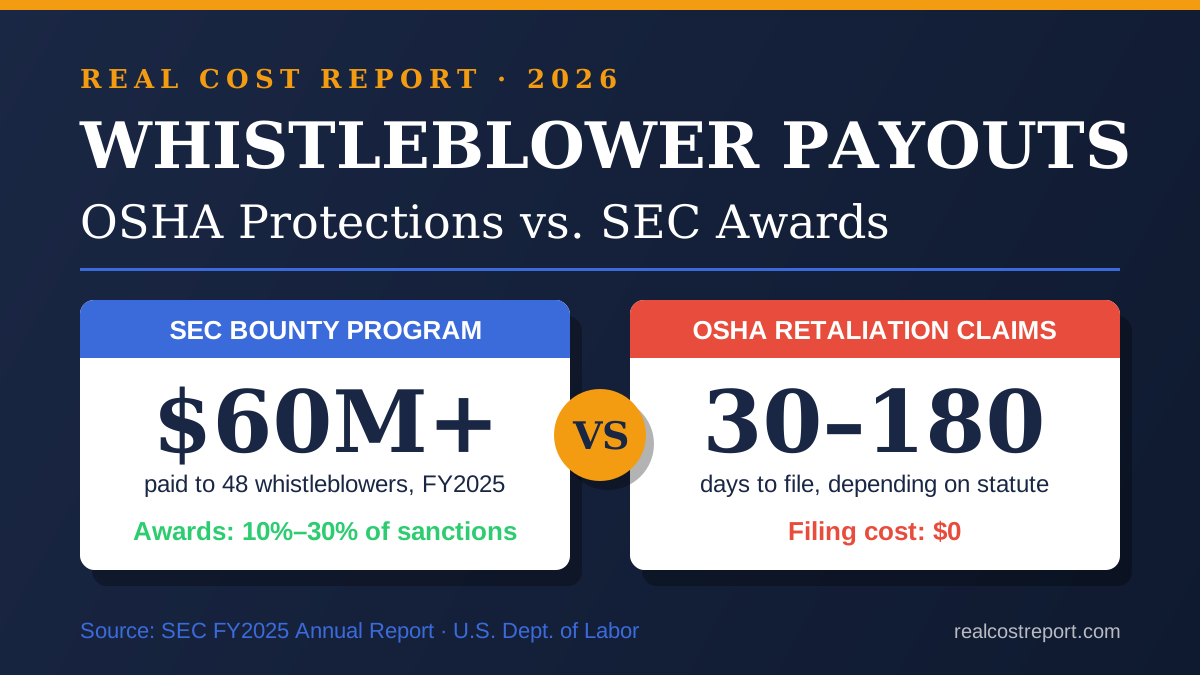
Mistake 5: Missing the filing window. The 180/300-day EEOC deadline is jurisdictional for most private-sector claims, and some whistleblower statutes require OSHA complaints within 30 days. The consequence is total forfeiture. Correct action: calendar the earliest possible deadline the day the adverse action happens.
Is Pursuing a Retaliation Claim Worth It?
It depends on four variables you can assess today. If you have written evidence of your protected activity, an adverse action within roughly 90 days, quantifiable lost income above $25,000, and an employer with more than 100 employees — pursue the claim, and interview two or three contingency-fee employment attorneys before responding to any offer. Attorneys who decline your case are giving you free valuation data; ask why.
If your losses are small (you found equivalent work immediately), your evidence is verbal-only, or the employer has fewer than 15 employees (below Title VII’s threshold, though state law may still apply), the EEOC mediation track or a state agency filing is usually the better risk-adjusted path: zero cost, fast resolution, no deposition. Retirees and near-retirees should weigh one extra factor — front pay claims shrink as your remaining working years shrink, but pension and retiree-benefit losses can replace them, and those require an attorney who will actually model them rather than round to zero.
Whichever path fits, the one universally correct move is preserving the claim: file the charge, stop the clock, and negotiate from a position where walking away remains possible.
How We Researched This Article
This report was compiled from primary federal sources. Charge volume and prevalence percentages come from the U.S. Equal Employment Opportunity Commission’s FY 2024 Annual Performance Report and its Enforcement and Litigation Statistics portal. Recovery totals for FY 2025 — $528 million for 13,351 workers pre-litigation, $27 million for 2,505 individuals through litigation, and $104.6 million for 1,824 federal workers — come from the agency’s FY 2025 Agency Performance Report. Mediation program figures (11,998 mediations held, 8,543 resolved, $243.2 million in FY 2024 benefits) come from the EEOC’s FY 2026 Congressional Budget Justification. Litigation case detail draws on the Office of General Counsel FY 2024 Annual Report. Damage caps are taken from the Civil Rights Act of 1991 as codified at 42 U.S.C. § 1981a.
Per-person recovery averages are our own calculations: published dollar totals divided by published beneficiary or resolution counts. They are measured-data derivatives, not survey results. The industry settlement ranges and the worked scenario are modeled, not measured: we built them from the statutory cap structure, sector wage levels, standard contingency-fee economics, and resolution-stage patterns visible in EEOC outcomes, and we label them as models wherever they appear. Key limitations: most private settlements are confidential, so no dataset — ours included — captures the full distribution; EEOC litigation averages are depressed by class actions; per-mediation averages describe the entire charge, which may bundle several claim types alongside retaliation; and state-law claims in uncapped jurisdictions can exceed every range shown. Research for this article was last conducted July 2026. All figures were verified against named primary sources before publication.