This article is general legal information, not legal advice; consult a licensed employment attorney in your state before acting on an FMLA claim.
TL;DR — Quick Verdict
- A wrongfully terminated employee earning $65,000 who is out of work for 6 months can recover roughly $77,000 under the FMLA once liquidated damages double the award — before attorney’s fees are added on top.
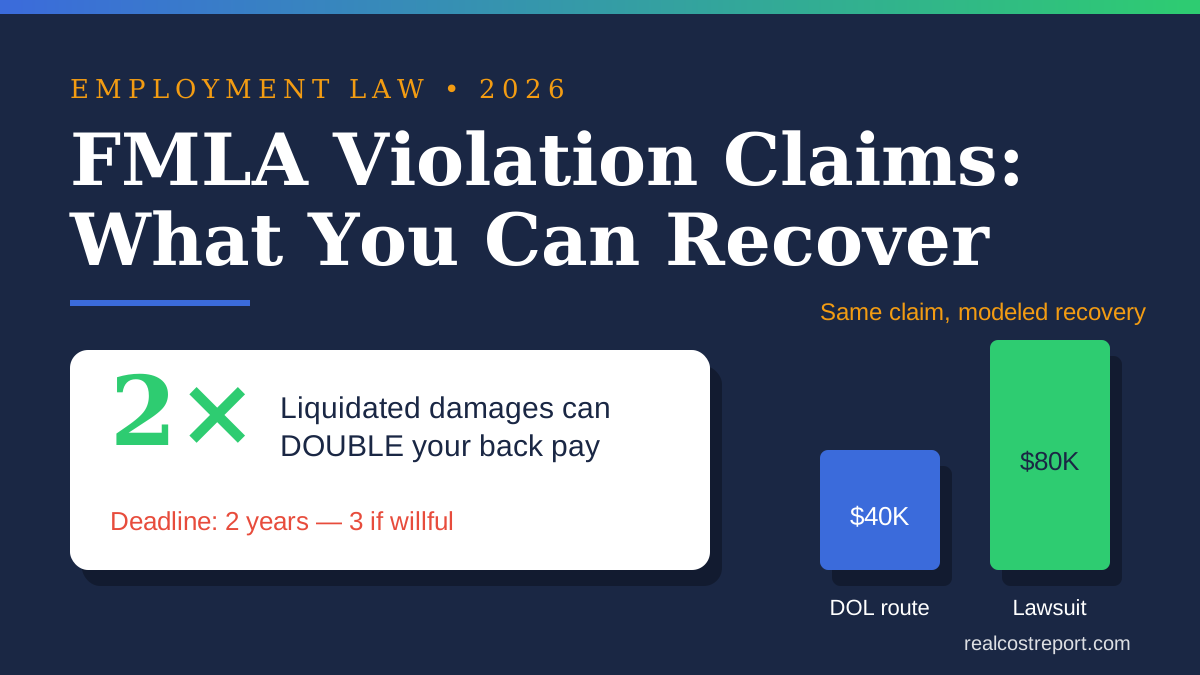
- Liquidated damages are the FMLA’s most valuable feature: courts award them by default, doubling your back pay unless the employer proves it acted in good faith.
- The FMLA does not pay emotional distress or punitive damages — recovery is strictly economic, which shapes whether a claim is worth pursuing.
- Comparison result: a free DOL Wage and Hour Division complaint resolves faster, but a private federal lawsuit typically recovers far more because DOL settlements rarely include liquidated damages or fees.
- Deadlines are hard: 2 years from the violation, or 3 years if the violation was willful.
- Recommendation: if your lost wages exceed roughly $10,000, get a contingency-fee consultation before filing anything with the DOL — most employment attorneys review FMLA claims for free.
The U.S. Department of Labor’s Wage and Hour Division recovered more than $259 million in back wages for nearly 177,000 workers in fiscal year 2025 — an average of $1,465 per worker across all the laws it enforces. That average is exactly why so many employees with strong Family and Medical Leave Act claims leave money on the table. FMLA-specific collections through the DOL have historically run under $1 million per year, while a single well-documented private FMLA lawsuit can settle for five or six figures. The gap comes down to one word: liquidated damages, which double back pay in court but rarely appear in agency settlements. This report breaks down every category of recovery the statute allows, models a real-dollar scenario for a $65,000 employee, compares the free DOL complaint route against hiring a contingency-fee firm (Morgan & Morgan and regional employment boutiques dominate this space), and walks through filing deadlines. All damages figures trace to 29 U.S.C. § 2617 and DOL Wage and Hour Division enforcement data.
What Counts as an FMLA Violation in 2026
The FMLA entitles eligible employees to 12 workweeks of unpaid, job-protected leave in a 12-month period for a serious health condition, a family member’s serious health condition, or the birth or placement of a child — and up to 26 weeks for military caregiver leave. Eligibility requires 12 months of employment, 1,250 hours worked in the prior 12 months, and a worksite with 50 or more employees within 75 miles.
Two categories of violations produce claims. Interference means the employer prevented you from using leave you were entitled to: denying a valid request, counting FMLA absences against you under an attendance policy, discouraging you from applying, or failing to restore you to the same or an equivalent position afterward. Retaliation means the employer punished you for using or requesting leave — termination, demotion, a cut in hours, or a suspiciously timed negative review.
According to DOL Wage and Hour Division enforcement data (verify at dol.gov), the most common substantiated violations in recent fiscal years have been refusal to grant leave, termination of employees on leave, and failure to restore employees to equivalent positions — with failure to maintain health benefits during leave appearing far less often. That pattern matters for valuation: termination and failure-to-restore cases generate the largest wage losses, and wage loss is the engine of every FMLA recovery.
What You Can Recover: The Full Damages Breakdown
FMLA remedies come from 29 U.S.C. § 2617, and the statute is unusually mechanical. There is no jury discretion to award pain and suffering, and no punitive damages — a structure most circuit courts have consistently enforced. Here is every component, with modeled examples for an employee earning $1,250 per week ($65,000 per year).
Damages framework: 29 U.S.C. § 2617, Family and Medical Leave Act. Statutory text available via the Legal Information Institute (verify at law.cornell.edu). Modeled examples are Real Cost Report calculations for a $65,000 salary, not case outcomes.
Two features distinguish the FMLA from discrimination statutes. First, the fee-shifting provision is mandatory, not discretionary — which is why contingency-fee employment firms actively pursue even mid-sized FMLA claims. Second, the liquidated damages doubling flips the usual burden: the employer must prove good faith to escape it, and courts deny that defense more often than they grant it.
How Liquidated Damages Double Your Recovery: The Math
Consider a project coordinator earning $65,000 who takes approved FMLA leave for surgery and is terminated in week 10 of leave. She searches diligently and lands an equivalent job 26 weeks later.
Back pay: 26 weeks × $1,250 = $32,500. Lost employer health premiums, replaced through COBRA at roughly $1,000 per month for family coverage: $6,000. Prejudgment interest adds approximately $1,500 at prevailing rates. Subtotal: $40,000.
Now the doubling. Unless the employer proves it terminated her in good faith with reasonable grounds to believe it was complying with the FMLA — a defense that fails, for example, when HR never analyzed her leave status before the termination decision — the court adds liquidated damages equal to the subtotal. Total judgment: $80,000. Her attorney’s fees, perhaps $35,000–$60,000 through trial, are billed to the employer separately rather than deducted from her award.
Compare that with the same claim resolved through a DOL Wage and Hour Division investigation. Agency settlements typically recover back wages — the $32,500 — and reinstatement where feasible, but historically have not included liquidated damages or fees. The FY 2023 DOL data illustrates the scale difference: total FMLA back wages collected nationwide through the agency ran under $1 million, spread across all substantiated complaints. The same statutory violation is worth roughly half as much through the free channel. That is not an argument against the DOL route in every case — it is a warning to run this math before choosing one.
DOL Complaint vs. Private Lawsuit: Which Is Better for Your Situation?
Unlike Title VII discrimination claims, the FMLA has no exhaustion requirement — you may file a federal lawsuit immediately without ever contacting the DOL. That makes this a genuine either/or decision.
Filing procedures and remedies: U.S. Department of Labor, Wage and Hour Division (verify at dol.gov); federal filing fee schedule per the U.S. Courts fee schedule (verify at uscourts.gov). Timeline figures are Real Cost Report estimates from typical case progressions, not guarantees.
Verdict
For a termination or failure-to-restore claim with meaningful lost wages, the private lawsuit wins decisively: liquidated damages and mandatory fee-shifting roughly double the economic value of the identical facts, and contingency representation removes the upfront cost barrier. The DOL complaint is the better tool when you are still employed, your losses are small, or your primary goal is forcing a policy correction without litigation. A hybrid approach — free attorney consultation first, DOL complaint only if no firm takes the case — dominates either pure strategy.
What Most People Get Wrong About FMLA Claims
Mistake 1: Waiting for an EEOC right-to-sue letter. The EEOC does not enforce the FMLA, and there is no administrative prerequisite. Consequence: employees burn months of their limitations period waiting for a letter that will never come. Correct action: calendar the 2-year deadline from the violation date and treat it as absolute.
Mistake 2: Assuming emotional distress damages are available. Consequence: employees reject reasonable settlement offers expecting a pain-and-suffering premium the statute cannot deliver. Correct action: value your claim as back pay plus benefits, doubled, plus fees — nothing more. If distress damages matter to you, ask counsel whether a parallel ADA or state-law claim fits your facts.
Mistake 3: Failing to mitigate. Back pay is reduced by wages you earned — or reasonably could have earned — after the violation. Consequence: a judge cuts a $40,000 back-pay claim to $15,000 because the plaintiff stopped job searching. Correct action: document every application, interview, and rejection from day one.
Mistake 4: Quitting without documenting the interference. Consequence: a resignation converts a strong retaliation case into a difficult constructive-discharge case. Correct action: put your leave request and the employer’s response in writing, preserve emails to a personal account lawfully, and consult counsel before resigning.
Mistake 5: Ignoring the willfulness extension. Consequence: employees past the 2-year mark assume they are barred. Correct action: if evidence shows the employer knew it was violating the FMLA — an HR email flagging the risk, for instance — the deadline extends to 3 years. Let an attorney make that call.
Is Filing Worth It? A Conditional Framework
File — through counsel — if all three conditions hold: you were an eligible employee at a covered worksite; you suffered a concrete economic loss (termination, demotion, lost hours, or unreimbursed costs); and you are inside the 2-year window. With losses above $10,000, the doubling mechanism plus fee-shifting makes these claims economically attractive to contingency firms, which means representation costs you nothing upfront.
Use the free DOL route if your losses are under roughly $5,000, you remain employed and want the practice corrected, or no private firm accepts the case after two or three consultations. The Wage and Hour Division’s investigation costs you nothing and preserves your right to sue later, provided the deadline has not run.
Skip the claim if you cannot establish eligibility — the 1,250-hour and 50-employee thresholds eliminate many part-time workers and small-business employees — or if your only injury is frustration without economic loss. The statute’s actual-monetary-loss cap of 12 weeks’ wages means a no-wage-loss claim for a $65,000 employee tops out near $15,000 before doubling, which some firms will still take but many will not.
One 2026 development worth watching: the DOL has expanded its PAID self-audit program to cover FMLA violations, letting employers self-report and settle. If your employer approaches you with a PAID-related back-wage payment, understand that accepting it may waive claims worth substantially more — get the offer reviewed before signing anything.
How We Researched This Article
This analysis was last conducted in July 2026. Our damages framework comes directly from the statutory text of the Family and Medical Leave Act, 29 U.S.C. § 2617, as published by the Legal Information Institute at Cornell Law School. Eligibility thresholds, covered-employer definitions, and filing procedures were verified against the U.S. Department of Labor Wage and Hour Division’s FMLA resource pages. Enforcement statistics — including the $259 million in total FY 2025 back-wage recoveries and historical FMLA-specific collections — come from the Wage and Hour Division’s fiscal year enforcement data. The $405 federal civil filing fee was checked against the U.S. Courts district court fee schedule.
Distinguishing modeled from measured figures: the $80,000 recovery scenario, attorney-fee ranges, litigation timelines, and COBRA replacement costs are Real Cost Report models built from the statutory formula and typical market rates — they are illustrative calculations, not reported verdicts. The DOL recovery totals, statutory caps, deadlines, and eligibility thresholds are measured figures from the primary sources above. Limitations: FMLA settlement values vary enormously by salary, jurisdiction, and evidence quality; no public database captures private settlement amounts comprehensively, so we deliberately avoided quoting “average settlement” figures that circulate without sourcing. Contingency-fee percentages reflect prevailing market norms rather than a regulated schedule and should be confirmed in any retainer agreement. All figures were verified against named primary sources before publication.