This article is general legal information, not legal advice; consult a licensed employment attorney or your state labor agency before acting on a wage claim.
TL;DR — Quick Verdict
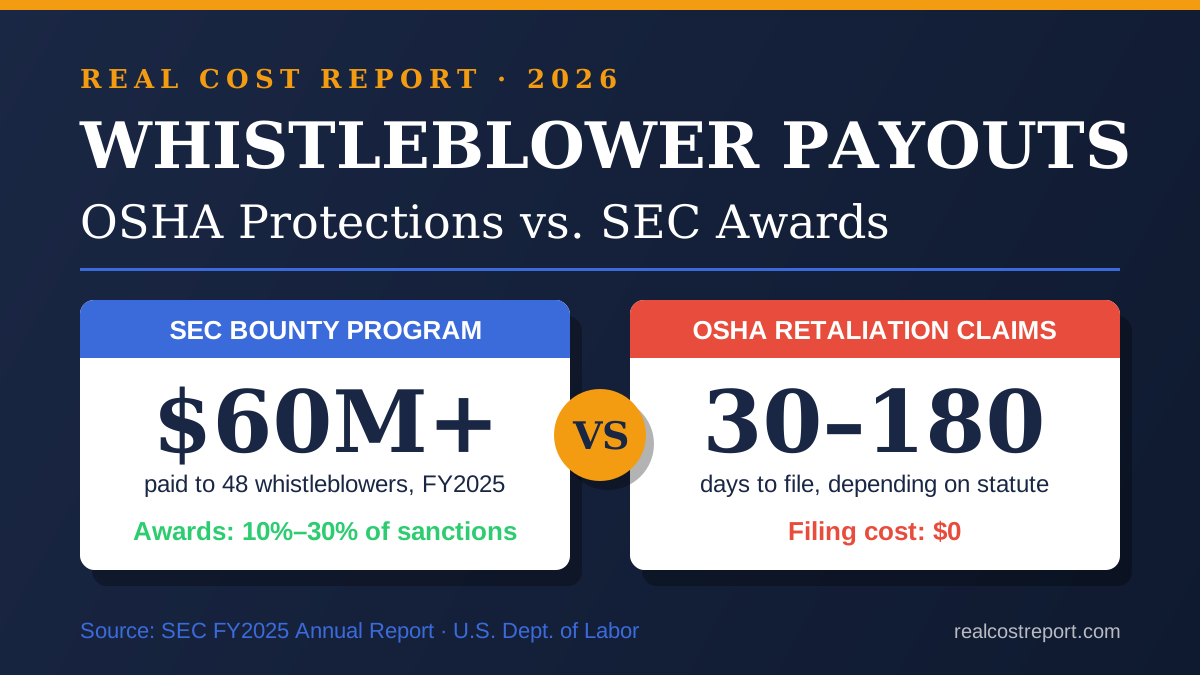
- The U.S. Department of Labor’s Wage and Hour Division recovered more than $270 million in back wages for workers in a single recent fiscal year — and filing a complaint costs $0.
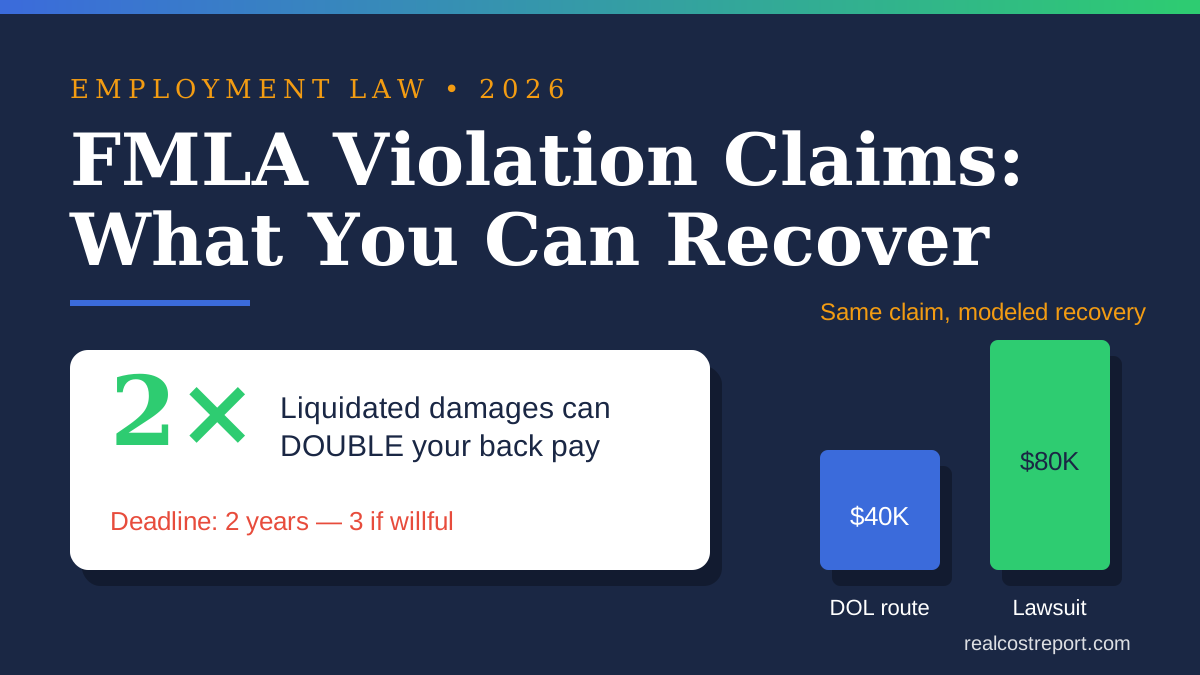
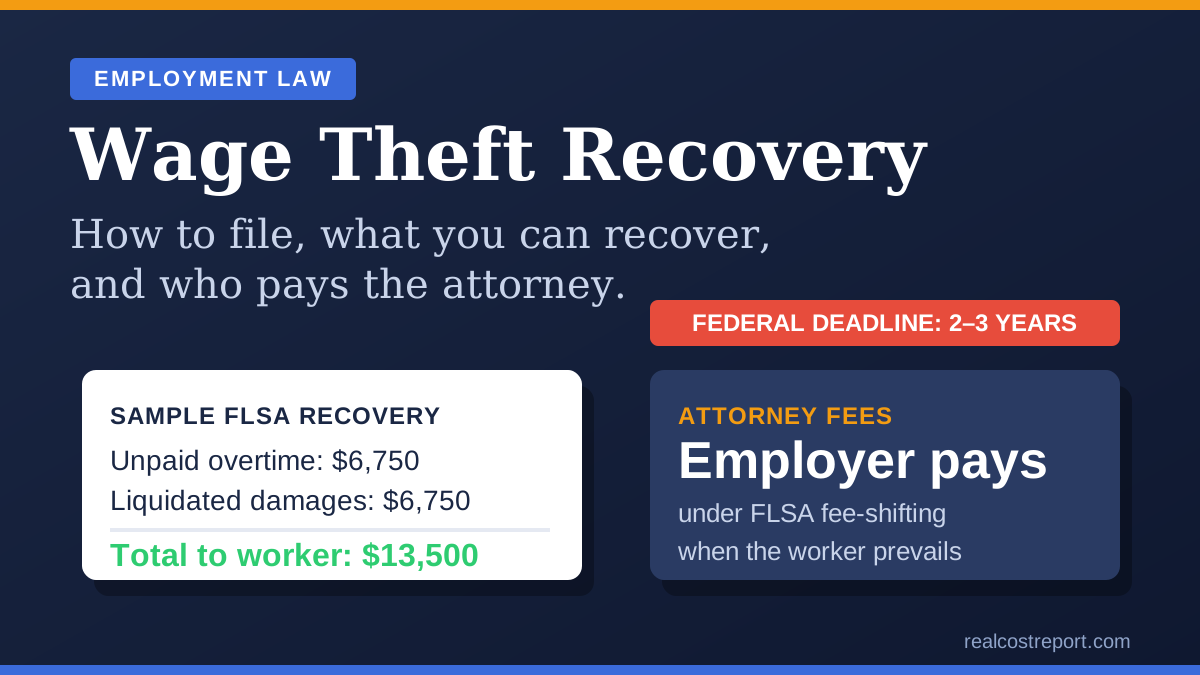
- Under the federal Fair Labor Standards Act (FLSA), most successful claimants recover double their unpaid wages: back pay plus an equal amount in liquidated damages.
- A worker owed $6,750 in unpaid overtime can typically recover $13,500 before penalties — and the employer, not the worker, pays attorney fees when the worker prevails.
- DOL complaint vs. private lawsuit: the DOL route is free and anonymous-friendly, but private lawsuits recover more on average because liquidated damages and state penalties are pursued aggressively.
- The federal deadline is 2 years (3 for willful violations) — every month of delay permanently erases the oldest month of recoverable wages.
- Recommendation: claims under roughly $3,000 → free state or DOL complaint; claims above $10,000 or involving multiple coworkers → contingency-fee employment attorney.
The Economic Policy Institute estimates that U.S. workers lose roughly $15 billion every year to minimum wage violations alone — more than the combined annual value of all robberies, burglaries, and motor vehicle thefts reported to the FBI. Yet most victims never file, usually because they assume recovery is expensive, slow, or requires hiring a lawyer out of pocket. All three assumptions are wrong. Filing a wage complaint with the U.S. Department of Labor or a state agency like the California Labor Commissioner’s Office costs nothing, and federal law forces employers who lose to pay the worker’s attorney fees. This guide walks through the three recovery routes and their real costs, exactly what you can recover (with the math shown), how the 2-year federal clock works, a head-to-head comparison of a DOL complaint versus a private lawsuit filed by a plaintiff-side firm such as Morgan & Morgan or Outten & Golden, the five mistakes that shrink recoveries, and who should use which route.
What Counts as Wage Theft — and How Much Is Actually Recovered
Wage theft is any failure to pay legally owed compensation. The most common forms, according to Department of Labor enforcement data, are unpaid overtime (paying straight time for hours over 40), minimum wage violations, off-the-clock work (pre-shift setup, mandatory unpaid meetings), illegal tip pooling or tip credits, misclassifying employees as independent contractors, unpaid final paychecks, and illegal paycheck deductions that drop pay below minimum wage.
The scale of enforcement is substantial. The Wage and Hour Division reports recovering more than $270 million in back wages for over 160,000 workers in a recent fiscal year — an average of roughly $1,600 per worker, though litigated private claims typically recover several times that because they include liquidated damages and state penalties that agency settlements sometimes waive. Industries with the highest violation rates in DOL data include food service, construction, home healthcare, retail, and agriculture.
Three bodies of law can apply simultaneously: the federal Fair Labor Standards Act, your state’s wage laws (often more generous — New York allows a 6-year lookback versus the FLSA’s 2–3 years), and in some cities, local ordinances. Sophisticated claimants file under whichever law pays the most. California, for example, adds “waiting time penalties” of up to 30 days of wages when a final paycheck is late — a penalty the FLSA does not offer at all.
Your Three Filing Routes: Cost, Timeline, and Recovery Compared
There are three main ways to recover stolen wages, plus small claims court for modest amounts. The right choice depends on claim size, whether coworkers are affected, and whether you still work for the employer.
Sources: U.S. Department of Labor, Wage and Hour Division dol.gov/agencies/whd; state small claims limits compiled from state court self-help materials — California Courts (verify at courts.ca.gov) and New York Unified Court System (verify at nycourts.gov). Timelines reflect agency and court averages, not guarantees.
Filing with the DOL is deliberately simple: call 1-866-487-9243 or file online, provide your employer’s name, your pay records, and a description of the violation. The agency investigates, and if it confirms violations, it supervises payment of back wages. Crucially, the FLSA’s anti-retaliation provision makes it illegal to fire, demote, or cut hours of a worker who files — and retaliation itself creates a second, often larger, claim.
What You Can Recover: The Math Behind a Real Claim
Federal law does not just return what was stolen — it doubles it. Under the FLSA, a prevailing worker recovers back pay plus an equal amount in “liquidated damages” unless the employer proves it acted in good faith, a defense courts rarely accept. Here is the arithmetic for a realistic claim: a warehouse worker earning $18/hour who worked 5 unpaid overtime hours per week for 50 weeks.
Calculation model by Real Cost Report using FLSA overtime and liquidated damages provisions, 29 U.S.C. §207 and §216 — U.S. Department of Labor (verify at dol.gov). California waiting time penalty per Labor Code §203 — California Department of Industrial Relations (verify at dir.ca.gov).
Notice what doubles the value of this claim: it is not the hourly rate but the liquidated damages multiplier and the fee-shifting rule. Because the employer pays attorney fees on top of the judgment — not out of it — a $13,500 recovery stays $13,500 in a fee-shifted case. In contingency arrangements without fee-shifting, a standard 33%–40% contingency fee would have cost this worker $4,455–$5,400.
How Attorney Fees Actually Work in Wage Cases
Wage claims are the rare legal matter where hiring a lawyer often costs the worker nothing. Three fee structures dominate.
Statutory fee-shifting. The FLSA and most state wage laws require a losing employer to pay the worker’s reasonable attorney fees and costs. This is why plaintiff-side employment firms — Morgan & Morgan, Outten & Golden, Nichols Kaster, and thousands of local firms — take wage cases with no upfront payment. Fee-shifting also explains why employers settle: a $6,000 wage dispute can generate $40,000 in fee exposure if litigated to trial.
Contingency fees. Most employment lawyers charge 33%–40% of the recovery, typically taking the greater of the contingency percentage or the court-awarded statutory fee. Read the retainer carefully: the best-structured agreements credit the statutory fee award against the contingency so the two are not stacked.
Hourly retainers. Rare in wage cases, but available for workers who want maximum control. Employment attorneys bill roughly $250–$600 per hour depending on market. Hourly billing only makes sense for very large, near-certain claims — six figures or more — where a contingency percentage would exceed the hourly cost.
One practical screening tip: if three contingency firms decline your case, it usually signals a proof problem (no records) or a collection problem (insolvent employer), not a legal problem. That is your cue to pivot to the free agency route, where the government carries the investigation burden.
DOL Complaint vs. Private Lawsuit: Which Is Better for Your Situation?
This is the decision most claimants face, and the honest answer depends on claim size, evidence, and whether coworkers share the same violation.
The DOL route wins on cost and simplicity: it is free, requires no lawyer, and DOL investigators can subpoena payroll records you cannot access yourself. It also protects workers who fear confrontation — the agency can investigate an entire workplace without disclosing who complained. Its weaknesses: investigations queue for months, the agency prioritizes larger multi-worker cases, and negotiated settlements sometimes recover back pay without full liquidated damages.
The private lawsuit route wins on total recovery. Attorneys pursue liquidated damages, state penalties, and interest as a matter of course, and the fee-shifting hammer pressures employers into faster, richer settlements. FLSA collective actions let one worker sue on behalf of similarly situated coworkers, multiplying leverage. Weaknesses: attorneys screen out small or hard-to-prove claims, litigation can run 1–3 years, and filing a lawsuit is public.
Verdict
For claims under roughly $3,000–$5,000 or where you lack records, file the free DOL or state agency complaint — the expected value of hiring counsel is negative at that size. For claims above $10,000, willful violations, or violations affecting multiple coworkers, a contingency-fee private lawsuit recovers meaningfully more: liquidated damages alone typically double the outcome, and the employer pays your lawyer. Between those thresholds, consult two contingency firms (free) before defaulting to the agency — their willingness to take the case is itself a signal of its value.
What Most People Get Wrong About Wage Claims
Mistake 1: Waiting to gather “perfect” evidence. Consequence: the FLSA’s 2-year statute of limitations (3 years for willful violations) erases the oldest pay period every single day you wait — a worker who delays 12 months permanently forfeits 12 months of wages. Correct action: file first; agencies and courts accept reasonable estimates when the employer’s records are deficient, a burden-shifting rule from the Supreme Court’s Anderson v. Mt. Clemens Pottery decision.
Mistake 2: Assuming a salary means no overtime. Consequence: salaried workers below the federal exempt-salary threshold, or whose duties are non-managerial, forfeit overtime they legally earned. Correct action: check the current DOL exempt salary threshold (verify at dol.gov) and compare your actual duties — not your title — against the exemption tests.
Mistake 3: Quitting before documenting. Consequence: losing access to schedules, timeclock data, and pay stubs makes damages harder to prove. Correct action: before resigning, photograph schedules, export timeclock records, and save pay stubs to a personal (not work) account.
Mistake 4: Fearing retaliation into silence. Consequence: forfeiting the entire claim. Correct action: know that retaliation is independently illegal under 29 U.S.C. §215, and retaliation claims frequently settle for more than the underlying wage claim.
Mistake 5: Accepting the employer’s first “correction” check. Consequence: cashing a check labeled as full settlement can compromise your claim to liquidated damages. Correct action: private FLSA settlements generally require DOL supervision or court approval to be valid — have any release reviewed before signing.
Is Filing Worth It? A Conditional Answer
File through a free agency if: your claim is under about $3,000; you lack strong records; you still work for the employer and want the shield of an agency investigation; or the employer is small and possibly judgment-proof, since the DOL can pursue payment through channels a private judgment cannot.
Hire a contingency attorney if: your claim exceeds $10,000; the violation appears willful (extending the lookback to 3 years); coworkers share the violation, making a collective action possible; or the employer already retaliated. In these cases the liquidated-damages doubling and fee-shifting change the economics decisively in your favor.
Use small claims court if: your claim sits under your state’s cap (commonly $5,000–$12,500), the math is simple, and you want resolution in weeks rather than years. You cannot recover attorney fees you did not incur, but you also give up nothing to a contingency percentage.
Skip filing only if: the amount is trivial relative to your time, or the employer has dissolved with no assets and no successor — though even then, some states hold individual owners personally liable for unpaid wages, so a free consultation costs you nothing but an hour. The break-even question is simple: divide the doubled claim value by the hours the route requires. A $2,000 claim recovered as $4,000 through a 10-hour agency filing pays $400 per hour of your effort — better than most people’s wage, which is precisely the point.
How We Researched This Article
This article was researched and last updated in July 2026. Our primary legal sources are the Fair Labor Standards Act itself — specifically the overtime provision at 29 U.S.C. §207, the remedies and fee-shifting provision at §216, and the anti-retaliation provision at §215 — as published by the U.S. Department of Labor’s Wage and Hour Division, which is also the source for enforcement recovery statistics and complaint-filing procedures. National wage theft loss estimates come from the Economic Policy Institute, whose published research on minimum wage violations underlies the $15 billion annual figure cited in the introduction. Wage benchmarks used in scenario modeling were checked against occupational wage data from the U.S. Bureau of Labor Statistics. California-specific penalty rules reference Labor Code §203 as published by the California Department of Industrial Relations (verify at dir.ca.gov), and small claims limits were compiled from state court self-help publications.
Two figures in this article are modeled rather than measured: the $13,500 sample recovery is an original calculation applying FLSA formulas to a hypothetical $18/hour worker, and agency timeline ranges are drawn from published agency guidance and practitioner reporting rather than a systematic dataset, since neither the DOL nor most state agencies publish case-level processing times. Attorney fee percentages (33%–40%) and hourly rates ($250–$600) reflect commonly published retainer norms and vary by market; they are estimates, not survey data. Statutes of limitations, exemption thresholds, and small claims caps change — verify current figures with the linked agencies before filing. All figures were verified against named primary sources before publication.