This article is general information based on publicly reported federal data, not legal advice; settlement outcomes depend on the facts of each case, and you should consult a licensed employment attorney before making decisions.
TL;DR — Quick Verdict
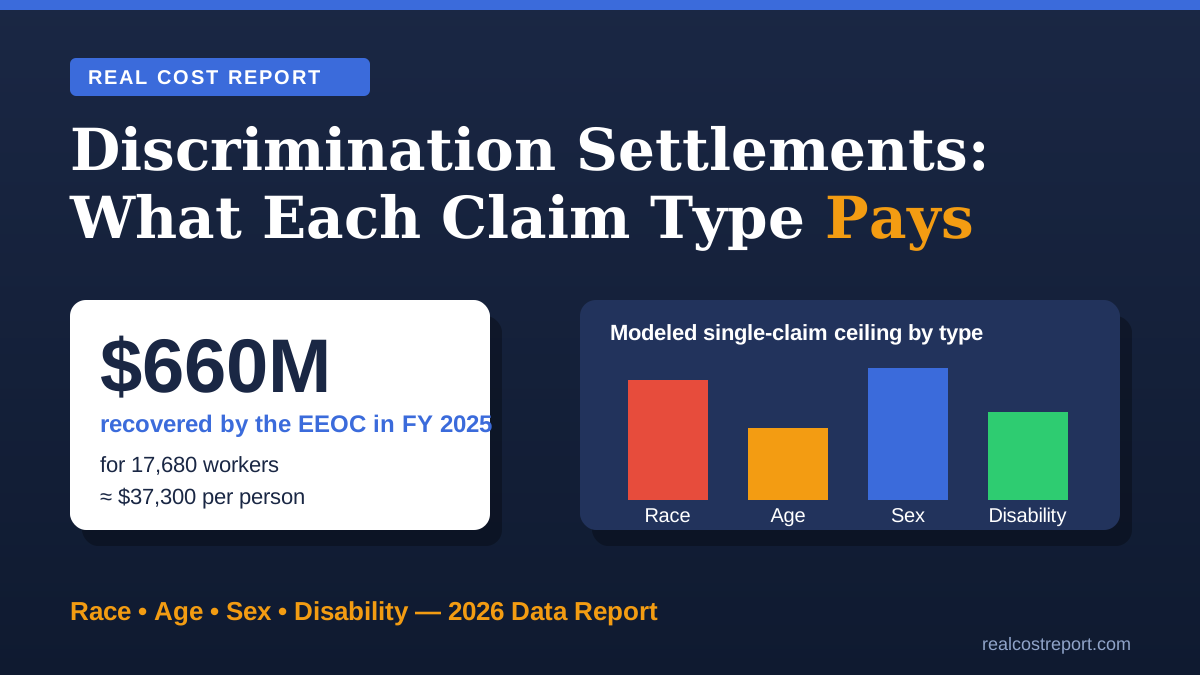
- The EEOC recovered $660 million for 17,680 workers in FY 2025 — roughly $37,300 per person on average, up from about $33,300 per person in FY 2024.
- Federal damage caps limit combined compensatory and punitive damages to between $50,000 and $300,000 depending on employer size — but back pay sits outside those caps.
- Race claims have a unique advantage: filing under Section 1981 of the Civil Rights Act of 1866 avoids the caps entirely. Age claims have a unique disadvantage: the ADEA allows no emotional-distress or punitive damages at all.
- Our comparison of EEOC mediation vs. a private lawsuit found mediation resolves in roughly 3 months at lower average payouts, while litigation can take 2–4 years but produced an average of about $71,700 per person in non-systemic EEOC lawsuit resolutions in FY 2024.
- Recommendation: if your documented lost wages exceed roughly $50,000 and you have written evidence, talk to a contingency-fee employment attorney before accepting any early offer.
In fiscal year 2025, the U.S. Equal Employment Opportunity Commission recovered $660 million for 17,680 victims of workplace discrimination — an average of roughly $37,300 per worker. That single average, however, conceals enormous variation. A disability accommodation claim settled through EEOC mediation might close for under $20,000, while race discrimination litigation against DHL Express produced an $8.7 million consent decree covering 83 Black delivery drivers, and a sex discrimination jury verdict against SkyWest Airlines reached $2.17 million before federal caps cut it to $300,000. This report breaks down what race, age, sex, and disability claims actually pay in 2026, why the governing statute matters more than the strength of your story, how federal damage caps work against you (and how race claimants can escape them), and whether an EEOC charge or a private lawsuit is the better path for your situation. All headline figures come from the EEOC’s own annual performance and enforcement data (verify at eeoc.gov).
The Baseline Numbers: What Federal Data Shows Discrimination Claims Pay
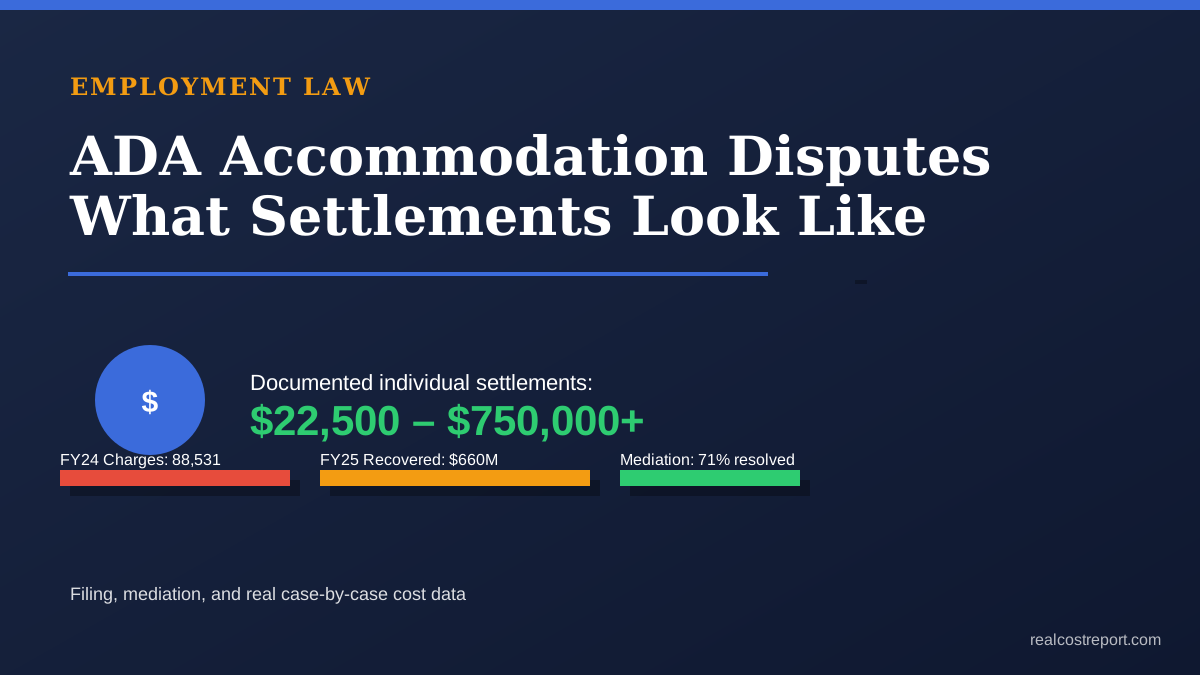
Before looking at type-by-type differences, anchor your expectations to the only large public dataset available: EEOC recoveries. In FY 2024, the agency secured nearly $700 million for about 21,000 workers. Of that, $469.6 million went to 13,516 private-sector and state/local government workers through mediation, conciliation, and administrative settlements — about $34,700 per person. Litigation recovered $40.4 million for 4,304 people, a deceptively low $9,400 average that is dragged down by large systemic class cases.
Strip out the systemic cases and the picture changes sharply. The EEOC’s Office of General Counsel reported $23.9 million recovered for roughly 4,074 people in 16 systemic suits (about $5,900 each). The remaining $16.5 million went to approximately 230 individuals in non-systemic suits — about $71,700 per person. Individual litigation, in other words, pays roughly seven times the blended litigation average.
Source: EEOC FY 2024 Annual Performance Report and Office of General Counsel FY 2024 Annual Report. Per-person figures are RealCostReport calculations from published totals. EEOC FY 2024 Annual Performance Report.
Settlement Amounts by Discrimination Type: Race vs. Age vs. Sex vs. Disability
No government agency publishes median settlement values by claim type — private settlements are confidential. What we can do is combine EEOC per-capita recovery data, statutory damage rules, and named public resolutions to build realistic modeled ranges for a single-plaintiff claim with documented job loss.
Ranges are RealCostReport modeled estimates for individual claims with documented termination, built from EEOC per-capita recovery data and published resolutions; they are not statistical medians. Examples from EEOC litigation announcements — U.S. Equal Employment Opportunity Commission (verify at eeoc.gov).
The pattern worth noticing: sex and race claims have the highest ceilings, age claims have the most restricted damages, and disability claims — despite being 38% of all FY 2024 charges — cluster lower because many involve accommodation disputes rather than firings, which limits back-pay exposure.
What Determines Your Settlement: Caps, Back Pay, and a Worked Scenario
Three variables drive most negotiated outcomes: your provable lost wages, your employer’s headcount, and the statute your claim falls under. Federal law caps combined compensatory (emotional distress) and punitive damages under Title VII and the ADA as follows — U.S. Equal Employment Opportunity Commission (verify at eeoc.gov):
Statutory caps under the Civil Rights Act of 1991, 42 U.S.C. § 1981a. Source: U.S. Equal Employment Opportunity Commission (verify at eeoc.gov). Back pay, front pay, and attorney’s fees are not subject to these caps.
Now the math. Suppose a 52-year-old operations manager earning $65,000 is fired at a 300-person company and remains unemployed for 8 months. Back pay: $65,000 × 8/12 = roughly $43,300, plus lost benefits (typically 25–30% of salary, adding $10,800–$13,000). If the claim is sex or disability discrimination, emotional-distress damages up to the $200,000 cap sit on top, so a realistic settlement demand starts near $100,000 and negotiations often land at 40–60% of the demand. If the identical facts are an age claim, the ADEA erases the emotional-distress component entirely — the case is worth back pay, possibly doubled to about $86,600 if willfulness can be shown, and nothing more. Same firing, same employer, potentially a $60,000 swing based purely on statute.
EEOC Mediation vs. Private Lawsuit: Which Is Better for Your Claim?
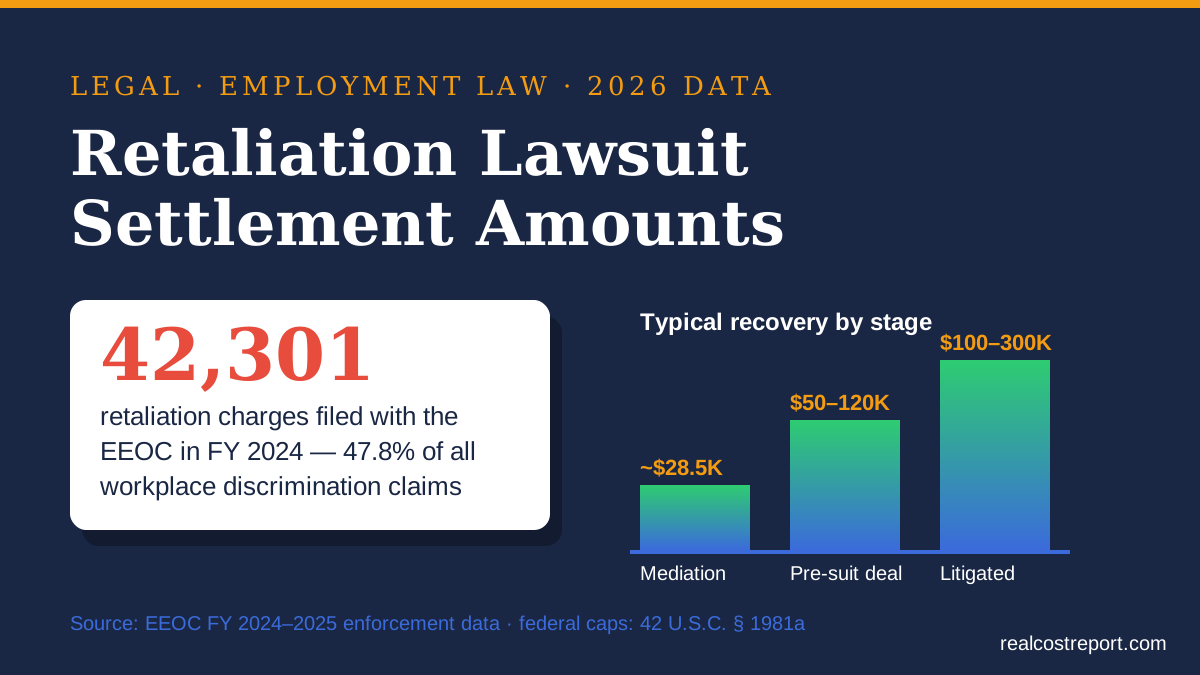
Every claimant faces this fork. EEOC mediation is free, confidential, and fast — the agency’s mediation program resolved over 71% of private-sector mediations in FY 2024 and secured $243.2 million in benefits, typically within about 3 months of a charge. Historical EEOC mediation outcomes have averaged in the mid-$20,000s per resolution, well below litigation values. A private lawsuit — filed after you receive a right-to-sue letter — takes 2 to 4 years, but non-systemic litigation outcomes in FY 2024 averaged around $71,700 per person, and contingency-fee employment attorneys (typically charging 33–40% of recovery) take strong cases at no upfront cost.
The trade-off is concrete: mediation trades roughly $40,000–$50,000 of expected value for speed, certainty, and zero legal fees. Litigation trades years of your life and a real chance of losing — plaintiffs win at trial less than half the time — for a materially higher ceiling.
Verdict
Take EEOC mediation if your provable lost wages are under about $40,000, you need money within months, or your evidence is thin. Pursue a private lawsuit if you have documented lost wages above $50,000, written evidence (emails, texts, performance reviews), and an attorney willing to take the case on contingency — the expected-value math favors litigation despite the delay. For race claims specifically, litigation under Section 1981 is disproportionately attractive because damage caps disappear.
What Most People Get Wrong About Discrimination Settlements
Mistake 1: Assuming the caps limit everything. Consequence: claimants undervalue strong cases and accept lowball offers. Correct action: remember back pay, front pay, and attorney’s fees sit outside the $50,000–$300,000 caps, and state statutes (California’s FEHA, New York’s Human Rights Law) often have no caps at all.
Mistake 2: Filing race claims only under Title VII. Consequence: a self-imposed $300,000 ceiling and a 180/300-day filing deadline. Correct action: ask your attorney about 42 U.S.C. § 1981, which covers race claims with no damage caps and a 4-year statute of limitations.
Mistake 3: Expecting age claims to pay like sex claims. Consequence: rejecting reasonable ADEA offers while holding out for emotional-distress money that the statute does not allow. Correct action: value an age case at back pay, doubled only if willfulness is provable.
Mistake 4: Missing the deadline. Consequence: total forfeiture — you generally have only 180 days (300 in states with their own agencies) to file an EEOC charge. Correct action: file the charge first; investigate and negotiate second.
Mistake 5: Treating headline verdicts as benchmarks. Consequence: unrealistic demands that stall negotiations. Correct action: anchor to per-capita data (roughly $34,700 administrative, $71,700 individual litigation), not the $2.17 million SkyWest verdict — which the court cut to $300,000 anyway.
Is Filing Worth It? Who Should Pursue a Claim in 2026
Filing an EEOC charge costs nothing, so the real question is how far to push. The conditional logic looks like this. File and mediate if: you experienced a discrete adverse action (firing, demotion, failure to promote), you are within the 180/300-day window, and any recovery would help — the downside is near zero. Escalate to litigation if: your lost wages exceed roughly $50,000, you have contemporaneous written evidence, the employer has 200+ employees (higher caps, deeper pockets, stronger settlement incentive), and a contingency attorney accepts the case after reviewing it — attorney acceptance is itself a strong signal of value.
Think twice if: your damages are mostly emotional with little wage loss and the claim is age-based (the ADEA won’t compensate it), you resigned without a documented constructive-discharge trail, or your only evidence is your own recollection. Retaliation deserves a final note: it appeared in 47.8% of all FY 2024 charges — 42,301 filings — and is often easier to prove than the underlying discrimination, because the timeline (complaint, then punishment) speaks for itself. If you reported discrimination and were then fired, demoted, or transferred, that retaliation claim may be worth more than the original claim. Charge volume matters too: with 88,531 new charges filed in FY 2024 — up 9.2% year over year — the EEOC prioritizes well-documented cases. Organized evidence isn’t just persuasive at trial; it moves you up the queue.
How We Researched This Article
This analysis was last conducted in July 2026 and draws exclusively on primary federal sources and named public case resolutions. Charge-volume figures (88,531 total FY 2024 charges; 42,301 retaliation; roughly 30,270 race; 26,872 sex; 16,223 age; disability at 38% of charges) come from the EEOC’s published Enforcement and Litigation Statistics. Recovery totals ($469.6 million administrative, $190 million federal-sector, $40.4 million litigation in FY 2024; $660 million for 17,680 workers in FY 2025) come from the EEOC FY 2024 Annual Performance Report, the agency’s accompanying newsroom release, and the Office of General Counsel FY 2024 Annual Report. Damage caps reflect the Civil Rights Act of 1991, 42 U.S.C. § 1981a.
Two categories of numbers in this article are modeled rather than measured, and we label them as such throughout. First, all per-person averages (about $34,700 administrative, $5,900 systemic litigation, $71,700 non-systemic litigation, $62,500 federal-sector) are RealCostReport calculations dividing published recovery totals by published claimant counts; they are means, not medians, and large cases skew them. Second, the type-by-type settlement ranges in our comparison table are modeled estimates combining those per-capita figures with statutory damage rules and named public settlements — private settlements are confidential, so no true median by claim type exists in any public dataset. The scenario calculation (the $65,000 manager) is illustrative arithmetic, not a prediction. Key limitations: EEOC data excludes state-agency recoveries and private settlements reached without an EEOC charge, both of which are substantial; and enforcement priorities shifted after the January 2025 change in administration, which may affect future recovery patterns. All figures were verified against named primary sources before publication.