This article is general legal information, not legal advice; non-compete enforceability varies by state and by contract, so consult a licensed employment attorney in your jurisdiction before acting.
TL;DR — Quick Verdict
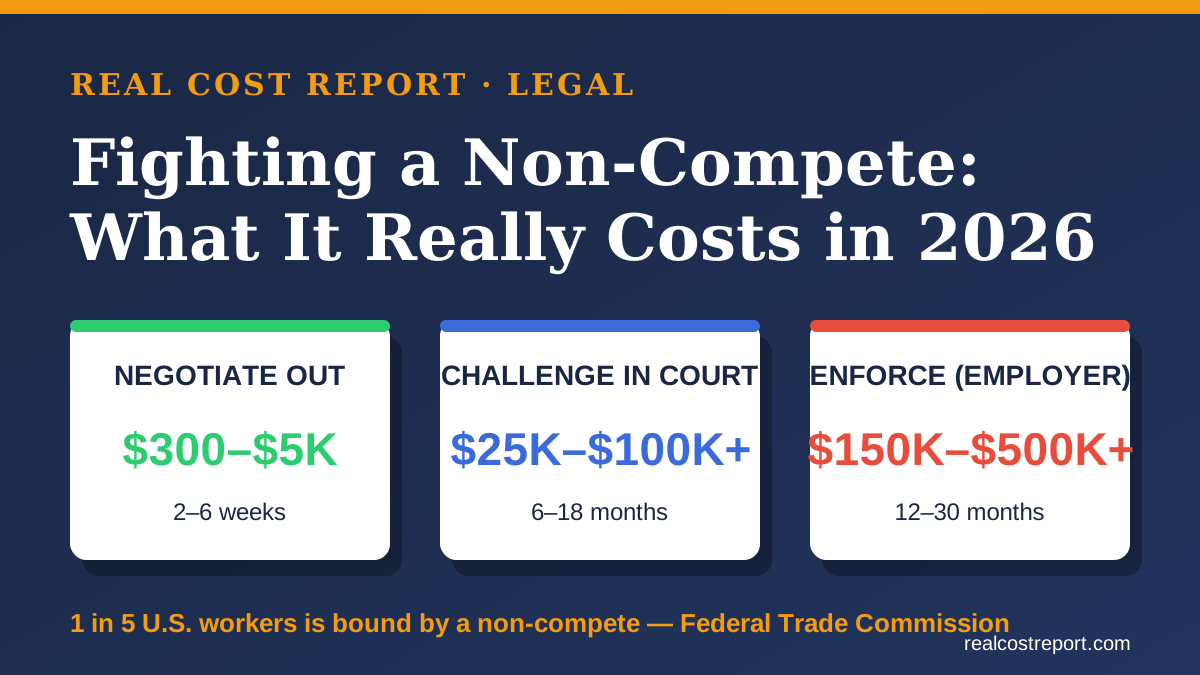
- Negotiating out of a non-compete is the cheapest path by far: a flat-fee attorney review runs $300–$1,000, and a negotiated release or carve-out typically costs $1,500–$5,000 in legal fees.
- Challenging a non-compete in court through a declaratory judgment action commonly costs $25,000–$100,000+; employers spend $50,000–$150,000 just to win a preliminary injunction, and $150,000–$500,000+ through trial.
- The FTC’s nationwide non-compete ban never took effect — it was struck down by a federal court in Texas in August 2024, and the FTC abandoned its appeals in 2025, shifting to case-by-case enforcement.
- Roughly one in five U.S. workers — about 30 million people — is covered by a non-compete, according to the Federal Trade Commission’s rulemaking record.
- Comparison result: negotiation beats litigation for most employees earning under $150,000; litigation only pencils out when the blocked opportunity is worth six figures more than your current role.
- Recommendation: pay for a one-hour flat-fee review before you sign, resign, or accept a competing offer — it is the highest-ROI $500 in employment law.
About 30 million American workers — roughly one in five — are bound by a non-compete agreement, according to the Federal Trade Commission’s 2024 rulemaking record (verify at ftc.gov). Most of them signed without negotiating, and many assume the clause is either ironclad or worthless. Both assumptions are expensive. The real question is not whether non-competes are enforceable in the abstract; it is what each path — enforcing one, challenging one, or negotiating your way out — actually costs in 2026, and when each is worth paying for. This article prices all three paths using published attorney fee benchmarks, court filing schedules, and state statutes, models three realistic scenarios, and maps the state laws that can make a clause void before you spend a dollar. Legal marketplaces such as Avvo, Rocket Lawyer, and LegalZoom have made the cheapest step — a flat-fee contract review — easier to buy than ever, so we start with the numbers that matter.
What It Actually Costs: Enforce vs. Challenge vs. Negotiate
Employment litigators in major metro markets commonly bill between $250 and $650 per hour, based on published fee surveys such as the Clio Legal Trends Report (verify at clio.com). Applying those rates to the typical hours each path consumes produces the modeled ranges below. These are legal fees only; they exclude lost wages during any sit-out period, which is often the largest hidden cost.
Modeled ranges calculated from published attorney hourly-rate benchmarks in the Clio Legal Trends Report (verify at clio.com) and federal court filing fee schedules from the Administrative Office of the U.S. Courts (verify at uscourts.gov). Last updated July 2026.
Two asymmetries jump out. First, enforcement costs the employer 10 to 50 times what a negotiated exit costs the employee — which is why most disputes settle after the demand-letter stage. Second, a fee-shifting clause in your agreement can transfer the employer’s six-figure litigation bill to you if you lose. Check for one before choosing the litigation path.
What Determines Whether a Non-Compete Is Enforceable
Outside the ban states, courts apply a reasonableness test with three prongs: duration, geographic scope, and the legitimate business interest being protected. Twelve months is broadly defensible in most enforcement-friendly states; anything beyond 24 months draws skepticism unless trade secrets or a business sale are involved. Geographic scope must match where you actually worked or sold. A “legitimate business interest” means trade secrets, confidential pricing, or customer relationships you personally controlled — not the mere desire to avoid competition.
Consider a realistic scenario. A pharmaceutical sales representative in Ohio earns $95,000 and signs a two-year, 100-mile non-compete. She covered a three-county territory. A competitor offers $120,000 for an adjacent territory she never touched. Under Ohio’s reasonableness standard, a court would likely “blue-pencil” the agreement — narrowing it to her actual counties — rather than void it. Her attorney’s $3,500 opinion letter to the new employer, explaining that the role falls outside any defensible scope, resolves the matter in five weeks without a lawsuit. Her former employer, facing a $75,000+ bill to seek an injunction it would probably lose in part, declines to sue.
Now change one fact: she downloaded the customer pricing file before resigning. Enforcement probability, and her legal exposure, both jump dramatically, because trade-secret misappropriation converts a shaky contract claim into a strong statutory one under the Defend Trade Secrets Act (verify at congress.gov). Conduct, not just contract language, determines outcomes.
Challenging in Court vs. Negotiating a Release: Which Is Better for Your Situation?
Litigation buys certainty and precedent; negotiation buys speed and predictable cost. A declaratory judgment action makes sense when the clause blocks a genuinely transformative opportunity — say, a $180,000 offer against a $110,000 current salary — because the $40,000–$80,000 expected legal spend is recovered within the first year of the raise, and many new employers will fund the fight for a senior hire. It also makes sense when your state’s law is clearly on your side and you want a binding ruling, not a private truce.
Negotiation wins in almost every other case. A carve-out letter — the employer agrees in writing that a specific role at a specific company does not violate the agreement — costs $1,500–$5,000 and typically closes in under six weeks. Employers say yes surprisingly often because their alternative is a $50,000+ injunction fight with uncertain odds. Negotiation also preserves references and avoids the discovery process, in which your emails, texts, and files become evidence.
Verdict
Negotiate first, litigate only with leverage. For employees earning under roughly $150,000, or facing a raise of less than $30,000, negotiation dominates: the expected cost is 90–95% lower and the timeline 80% shorter. Litigation is rational only when the blocked opportunity exceeds your current compensation by six figures over the contract term, a new employer is funding counsel, or you live in a state where the statute has already done the work for you.
State Law Map 2026: Where the Clause May Already Be Void
Before spending anything, check your state. Several states void most non-competes outright, and a growing list voids them below an income threshold — meaning your cheapest challenge may be a statute, not a lawsuit.
Compiled from state statutes: California Legislative Information (verify at leginfo.legislature.ca.gov), Minnesota Revisor of Statutes (verify at revisor.mn.gov), Washington State Legislature (verify at leg.wa.gov), and Florida Senate (verify at flsenate.gov). Last verified July 2026.
Oregon, Virginia, Maryland, Maine, New Hampshire, and Rhode Island also impose income floors or occupation-specific limits. If you earn under your state’s threshold, a single certified letter citing the statute — often drafted for under $500 — can end the dispute.
What Most People Get Wrong About Non-Competes
Mistake 1: Assuming the FTC banned non-competes nationwide. Consequence: workers resign believing the clause is dead, then face an injunction. The FTC’s 2024 rule was set aside by a federal district court in Texas before it ever took effect, and the agency dropped its appeals in 2025. Correct action: treat your state statute and your contract as controlling law, and confirm current status at ftc.gov.
Mistake 2: Signing without negotiating because “everyone signs.” Consequence: you forfeit leverage you will never have again — the moment before signing is your maximum-leverage point. Correct action: ask for a shorter term, a narrower scope, or paid garden leave; a $500 flat-fee review through a marketplace like Rocket Lawyer or a local employment attorney found via Avvo often pays for itself many times over.
Mistake 3: Taking company files “just in case” before resigning. Consequence: a weak contract claim becomes a strong trade-secrets claim, with fee awards and potential injunctions against your new employer. Correct action: return every device and file, and document the return in writing.
Mistake 4: Hiding the non-compete from the new employer. Consequence: rescinded offers and tortious-interference exposure once the demand letter arrives. Correct action: disclose early; many employers will indemnify you or fund a challenge for the right hire.
Mistake 5: Ignoring the non-solicit and confidentiality clauses. Consequence: you “win” on the non-compete but get sued for calling former clients. Correct action: have counsel review all restrictive covenants together, not the non-compete in isolation.
Is Fighting Your Non-Compete Worth It?
Run the decision as conditional logic, not emotion. If you live in a ban state or earn below your state’s threshold, spend $300–$500 on a statutory-citation letter and nothing more — litigation would be paying for a result the legislature already gave you. If your new role is in a different territory, product line, or customer segment, spend $2,500–$5,000 on an opinion letter and a negotiated carve-out; expected success is high because the employer’s enforcement math is terrible.
If the clause squarely covers the new role and you earn $150,000+, model it as an investment: a $60,000 declaratory action that unlocks a $70,000 annual raise breaks even in about 10 months, ignoring taxes. Below that ratio, ask the new employer to fund the fight or negotiate a delayed start date instead — sitting out six months on a negotiated severance often costs less than eighteen months of litigation. If you took files, contacted clients early, or have a fee-shifting clause, settle quickly; your downside is uncapped. Employers face the mirror-image test: enforcement is worth $100,000+ only against departures that threaten identifiable revenue or trade secrets, which is why most companies send letters to many and sue almost none.
What’s Changed in 2026
Three shifts matter this year. First, federal rulemaking is dead but federal enforcement is not: after abandoning the blanket rule, the FTC signaled it would pursue individual companies whose non-compete practices it views as unfair methods of competition, and it has issued warning letters to employers in healthcare and other sectors (verify current actions at ftc.gov). Second, the state patchwork keeps widening — Wyoming’s ban took effect in July 2025, while Florida’s CHOICE Act moved aggressively in the pro-enforcement direction, allowing covenants up to four years for high earners. The same clause can be void in Minneapolis and iron-clad in Miami. Third, income thresholds in Washington, Colorado, Oregon, and Maine adjust annually for inflation, so a clause that bound you in 2024 may have aged out of enforceability. Check the current-year threshold before assuming anything — the two minutes it takes can save a five-figure legal bill.
How We Researched This Article
This analysis draws on primary legal sources and published fee benchmarks, cross-checked in July 2026. Statutory rules came directly from state legislative databases: California Business and Professions Code §16600 via California Legislative Information, Minnesota’s 2023 ban via the Minnesota Revisor of Statutes, Washington’s income-threshold statute via the Washington State Legislature, and Florida’s CHOICE Act via the Florida Senate’s bill archive. The status of the federal rule — its adoption in April 2024, the district court decision setting it aside in August 2024, and the agency’s subsequent withdrawal of its appeals — was verified against the Federal Trade Commission’s rulemaking docket. The 30-million-worker coverage estimate comes from the FTC’s own rulemaking record. Background on restrictive-covenant doctrine was checked against the Legal Information Institute at Cornell Law School.
Cost figures require an honest caveat: no government agency publishes official non-compete litigation costs. Our ranges are modeled, not measured. We combined published attorney hourly-rate benchmarks (including the Clio Legal Trends Report) with typical hour counts for each procedural stage and federal filing fees from the Administrative Office of the U.S. Courts, then sanity-checked the ranges against publicly reported fee awards in restrictive-covenant cases. Actual costs vary widely by market, firm size, and case complexity, and 2026 income thresholds in indexing states should be confirmed against the administering agency before relying on them. Research was last conducted July 2026. All figures were verified against named primary sources before publication.