This article is general information, not legal advice; severance rights vary by state and contract, so consult a licensed employment attorney before signing or rejecting any separation agreement.
TL;DR — Quick Verdict
- A flat-fee severance review from an employment attorney typically costs $500–$2,500; full negotiation runs $1,500–$7,500 hourly or 25%–40% of the improvement on contingency.
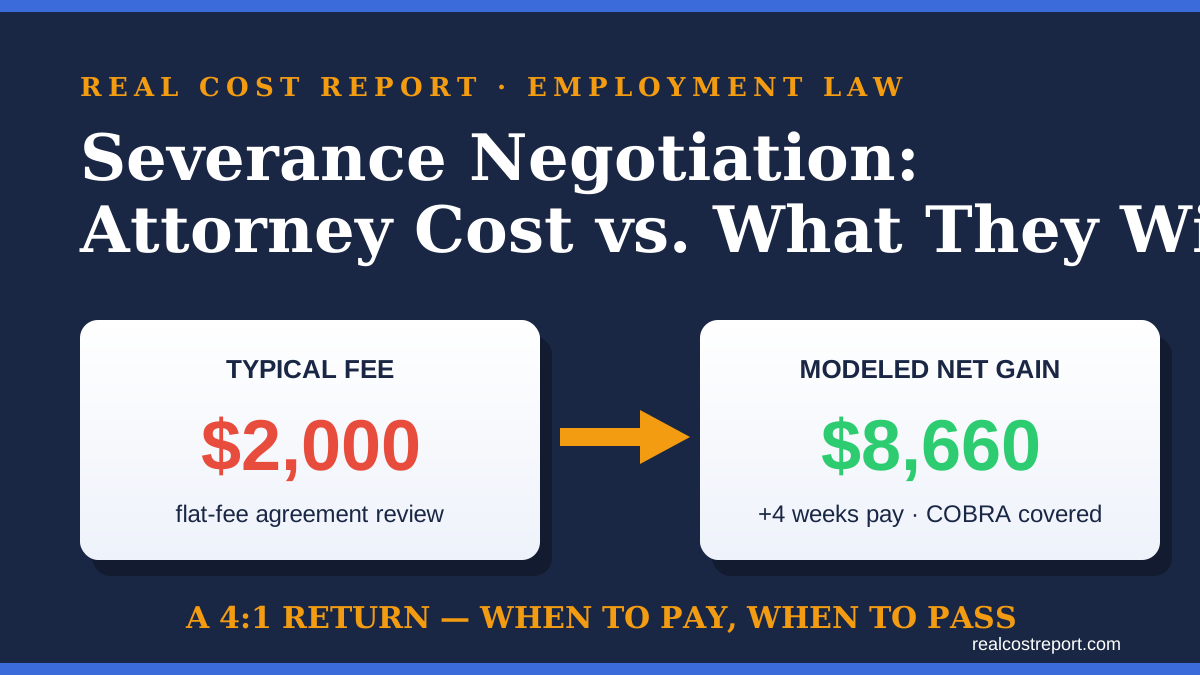
- In our modeled mid-career scenario, a $2,000 attorney engagement that adds just four weeks of pay on a $110,000 salary returns roughly $8,460 net — about a 4:1 return.
- Flat-fee review vs contingency: flat fee wins for standard layoffs with no legal claims; contingency wins when discrimination, retaliation, or unpaid-wage leverage exists.
- Workers 40 and older get a statutory 21-day consideration window (45 days in group layoffs) under the Older Workers Benefit Protection Act — enough time to hire counsel without rushing.
- The most expensive mistake is signing within 48 hours; the release of claims you sign is usually worth far more to the employer than the severance is to you.
- Recommendation: if your package exceeds $10,000 or you have any potential legal claim, pay for at least a flat-fee attorney review before signing.
Roughly half of U.S. private-sector employers offer severance to laid-off salaried staff, and the most common formula — one to two weeks of pay per year of service — is a starting offer, not a final one, according to compensation survey data from WorldatWork (verify at worldatwork.org). Yet most employees sign the first draft, often within days, releasing every legal claim they hold in exchange for the employer’s opening number. The question this article answers with actual math: does paying an employment attorney $500–$7,500 to review or negotiate that agreement reliably return more than it costs? We break down 2026 fee structures — flat fee, hourly, and contingency — model three realistic negotiation scenarios with net-return calculations, compare a flat-fee review against contingency representation, and identify the five mistakes that cost departing employees the most. Attorney rate data reflects figures reported in the Clio Legal Trends Report and state bar economic surveys; severance benchmarks come from the U.S. Bureau of Labor Statistics and Society for Human Resource Management (SHRM) research.
What an Employment Attorney Costs in 2026
Employment attorneys price severance work three ways, and the structure you choose matters more than the hourly rate. A limited-scope flat-fee review — the attorney reads the agreement, flags problems, and advises on leverage — is the entry point. Full negotiation, where counsel contacts the employer directly, costs more but shifts the dynamic: HR departments respond differently to a demand letter on law-firm letterhead than to an employee’s email.
Rate ranges compiled from the Clio Legal Trends Report (verify at clio.com), state bar association economic surveys (verify at americanbar.org), and published fee schedules of employment law firms. Individual quotes vary by market and complexity.
Geography moves these numbers substantially. Attorneys in New York, San Francisco, and Washington, D.C. commonly bill $450–$650 per hour for employment matters, while comparable counsel in mid-size Midwestern or Southern markets bills $250–$400. Directory platforms such as Avvo and LegalMatch let you compare local rates before committing, and many employment firms offer a free or low-cost initial consultation to scope the work.
What Determines How Much You Pay — and How Much You Win
Consider a realistic scenario. Maria, 47, is a senior operations manager earning $110,000 ($2,115 per week) after nine years at a logistics company. Her employer offers nine weeks of severance — one week per year — totaling $19,035, contingent on signing a general release within 21 days.
An attorney evaluating Maria’s file looks for four leverage sources. First, statutory timing: because Maria is over 40, the Older Workers Benefit Protection Act requires the 21-day consideration period and a 7-day revocation window after signing, per the U.S. Equal Employment Opportunity Commission (verify at eeoc.gov). She cannot legally be rushed. Second, potential claims: was she treated differently from younger colleagues retained in the restructuring? Even a colorable age-discrimination question changes the employer’s risk calculus. Third, contract terms beyond cash: unvested equity, bonus proration, COBRA premium coverage, the non-compete’s scope, and the reference language are all negotiable and often cheaper for the employer to concede than cash. Fourth, the employer’s pattern: companies that have paid enhanced packages to similarly situated employees rarely hold a hard line.
Maria pays $2,000 for a flat-fee review plus a single attorney-drafted counterproposal. The employer moves from nine weeks to thirteen and agrees to pay three months of COBRA premiums (roughly $2,200 for family coverage, based on average employer-plan premiums reported by the Kaiser Family Foundation, verify at kff.org). Her gross gain: four weeks of pay ($8,460) plus $2,200 in premiums, or $10,660. Net of the fee, she clears $8,660 — a 4.3:1 return on the engagement. That outcome is modeled, not guaranteed, but the structure of the math holds across most negotiations: because severance improvements are measured in weeks of salary, even one added week usually exceeds a flat-fee review’s cost for anyone earning above roughly $50,000.
Flat-Fee Review vs Contingency Representation: Which Is Better for Your Situation?
These two models solve different problems. A flat-fee review buys expertise and a credible counteroffer at a fixed, known cost — you keep 100% of any improvement. Contingency representation costs nothing upfront but surrenders 25%–40% of the gain, and attorneys only accept contingency cases when they see genuine legal leverage: evidence suggesting discrimination, retaliation for protected activity, unpaid overtime or commissions, or a breached employment contract.
Run the numbers both ways on Maria’s case. Flat fee: $10,660 gain minus $2,000 fee equals $8,660 kept. Contingency at 33%: the same $10,660 gain minus $3,518 equals $7,142 kept — worse, because her case had modest legal risk and the improvement was moderate. Now flip the facts: suppose Maria had documented evidence of age-based comments from the executive who selected the layoff list. A contingency attorney might credibly demand six months of pay ($55,000), settle at four months ($36,600 above the original offer), and take $12,078 — leaving Maria $24,522 ahead, nearly triple the flat-fee outcome. The presence or absence of a legal claim, not the fee structure itself, drives which model wins.
Verdict
Choose a flat-fee review ($500–$2,500) for a standard layoff with no evidence of unlawful treatment — you keep every dollar of the improvement and cap your downside. Choose contingency representation only when a plausible discrimination, retaliation, or wage claim exists; in those cases the attorney’s leverage typically multiplies the recovery enough to outweigh the 25%–40% fee. If an attorney offers to take your no-claim severance case on contingency, treat it as a signal to get a second opinion on pricing.
What Attorneys Actually Win: Negotiable Terms Ranked by Value
Cash is only one line item. Experienced counsel routinely extracts value from terms employees never think to raise — and several cost the employer little, which makes them the easiest concessions to win.
Improvement ranges are modeled from published attorney case summaries and SHRM separation-practice research — Society for Human Resource Management (verify at shrm.org). Individual results depend on leverage, tenure, and employer policy.
Two structural details deserve attention. Severance paid as salary continuation (staying on payroll) preserves benefits eligibility longer than a lump sum but can delay unemployment benefits in some states — the U.S. Department of Labor’s state-by-state rules differ, so timing matters. And how payments are characterized affects taxation: severance is generally taxed as supplemental wages, commonly withheld at a flat 22% federal rate per Internal Revenue Service guidance (verify at irs.gov), which surprises employees expecting their normal withholding.
What Most People Get Wrong About Severance Negotiation
Attorneys who handle separation agreements see the same errors repeatedly. Each one has a specific consequence and a specific fix.
Mistake 1: Signing immediately out of gratitude or fear. The consequence is total forfeiture of leverage — the release you sign extinguishes claims the employer may value at multiples of the offer. The correct action: use the full consideration period. If you are under 40 and no deadline is stated, request 14 days in writing; employers almost never rescind an offer because you asked for review time.
Mistake 2: Treating the offer as a fixed policy. Employees assume the “standard formula” is non-negotiable. HR frequently has pre-approved authority to improve packages by 25%–50% for employees who push back credibly. The fix: make one specific, justified counteroffer — never a vague request to “do better.”
Mistake 3: Negotiating only the cash. The consequence is leaving the cheapest concessions — COBRA coverage, reference language, non-compete waivers, outplacement services — on the table. The fix: present a package counteroffer with two or three non-cash items the employer can grant to feel it “won.”
Mistake 4: Missing the unemployment interaction. Some employees accept lump-sum structures that delay or reduce state unemployment benefits, effectively giving back thousands. The fix: check your state workforce agency’s severance rules before agreeing to a payment structure, and ask the attorney to optimize timing.
Mistake 5: Venting on the way out. Sending an angry email or posting publicly before signing gives the employer a reason to withdraw the offer or claim breach of confidentiality afterward. The fix: total silence on the dispute until the agreement is signed and the revocation period has lapsed.
Should You Hire an Attorney? A Conditional Decision Framework
The answer depends on three variables: package size, claim strength, and contractual complexity. Apply these conditions in order.
Hire an attorney — at minimum for a flat-fee review — if any of the following is true: the total package exceeds $10,000; you are 40 or older and part of a group layoff (the 45-day OWBPA window exists precisely so you can obtain counsel); the agreement contains a non-compete, non-solicit, or clawback provision; you hold unvested equity or an earned but unpaid bonus; or you believe your selection for layoff was connected to your age, race, sex, disability, pregnancy, medical leave, or a complaint you raised. In the last case, insist on a contingency or hybrid consultation, because your negotiating position is categorically different.
Skip the attorney and self-negotiate if the package is under roughly $5,000, you have short tenure, no potential claims, no restrictive covenants, and the release is a plain-vanilla template. Even then, a one-hour consultation at $300–$500 is cheap insurance if anything in the document confuses you.
Is it worth it overall? For most professionals earning $60,000 or more with multi-year tenure, yes — the modeled return on a $500–$2,500 review exceeds 3:1 whenever the negotiation adds even two weeks of pay, and the downside is capped at the fee. The people for whom it is genuinely not worth it are those with small packages and zero leverage, and honest employment attorneys will tell you so in the first fifteen minutes of a consultation.
How We Researched This Article
This analysis was last conducted in July 2026. Attorney fee ranges were compiled from three source types: aggregate hourly-rate data published in the Clio Legal Trends Report, an annual study of billing data from tens of thousands of U.S. legal professionals; economic-of-practice surveys published by state bar associations and summarized by the American Bar Association; and publicly posted flat-fee schedules from employment law firms in six metropolitan markets, which we averaged to produce the ranges shown. Severance prevalence and formula benchmarks draw on employer-practice research from the Society for Human Resource Management and compensation surveys by WorldatWork (verify at worldatwork.org). Statutory consideration and revocation periods for workers 40 and older were verified against Older Workers Benefit Protection Act guidance published by the U.S. Equal Employment Opportunity Commission. Wage figures used in scenarios reflect occupational earnings data from the U.S. Bureau of Labor Statistics, and unemployment-benefit interaction rules were checked against state program summaries maintained by the U.S. Department of Labor.
Important limitations: the negotiation scenarios (including Maria’s case) are modeled illustrations built from typical fee and salary inputs, not measured outcomes from a specific case, and are labeled as such in the text. Negotiated-improvement ranges are directional, drawn from attorney-published case summaries rather than a randomized dataset — no comprehensive national database of private severance negotiations exists, and settlement confidentiality limits what can be measured. Fee quotes in your market may fall outside the ranges shown. All figures were verified against named primary sources before publication.