This article is for informational purposes only and is not legal advice; settlement outcomes depend on specific facts, and you should consult a licensed employment attorney about your situation.
TL;DR — Quick Verdict
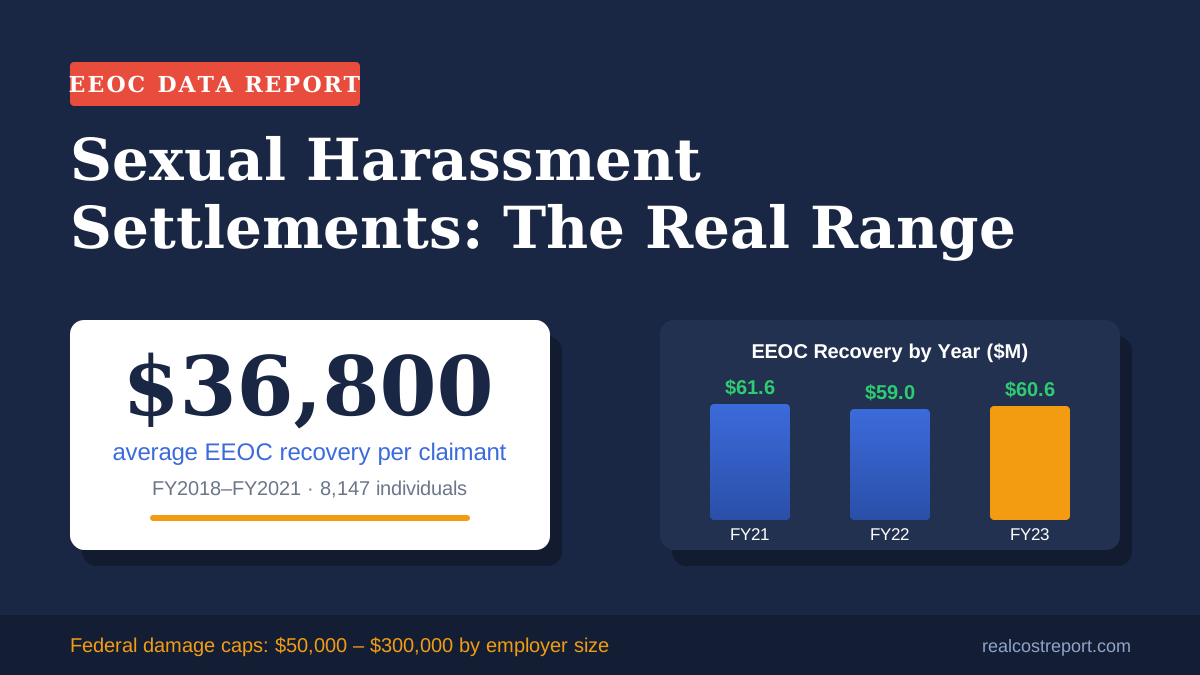
- EEOC recoveries for sexual harassment claimants averaged roughly $36,800 per person between FY2018 and FY2021 — $299.8 million spread across 8,147 individuals, per the agency’s own data.
- Agency-wide, the EEOC recovered $60.6 million on 7,732 sexual harassment charges in FY2023, but only about 9.9% of resolved charges ended in a negotiated settlement.
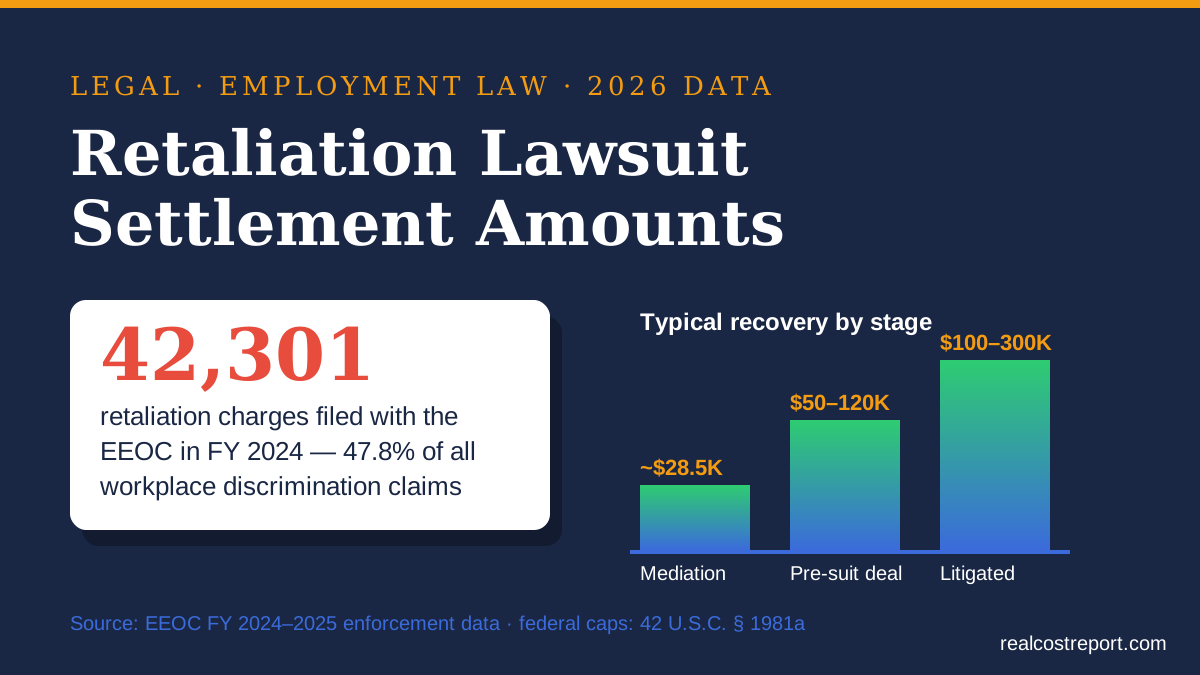
- Federal Title VII damage caps limit compensatory and punitive damages to between $50,000 and $300,000 depending on employer size — a ceiling most claimants never learn about until negotiations begin.
- Comparison result: the EEOC administrative process is faster and free, but private litigation with a contingency attorney typically produces larger recoveries for strong, well-documented claims.
- Recommendation: file the EEOC charge to preserve your rights (deadlines run 180–300 days), then get a contingency-fee consultation before accepting any early offer.
Between fiscal years 2018 and 2021, the U.S. Equal Employment Opportunity Commission recovered $299.8 million for people who filed sexual harassment claims — but that money reached just 8,147 individuals, an average of roughly $36,800 per person. That figure, drawn directly from the EEOC’s Office of Enterprise Data and Analytics, is far below the six- and seven-figure settlements that dominate headlines. The gap between the median outcome and the publicized outlier is exactly what this article measures.
If you are deciding whether to file a charge, accept a severance offer, or hire a contingency-fee employment attorney, you need the real distribution, not the outliers. Below, we break down verified EEOC recovery data through FY2024, calculate per-claimant averages the agency does not publish directly, explain the federal damage caps that silently limit most awards, and compare the EEOC administrative route against private litigation. Every figure is attributed to a named primary source, primarily the EEOC’s enforcement statistics and its FY2024 Annual Performance Report.
What EEOC Data Actually Shows About Sexual Harassment Recoveries
The EEOC publishes annual charge and recovery statistics that let us reconstruct the realistic settlement landscape. In FY2023, the agency received 7,732 sexual harassment charges under Title VII — the highest count since FY2010 — and recovered $60.6 million through its administrative process, according to EEOC charge data summarized in Littler’s 2024 annual harassment report. Recovery totals have been remarkably stable: $61.6 million in FY2021 and $59.0 million in FY2022.
Divide dollars by outcomes and the picture sharpens. The EEOC’s April 2022 Data Highlight reports $299.8 million recovered for 8,147 sexual harassment claimants across FY2018–FY2021 through both resolved charges and litigation. That works out to approximately $36,800 per benefiting individual. Note the phrasing: per benefiting individual. Most charges produce no monetary recovery at all.
Source: U.S. Equal Employment Opportunity Commission, Title VII Sexual Harassment Charge Receipts and Resolutions, FY2010–FY2023 (verify at eeoc.gov). Recovery figures reflect administrative resolutions and exclude private lawsuit settlements.
Two more resolution paths matter. In FY2023, another 867 charges (12.2% of resolutions) ended as “withdrawals with benefits” — the claimant withdrew after the employer paid or changed conditions. Combined, roughly 22% of resolved sexual harassment charges produced some benefit through the EEOC pipeline. The remainder closed with a right-to-sue letter, no cause finding, or administrative closure.
What Determines Where Your Settlement Lands
Settlement value is not a lottery; it is a calculation both sides’ attorneys run. Consider a realistic scenario: a marketing coordinator earning $65,000 a year resigns after eight months of documented harassment by a supervisor, reports it twice to HR with no response, and remains unemployed for five months.
Her economic damages start with lost wages: roughly $27,000 in back pay (five months at $5,417 per month), plus job-search costs and any therapy expenses. Emotional distress damages get layered on top, and their size depends heavily on documentation — contemporaneous texts, the HR complaint trail, and a treating therapist’s records. The employer’s exposure also includes its own defense costs, which frequently exceed $75,000 through discovery even in cases it expects to win. That defense-cost pressure is why many employers settle mid-range claims in the $40,000–$150,000 band rather than litigate.
Five variables move the number most. First, evidence quality: written harassment (texts, emails, Slack messages) can double or triple settlement value versus he-said-she-said testimony. Second, employer response: an ignored HR complaint destroys the employer’s Faragher/Ellerth affirmative defense and raises value sharply. Third, tangible employment action: a firing, demotion, or forced resignation adds back-pay and front-pay damages. Fourth, employer size, which sets the federal damage cap discussed below. Fifth, jurisdiction: claims filed under state statutes such as California’s FEHA or the New York State Human Rights Law avoid federal caps entirely.
The Federal Damage Caps Most Claimants Never Hear About
The Civil Rights Act of 1991 caps combined compensatory and punitive damages under Title VII based on employer headcount. Back pay and front pay sit outside the cap, but emotional distress and punitive awards — usually the largest components of a harassment verdict — are hard-limited. Juries are not told about the caps; judges reduce verdicts afterward.
Source: 42 U.S.C. § 1981a, Civil Rights Act of 1991, U.S. Equal Employment Opportunity Commission (verify at eeoc.gov). Caps apply to combined compensatory and punitive damages; back pay is excluded.
The practical effect: a claimant at a 60-person company suing solely under federal law faces a $50,000 ceiling on distress and punitive damages, no matter how egregious the conduct. This is why experienced plaintiff-side firms plead parallel state-law claims wherever available — and why headline verdicts in the millions almost always come from California, New York, New Jersey, or Illinois state statutes rather than Title VII alone.
EEOC Administrative Process vs. Private Lawsuit: Which Is Better for Your Claim?
Every federal claimant starts at the EEOC — filing a charge within 180 days (extended to 300 days in states with their own fair-employment agencies) is a legal prerequisite to suing under Title VII. The real decision is what happens after: let the EEOC mediate and conciliate, or request a right-to-sue letter and hire a private contingency attorney.
The EEOC route costs nothing, requires no lawyer, and resolves faster; the agency reports mediation typically concludes within about three months. But the per-person math above — roughly $36,800 average across FY2018–FY2021 — reflects an agency processing tens of thousands of charges with a budget of $455 million in FY2024, per its Annual Performance Report. The EEOC secured nearly $700 million for about 21,000 victims across all discrimination types in FY2024, an average near $33,300 per person agency-wide.
Private litigation flips the economics. Contingency employment attorneys typically charge 33–40% of recovery and decline weak cases, which itself is useful information. In exchange, they run discovery, depose the harasser and HR, and create the trial risk that moves employers from nuisance-value offers into the six-figure range for strong claims. The trade-offs: cases commonly run 12–30 months, depositions are invasive, and the fee reduces net recovery.
Verdict
File the EEOC charge in every case — the deadline is unforgiving and filing costs nothing. From there, claims with strong documentation, an employer of 100+ employees, or a tangible job loss are usually worth taking to a contingency attorney, where realistic outcomes materially exceed the EEOC’s roughly $36,800 average. Claims with thin evidence, small employers, and no job loss are often best resolved through free EEOC mediation, where a $15,000–$50,000 resolution in a few months can beat two years of litigation risk.
What Most People Get Wrong About Harassment Settlements
Mistake 1: Waiting past the filing deadline. The 180/300-day EEOC clock runs from the last harassing act, not from resignation or emotional readiness. Consequence: the federal claim dies entirely. Correct action: file the charge immediately — it can be amended later, and filing does not obligate you to sue.
Mistake 2: Quitting without documenting first. Resigning before creating a written complaint trail hands the employer its affirmative defense and weakens any constructive-discharge theory. Correct action: report in writing, keep copies off company systems, then make employment decisions with counsel.
Mistake 3: Anchoring on headline verdicts. Multi-million-dollar outcomes are statistical outliers driven by state statutes and exceptional facts. Consequence: claimants reject reasonable $60,000–$100,000 offers chasing numbers their case cannot support. Correct action: ask your attorney for comparable settlements in your jurisdiction and employer-size bracket.
Mistake 4: Signing a severance agreement unreviewed. Standard severance releases waive Title VII claims, often for 2–4 weeks of pay. Correct action: have an employment attorney review before signing; many will do so for a flat $300–$750 fee, and the leverage of an unfiled claim frequently multiplies the severance number.
Mistake 5: Assuming taxes don’t apply. Under IRS rules, harassment settlements are generally taxable income except amounts for physical injury or sickness, and since 2018 the tax code restricts employer deductions for confidential harassment settlements. Correct action: negotiate settlement allocation language and consult a tax professional before finalizing.
Is Filing Worth It? A Conditional Answer
Filing an EEOC charge is worth it for nearly everyone with a colorable claim, because it is free, preserves rights, and forecloses nothing. The harder question is pursuing the claim beyond the charge, and the answer is conditional.
Pursue aggressively if: you have written evidence or witnesses; you reported internally and the employer failed to act; you suffered a firing, demotion, or documented pay loss; the employer has more than 100 employees or you work in a strong-statute state such as California or New York. Under those conditions, contingency counsel will likely take the case, and realistic outcomes run from the high five figures into the low-to-mid six figures.
Lean toward EEOC mediation or a negotiated exit if: evidence is primarily testimonial; the employer is under 50 employees with limited insurance; you remain employed and want to stay; or your priority is speed and privacy over maximum dollars. A confidential mediated resolution in 90 days has genuine value that a gross-settlement comparison misses.
Either way, the sequencing is identical: document, file the charge before the deadline, and get at least one contingency consultation — nearly all plaintiff-side employment firms offer them free — before accepting any offer.
How We Researched This Article
This analysis draws exclusively on primary government sources and named legal-industry compilations of government data, last reviewed in July 2026. Charge counts, resolution types, and settlement percentages come from the EEOC’s enforcement statistics tables, specifically the EEOC’s Sexual Harassment in Our Nation’s Workplaces data highlight and its Title VII charge-resolution tables covering FY2010–FY2023. Agency-wide recovery totals, budget figures, and the FY2024 figure of nearly $700 million for about 21,000 individuals come from the EEOC’s FY2024 Annual Performance Report. Federal damage caps are taken from the Civil Rights Act of 1991 as codified at 42 U.S.C. § 1981a, accessible via the U.S. Government Publishing Office. Year-over-year sexual harassment recovery figures for FY2021–FY2023 were cross-checked against Littler Mendelson’s 2024 annual harassment report, which compiles the EEOC’s May 2024 statistical release.
Per-claimant averages in this article are modeled, not published: we divided the EEOC’s reported $299.8 million (FY2018–FY2021) by its reported 8,147 benefiting individuals. Limitations are significant. EEOC administrative data excludes private lawsuit settlements, state-agency resolutions, and confidential pre-charge severance deals, which are almost certainly larger in aggregate but are not systematically reported anywhere. Averages also mask a skewed distribution in which a small number of large recoveries pull the mean above the typical outcome. The illustrative scenario figures (defense costs, attorney fee percentages, severance review fees) reflect prevailing market ranges rather than a single measured dataset. Research was last conducted July 2026. All figures were verified against named primary sources before publication.