This article is educational research, not legal advice; settlement outcomes depend on individual facts, and you should consult a licensed employment attorney in your state before acting on any figure below.
TL;DR — Quick Verdict
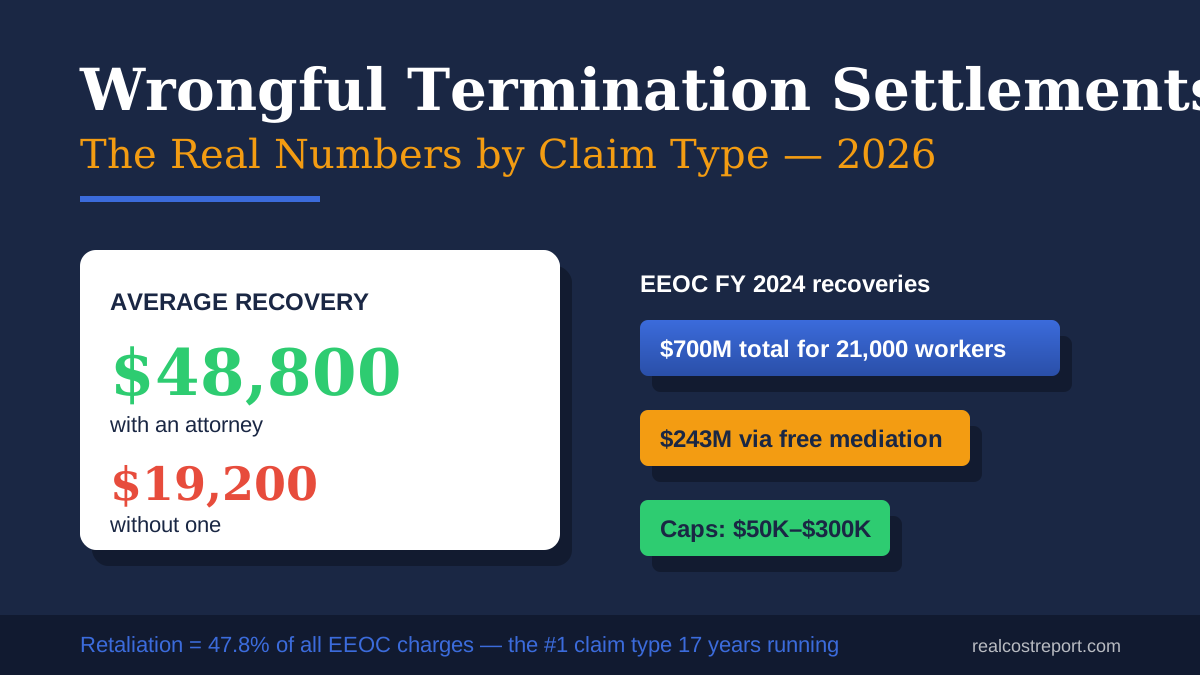
- National survey data from Martindale-Nolo shows wrongful termination claimants with an attorney averaged $48,800 in compensation, while unrepresented claimants averaged $19,200 — and represented workers were more than twice as likely (64% vs 30%) to receive anything at all.
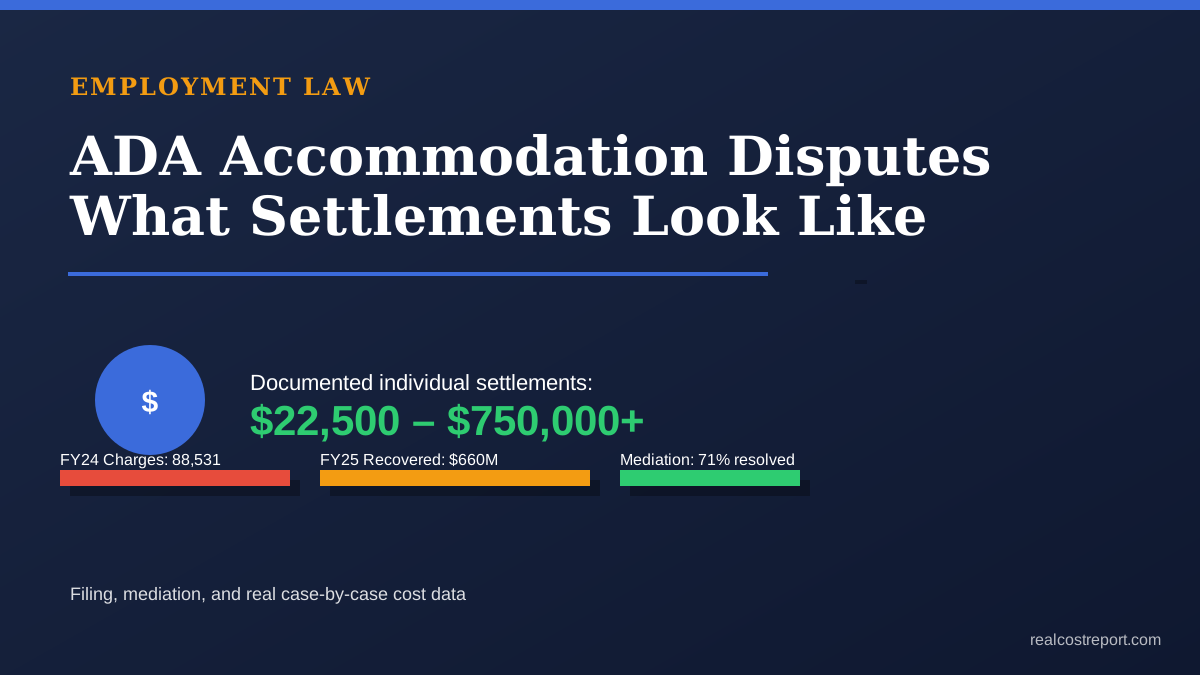
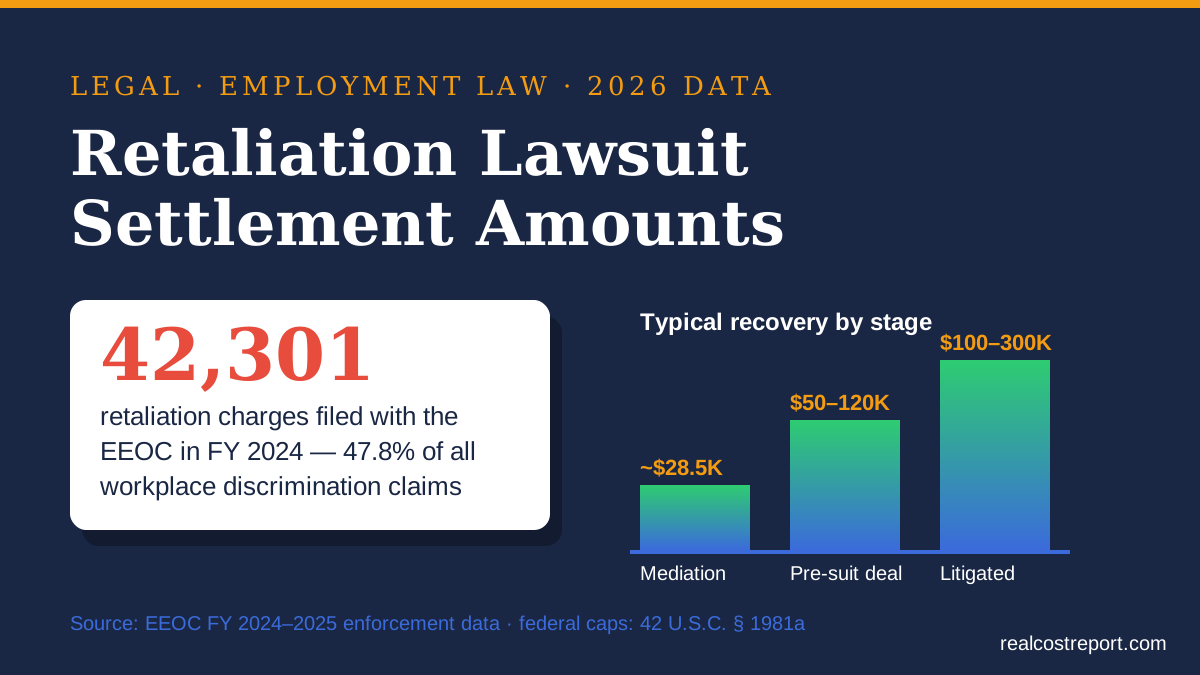
- The EEOC recovered nearly $700 million for roughly 21,000 workers in FY 2024, its highest recent total; its mediation program alone paid out $243.2 million across 8,543 resolved charges — an average of roughly $28,500 per mediated charge.
- Federal law caps compensatory and punitive damages between $50,000 and $300,000 depending on employer size, which is why identical facts settle for very different amounts at a 40-person company versus a Fortune 500 employer.
- Comparison result: EEOC mediation resolves in about 3–4 months at zero cost but averages modest payouts; private litigation takes 1–3 years and costs 29–40% in contingency fees, yet negotiated outcomes averaged more than double first-offer acceptances ($41,500 vs $19,200).
- Recommendation: if your documented lost wages exceed roughly $25,000 or your claim involves retaliation or disability discrimination with written evidence, consult a contingency-fee employment attorney before accepting any severance or agency-mediated offer.
The U.S. Equal Employment Opportunity Commission recovered nearly $700 million for approximately 21,000 workers in fiscal year 2024 — an average of roughly $33,000 per person, and the agency’s largest recent haul. Yet most fired employees who search for “average wrongful termination settlement” find a single recycled number with no context. The honest answer is that outcomes cluster into predictable bands driven by four variables: claim type, employer size, documented wage loss, and representation. Survey research published by Martindale-Nolo found that hiring an attorney shifted the average recovery from $19,200 to $48,800 — a 154% difference that dwarfs the typical 29–33% contingency fee charged by firms like Morgan & Morgan or regional employment boutiques found through directories such as Avvo. This report breaks down verified settlement and recovery data by claim type, shows the exact federal damage caps that constrain payouts, models a realistic back-pay calculation, and compares the free EEOC mediation route against private litigation so you can decide which path fits your losses.
Settlement Benchmarks by Claim Type: What the Data Actually Shows
No government agency publishes a clean “average settlement by claim type” table, so any site claiming precise per-claim averages is guessing. What can be done responsibly is anchoring modeled ranges to three verified data points: the EEOC’s FY 2024 mediation average (roughly $28,500 per resolved charge), the Martindale-Nolo survey averages ($19,200–$48,800 depending on representation), and the federal statutory damage caps discussed in the next section. The ranges below reflect those anchors plus the structural features of each claim type — for example, age claims exclude emotional-distress damages under federal law, while race claims filed under Section 1981 face no federal cap at all.
Bands modeled by Real Cost Report from FY 2024 EEOC enforcement data and Martindale-Nolo survey results; charge percentages from the U.S. Equal Employment Opportunity Commission (verify at eeoc.gov). Individual outcomes vary widely.
The Federal Damage Caps That Quietly Control Your Ceiling
Most workers have never heard of 42 U.S.C. § 1981a, but it explains more settlement variation than almost any other factor. For discrimination claims under Title VII, the Americans with Disabilities Act, and related statutes, combined compensatory and punitive damages are capped by employer headcount. Back pay and front pay sit outside these caps, but emotional distress and punitive awards — the components that produce headline verdicts — do not.
Compensatory and punitive damage caps under 42 U.S.C. § 1981a; U.S. Equal Employment Opportunity Commission (verify at eeoc.gov).
These caps explain why the Martindale-Nolo survey found claimants against employers with more than 100 workers averaged $43,400 — nearly double the average against smaller employers. Defense counsel at a 60-person company knows federal exposure beyond lost wages tops out at $50,000, and settlement offers reflect that arithmetic. Two important escape hatches exist: race and ethnicity claims can be filed under Section 1981, which has no federal cap, and many state statutes — California’s FEHA is the best-known example — impose no caps at all. Claim selection is not a technicality; it can triple the realistic ceiling on identical facts.
How a Settlement Number Actually Gets Built: A Worked Example
Settlement negotiations start from back pay, not from pain. Consider a realistic scenario: an operations manager earning $85,000 plus roughly $14,000 in annual benefits is fired two weeks after filing a written harassment complaint with HR, and remains unemployed for nine months before accepting a role paying $78,000.
The math proceeds in layers. Back pay: nine months of salary and benefits equals $74,250 ($99,000 × 0.75). Front pay: the new job pays $7,000 less annually; a court or mediator might credit two years of the differential, adding $14,000. Emotional distress: with documented anxiety treatment, a mid-band figure of $25,000–$40,000 is defensible against a mid-size employer. The pre-negotiation model therefore lands around $113,000–$128,000. Now apply reality: over 90% of these cases settle before trial, and settlements typically discount modeled damages by 30–50% to reflect litigation risk and time value. A negotiated outcome of $65,000–$90,000 would be a strong result — and after a 33% contingency fee, the worker nets roughly $43,000–$60,000. Compare that to the $19,200 average for unrepresented claimants, and the fee pays for itself twice over. The survey data confirms the mechanism: claimants who documented job-search costs averaged $60,700, nearly triple the $20,600 average for those who did not itemize them. Precision in documentation, not outrage, is what moves the number.
EEOC Mediation vs Private Lawsuit: Which Is Better for Your Situation?
Every federal discrimination claimant faces this fork, because filing an EEOC charge is a mandatory prerequisite to a Title VII lawsuit. The agency’s free mediation program is genuinely effective at what it does: in FY 2024 it resolved 71.2% of the 11,998 mediations it held and delivered $243.2 million to workers — but spread across 8,543 resolved charges, that averages about $28,500 each. Mediation typically concludes within three to four months, costs nothing, and requires no attorney, though you may bring one. Private litigation inverts every one of those traits: expect one to three years, a 29–40% contingency fee, invasive discovery — and a materially higher ceiling. Survey respondents who negotiated rather than accepting a first offer averaged $41,500 versus $19,200, and litigation is the ultimate negotiation lever because it triggers discovery, forcing the employer to produce internal emails and personnel files.
Verdict
Take EEOC mediation seriously if your documented wage loss is under roughly $25,000, you need money within months, or your evidence is thin — the ~$28,500 average payout with zero fees is hard to beat at that scale. Choose a contingency-fee attorney and preserve your right to sue if you have six-figure wage loss, written retaliation evidence, or an uncapped claim (Section 1981, state law, whistleblower statutes). For most mid-to-high earners with documentation, representation wins: the survey gap of $48,800 versus $19,200 exceeds any fee you will pay.
What Most People Get Wrong About Wrongful Termination Payouts
Five errors reliably cost claimants five figures each.
First: assuming “unfair” means “illegal.” At-will employment allows termination for bad reasons — just not illegal ones (discrimination, retaliation, protected activity). Consequence: months wasted on a nonexistent claim. Correct action: map your facts to a specific protected category before spending anything.
Second: accepting the first offer. Survey data shows first-offer acceptors averaged $19,200 against $41,500 for negotiators — a 116% penalty for impatience. Correct action: treat the first number as an opening bid, always.
Third: missing the filing deadline. EEOC charges must generally be filed within 180 days of the termination, extended to 300 days in states with their own fair-employment agencies. Consequence: total forfeiture regardless of merit. Correct action: file the charge immediately; you can negotiate afterward.
Fourth: signing a severance release without valuation. A four-week severance check routinely extinguishes a claim worth ten times more. Correct action: have an employment attorney review any release before signing — many offer free or flat-fee reviews.
Fifth: destroying the evidence trail. Forwarding work emails after termination can violate policy, but failing to preserve your own records — offer letters, reviews, HR complaints, texts — guts the claim. Cases with both written evidence and witness testimony succeeded 63% of the time in Martindale-Nolo research, versus 28% with witness testimony alone. Correct action: assemble a dated document file the week you are fired.
Is Filing a Claim Worth It in 2026? A Conditional Answer
Enforcement conditions matter, and they have shifted. The EEOC reported that FY 2025 systemic investigations recovered $55 million — roughly a 115% increase over FY 2024 — while new charge volume held steady at 88,201. Agency priorities have moved with the administration, but individual retaliation and disability charges remain the workhorse claims, and private litigation is unaffected by agency priorities.
File — and hire counsel — if all three hold: you can name the protected category, you have at least one piece of written evidence, and your wage loss exceeds $25,000. The expected value math is straightforwardly favorable: a 64% recovery rate at a $48,800 average, less a one-third fee, beats a 30% chance at $19,200 by a wide margin. Consider mediation alone if your losses are small, you found new work quickly, or you value speed and confidentiality over maximum recovery. Skip the process entirely if your claim rests solely on unfairness without a protected category — no attorney working on contingency will take it, and that market signal is itself diagnostic. Retirees and workers near retirement deserve one specific note: age-claim settlements often undervalue front pay because defense counsel argues a short remaining career; documented plans to work to a specific age counter this and can add tens of thousands to the model.
How We Researched This Article
This analysis was last conducted in July 2026 and draws exclusively on primary government data and named survey research. Enforcement figures — the 88,531 charges filed in FY 2024, the near-$700 million total recovery, the $243.2 million mediation total across 8,543 resolved charges, charge composition by category, and FY 2025 systemic recovery figures — come from the EEOC Enforcement and Litigation Statistics and the EEOC 2024 Annual Performance Report. Statutory damage caps reflect 42 U.S.C. § 1981a as summarized in EEOC guidance on remedies. Representation, negotiation, and evidence-strength statistics come from Martindale-Nolo Research surveys of wrongful termination claimants published at Nolo.com.
Limitations are material and worth stating plainly. The Martindale-Nolo survey data was collected in 2016; nominal dollar figures are likely 25–35% higher today after inflation, and the sample self-selected from legal-information site visitors. The per-claim-type settlement bands in our first table are modeled, not measured: no agency publishes settlement averages segmented by claim type, so we anchored ranges to verified aggregates (the EEOC mediation average, survey means, and statutory caps) and adjusted for each claim type’s structural damage rules. The $28,500 mediation average is our own calculation ($243.2 million ÷ 8,543 resolved charges) and blends termination with non-termination charges. Worked-example figures are illustrative scenario models, not case results. All figures were verified against named primary sources before publication.